Thursday, July 22, 2010

Cannibals and Kings


Cannibals and Kings provides a great deal of compelling anthropological thought; it focuses on a systemic view of the ebbs and flows of culture, and has been quite a mind-fuck for me, as I've been reading it in stops and starts alongside Manuel De Landa's A Thousand Years of Nonlinear History. Harris' style is dry but concise, and considering that dryness it is surprising what a quick read this is proving to be. (1000 Years of Nonlinear History, on the other hand, may take me about 1000 years to finish.)

I won't reiterate the central thesis of the book, as it is easy to find on the net. I will say this: a central conceit of this book, and many other works of (theoretical) anthropology that I've encountered, is the premise that there is some intention lying behind the large-scale endeavors of man. Though many of the ebbs and flows discussed in this book-- as one method of production and consumption is outmoded by population increases and so on-- can be understood to operate almost like a thermostat, lying underneath his arguments is the idea that there is something intelligible, something orderly, something sensible in macro- scale human behavior. I'm not saying I agree with this premise, or disagree. I don't honestly see a way that we can know one way or the other. But it's the invisible hook you have to swallow to follow him where he wants to take us. (I was going to say "implicit hook" but I really don't know how a hook can be implicit.)

Purchase book.


Tuesday, July 20, 2010

Shadow and Evil in Fairy Tales


A Jungian analysis of Fairy Tales. (Or is it the other way around?) Though many Jungian analyists have a "pat" method, von Franz recognizes that this is contrary to Jung's own intention in creating guideline concepts like the anima/animus, shadow, etc. As I had been hoping, she uses fairy tales as a method of showing the various ways that our inner lives can become tangled, or confusing, and sheds light on these through the examples provided by fairy tales. (This is contrary to the approach which would use Jungian analysis as a method of shedding more light on the literary elements of fairy tales, which would be less interesting to me.) Part of her thesis is that fairy tales are often even better indicators of psychological tendencies within a people, certainly within the lower class people, (the "folk") than the more traditional myths of a civilization that we might now encounter in Bullfinch's. I'm not sure if such a clear distinction can be drawn, but generally, it seems plausible, especially within the context of this work. (Goodreads review.)

Purchase book.

Myths of Capitalism (continued): The Inside Solution Fallacy


In the face of ecological and environmental challenges, which I don't think I need to enumerate here, I've often heard people make an assumption: at some point, they say, people will have to "wake up," and bring about some kind of change from the bottom up. I've even somewhat flippantly supported this premise, that if people "vote with their dollars" that, within the framework of capitalism, if the vote comes from a majority, it'll force a shift of priorities and may be the only way for a capitalist state to maintain cogency in the face of declining resources (material and human) that cannot support a never-ending increase in profits, even with the addition of technological advance in the mix. I even once wondered if this was an underlying element of the Obama administration, though in light of actions taken since he has taken office, I can only see it as a part of the narrative of the administration, rather than the reality- though this could be due to external political, economical, or social pressures.

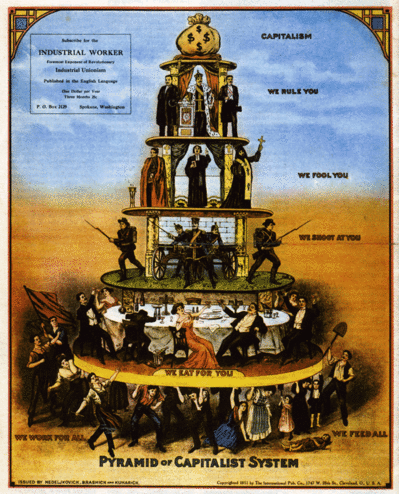
Be that as it may, having spent many hours thinking about this, I've been wondering if the underlying premise is flawed. We may be able to generate cultural reform from within the system in the way that counterculture attempts- and more rarely, succeeds at doing. But this does not extend nearly so far as we'd like. Consider instead the idea that the ecological and economic pressures are already intensifying, the destratification is already underway, though we have a hard time seeing it because even rapid change in a historic sense may still seem slow to our eyes. What's the result of these pressures? Depression. Wild hope. Fear. Panic. In that order, the hoi polloi may become more pliable, not less. All of these things make people easier to manipulate, not less. We do see anger and outrage, embodied, for instance, by the exaggerated posturing of the Teabaggers, but it seems fairly impotent in terms of enacting the kind of change that would actually bring our culture back into alignment. The new slaves don't build pyramids, they work in Walmart and Mcdonalds. It is a mistake to assume that at some point mistreated, underpayed peasants will inevitably rise up in arms. For thousands of years civilizations such as the Egyptians build their empire on the back of a workforce living little better than their livestock. This has been, if anything, the norm rather than the exception over the past 3000 years.

We may also want to look at the history of the rise of Capitalism to understand the seed of its undoing:
Capitalism is a system that is committed to an unbounded increase in production in the name of an unbounded increase in profits. Production, however, cannot be increased in an unbounded way. Freed from the restraints of despots and paupers, capitalist entrepreneurs still have to confront the restraints of nature. The profitability of production cannot expand indefinitely. Any increase in the quantity of soil, water, minerals or plants put into  a particular production process per unit of time constitutes intensification. It has been the intention of this book to show that intensification inevitably leads to declining efficiencies. That declining efficiencies have adverse effects upon the average standard of living cannot be doubted. (Cannibals and Kings, Harris.) 
This follows from Harris' general thesis, that the processes of human history shows groups and even civilizations following a certain pattern of production which, if population is not kept in check through internal or external means, results in a forced movement to another method of production which often has a decreasing effect on the standard of living. In plentiful times, effective hunter gatherers have to put in far fewer hours per day than farmers, who have to invest their energies into the entire life cycle of the plants that they are harvesting, as well as deal with the repercussions of the strain that may put on the environment as population increases.

My point being that the argument that the ills that capitalism produces will inevitably outweigh the boons, and that it may be unlikely that a transition to a different method of production can occur from within that same system. If history has anything to say about this, it simply cannot. What history cannot show us is the results of production on the scale that it is presently in place, nor on the effects of globally intertwined civilizations and economies. But it may not be very hard to guess... it certain stands to reason that this is one of the reasons why the apocalypse myth has so forcefully become the zeitgeist of our age, even as capitalism tries to pull a profit out of that.

Sunday, July 18, 2010

Murder, Sacrifice, and Punishment


I had a thought the other day. It was mostly a joke, an odd joke, that I repeated to several people. But, as often happens with jokes, it popped up again outside, and in a more serious context. Comedy masks and tragedy masks.

It goes like this. It is inevitable that we will all die. Murder is, in essence, the act of taking personal control of time, of speeding it up. A killer is a time lord.

The truth is, this idea actually mirrors many primitive ideas on the subject.
The habit of killing bad criminals by hanging them on trees is a very archaic one. It was originally practiced as a sacrifice: Germans in older days, for instance, hanged prisoners as sacrifices to the God Wotan. ... In Christianity you meet this archetypal idea in the form of the crucifixion of the Christ, and in the area of Asia Minor, Attis was suspended from a fir tree. We have to ask what lies behind the idea of killing an enemy not as social revenge or in judgement, but by the more archaic form of a sacrifice to the gods. I think that there is a much deeper and more meaningful idea than that of just punishment. If one has to fight against demonic evil in a human being, what strikes one most is that if people are outstandingly destructive, not just through the small mistakes of laziness and cheating, etc. which take place with every human being, but if they are seriously destructive, one's immediate reaction is that it is inhuman, ... and concomitantly so "divine," that one is overwhelmed. ... We use the word "inhuman" but one could equally well say "demonic" or "divine." (Shadow and Evil in Fairy Tales, von Franz.) 
The linguistic linkage between devil, demon, and devi, divinity, is one I've already prattled on about here. The central point is that a criminal has essentially embodied - or has been possessed - by something outside of the human, or at least social, sphere. They must then be returned to their source, to divinity, through the methods most fitting of such a union. The myths of Gods and heroes being dismembered, hung, and so on are of course numerous. To name a few: Wotan, Orpheus, Attis, and of course Jesus.

Sunday, July 11, 2010

And now for something completely different: butts.


You're welcome.

America's Creativity Crisis

Newsweek ran an article recently on the supposed "creativity crisis" in America: 
...after analyzing almost 300,000 Torrance scores of children and adults. Kim found creativity scores had been steadily rising, just like IQ scores, until 1990. Since then, creativity scores have consistently inched downward. “It’s very clear, and the decrease is very significant,” Kim says. It is the scores of younger children in America—from kindergarten through sixth grade—for whom the decline is “most serious.”
Read full article.

I'm actually dubious of the ability to perform a standardized test of creativity. What exactly is being tested? How does the bias of the evaluators color the results?

However, I will say that it seems patently obvious that if there is indeed such a crisis - which I don't otherwise doubt - then it is this very homogenizing impulse that is the real culprit.

Friday, July 09, 2010

Romantically Apocalyptic

Something I happened upon a little while ago. Enjoy.


Read Romantically Apocalypse.

Sloppy Vagina Circus


Psst. Something mighty weird will be brewing at Sloppy Vagina Circus in coming weeks... starting with a teaser in an upcoming Gspot. Media soon.


Thursday, July 08, 2010

Dionysus, Tequila, and Kung Fu don't mix.

I don't want to give the impression that the only modern expression of Dionysian energy is to be found in drum circles. Far from it. Nor, as we've said, is ecstasy the only human experience that brings us in touch with it.

I've had many experiences which I think fall into this other category. However, one comes immediately to mind. It has the added benefit of being comical at my expense.

When I was in my early twenties I become very interested in Kung Fu, both Shaolin and Bagua. I never got incredibly good at it, but I was certainly more expert at it than the average person. This is always a dangerous amount of knowledge.

I was at a party over the summer. It was a picnic kind of event, with alcohol and live bands. I decided to dress up in one of my Shaolin outfits, and was already pretty punchy by midday. A friend was bartending, and lit a shot of what looked like Windex and 151 on fire. Quickly blowing it out, I grabbed it and prepared to down the thing. However, an invisible flame was still burning off the fumes, and the glass was scorching hot. I twitched, and the alcohol poured across my hand, re-igniting in the process. I stared for a moment at my hand, as the skin bubbled. My friend grabbed a bucket of ice, and very much like a cartoon, I shoved my hand into it, expelling a little huff of steam.

I wrapped the hand up, and then proceeded to wander around with the obligatory bottle of Patron, as I was want to do in those days. Afterwards, I started doing my daily stretching exercises and forms - a little bit of alcohol and a burned hand wasn't about to stop me. I'd also worked up quite a bit of the mad kind of enthusiasm that can come from an energetic practice like Kung Fu, especially when mixed with alcohol.

Some people noticed me, and somehow a short demonstration of some exercises turned into a full out sparring match. Ten or twenty of us were fighting in the back yard- some with shinai, others (such as myself) bare-handed. A couple minutes in, two people approached me to attack simultaneously with their shinai. Without thinking I took two sprinting steps and lept into the air, connecting with each of them with my feet. What I hadn't counted on was connecting slightly below their center of gravity, and I also had no particular plan for how I was going to land after landing this attack. So they fell on me, and there was a loud crunch.

When I got to my feet, I was greeted by a flock of people staring at me in disgust. I still remember the look on one girl's face- it was a look of horror that you might expect, say, if a giant centipede had just burst out of my chest. I couldn't imagine what was causing this reaction. I felt a dull kind of pain, but it didn't match what I saw when I looked down. My arm was bent at a near ninety degree angle, about six inches below my wrist. Both bones in my forearm were clearly snapped, though thankfully they hadn't punched through the skin.

Friday, June 25, 2010

BP and Obama: Where’s Our Kairotic Moment?


"Obama has failed to step up to the plate, this is not because he is dealing with a recalcitrant congress or an obstructive opposition party, but because he has failed to step up to the plate and perform the kairotic act. Here we have an event that is going to have massive economic and ecological impact that will reverberate for years, an event is a direct outcome of deregulation and corporate greed, an event that will, in one way or another effect all Americans, and we have an administration that refuses to quilt this event into a whole series of events that have buffeted both the country and the world. In Difference and Repetition Deleuze speaks of repetition in terms of resonances, echoes, and reflections of the past. In repetition the present actuality somehow is haunted by all sorts of other past events.
...
The oil catastrophe echoes and resonates not only with past oil catastrophes, but with the financial collapse, the West Virginia mining disaster, the exploitation of American tax payer dollars by contractors in Iraq and Afghanistan, the exploitation of American citizens by insurance companies, and on and on. If there were ever a moment to quilt together our economic woes, the impending environmental apocalypse, and rampant corruption among the corporations and government as a result of neoliberal ideology,this is that moment. Obama needs to step up to the plate and take advantage of this moment, performing a Kennedyesque moment not unlike that of persuading the American people to go to the moon."
Full article.

Tuesday, June 22, 2010

Suicide Machines and Beardy Men

clock


A thought from an email conversation today:

I am quite convinced that big business will rape the Earth near the point of no return, or beyond it -- in terms of habitability by humans -- the only question is which of the two it will be before the Earth is finally roused into itching the rash they produce. Water, plants, animals, minerals, and human beings are not commodities, and thinking of them as such produces a global suicide-machine. Because these things can be reduced to numbers in a spreadsheet does not mean that that reduction actually applies to them. (Nor does this evaluation apply to all business-- they can even serve a social function, as Drucker lays out in Management.)

I wonder if the people truly responsible for disasters like the BP spill, or the wholesale purchase of water rights etc etc. know and simply don't care, or whether they are so taken in by their myths, (the values that those myths engender), that they can't see it any other way. It really doesn't matter, except inasmuch as whether they are spiritually as well as morally culpable. 
(As I said previously, we're all a little complicit- but not to the extent of those who cut corners and reap absurd profits.)

I spent most of today going around the city spoiling Jazmin and reading Robertson Davies. She saw him on the "free books" shelf in front of the anarchist hangout nearby, and thought I would like the beardy man. As it turns out, I do indeed like the beardy man. After reading One Half Of Robertson Davies -- a collection of speeches -- I decided to order his Deptford Trilogy. I have been reading so much non-fiction for the Immanence of Myth, it's time to dig into a good novel. I hope this is one. (Or three.)

Sunday, June 20, 2010

Interview with Wendy Brown

Late night reading/listening as I try to muster up more brain-juice (read: caffeine) to edit. Enjoy.

Wendy Brown

CPS: You have argued, speaking of neoliberalism, you have argued that neoliberalism does not simply promote economic policies but to quote you “disseminates market values into every sphere of human activity.” What distinguishes your perspective here from the despair found in someone like Adorno? What would it require to translate the despair that many people experience in very personal and de-politicized ways into a form of political mobilization?

Wendy Brown: That is an interesting question because it assumes that neoliberalism produces despair. I wish it did but I am not convinced that it does. I think that the process that some of us have called neoliberalization actually seizes on something that is just a little to one side of despair that I might call something like a quotidian nihilism. By quotidian, I mean it is a nihilism that is not lived as despair; it is a nihilism that is not lived as an occasion for deep anxiety or misery about the vanishing of meaning from the human world. Instead, what neoliberalism is able to seize upon is the extent to which human beings experience a kind of directionlessness and pointlessness to life that neoliberalism in an odd way provides. It tells you what you should do: you should understand yourself as a spec of human capital, which needs to appreciate its own value by making proper choices and investing in proper things. Those things can range from choice of a mate, to choice of an educational institution, to choice of a job, to choice of actual monetary investments – but neoliberalism without providing meaning provides direction. In a sad way it is seizing upon a certain directionlessness and meaninglessness in late modernity. Again, I am talking mainly about the Euro-Atlantic world: without providing meaning, it provides direction. So I think it is quite a different order of things from the one that Adorno was describing.

Tuesday, June 15, 2010

post-modern marriage myths 2


From an ongoing conversation about our upcoming wedding. Thought I'd share a snippet...

"Marriage itself, stripped of that element and any ideas of possession - is the desire to make continuity out of discontinuity. I'm not especially fixated on whether or not it can be broken - I know all too well from past experience that everything eventually succumbs to entropy in one way or another - it is the ongoing intent, the will, to unite different elements within the circle of "a marriage." To bring that about some things may need to be sacrificed, though again, not so cut and dry as traditional values would imply. Nevertheless, anything brought into one part of the circle effects other parts of it, for better or worse, and the results of that are shared so long as that striving towards unity is stronger than the forces that bring about discontinuity. Even the words "divorce" and "marriage" imply this. The circle is so primal and universal of a symbol that it might seem a bit too general for this but at it's most simple I think marriage is simply "casting a circle." Whatever is brought inside the confines of that figure become a part of ones center of personal concern.

I'm not sure if this provides an entry point for you. I am sure a lot of people would consider that too philosophical to be meaningful. My rebuttal would be that they may not think about the terms and rituals they're using (parroting) enough to give them any particular meaning whatsoever."

Sunday, June 13, 2010

Alterati GSpot: James Curcio talks to Clark Williams

Special guest host James Curcio talks to Clark Williams about everything from tabla to tantra and all points in between.


gspot


Over the course of the Immanence of Myth project, Jamie Lee (James Curcio) has had many conversations with mythic artists, intellectuals and professors, and outright mutants who in Hunter’s words are “too weird to live and too rare to die.” Most of these are being written or transcribed in part for the book. This special episode of the G Spot is one of these conversations, in full.

frater william clark


With a Doctorate in the Hyperdynamism of Sacred Geometries from the College of Aethyric Sciences, Clark Williams could be said to be a little of the three. We discuss his experiences in India learning tabla and eventually falling in with a bunch of Aghoris, tantra in its various forms – from black magic to candle-lit sex, Kali worship, Hinduism, Bengali folk music, the razors edge between insanity and creativity, and the slippery slope of gurus and occultism.

Listen

Thursday, June 10, 2010

Immanence of Myth - introduction update

Most of the work I've been doing on this project hasn't been the kind that I can blog about: compiling the submissions, beginning the very long process of creating formatting standards- a process which Jazmin will be helping me with in coming months- and gathering more quotations, citations, tweaking writing here and there, and so on. However, I wanted to share the introduction as it presently stands, both to show how it's changed and also to introduce the project to some new people.

We're looking at first edition publication in early 2011, all going well. (Sign up through one of the many means on the sidebar if you want to remain in the loop on that without the hassle of checking the blog periodically.)

-----
Myths and legends die hard in America.
We love them for the extra dimension they provide, 
the illusion of near-infinite possibility 
to erase the narrow confines of most men's reality. 
Weird heroes and mold-breaking champions
exist as living proof to those who 
need it that the tyranny of "the rat race" is not yet final.
Hunter S. Thompson

My essays for this book, though varying in scope and content, all deal with the overarching concepts of myth and art, and all of the issues that invariably are tied into them: from the nature of representation to issues such as that of initiation and its psychological and social roles. 
    Much of this material expands on the ideas I first presented in “Living The Myth,” my contribution to the Generation Hex anthology, published by Disinformation Press in 2005. The idea of “living myth” implies at once two interpretations: that myth is in some way alive, and that we can live it. These two are, to use a cliché, like two sides of a coin. This idea underlies everything else that is to follow.     
This is a concept that has guided all of the creative work I have done. However, as I have collaborated with other artists over the past decade, I came to realize that I was not at all alone in a mythic approach to art, even if all of our processes differ somewhat. This book began as a purely solo endeavor, a collection of essays based around the issues and ideas that arose naturally as I worked on various collaborative, mythic art projects. Eventually, it dawned on me that I should open this process up to others who might contribute their own thoughts on the subject of modern mythology. In retrospect, it is almost self-explanatory that an anthology such as this one would need to come about.
    In many ways this is a sideways glance at an art movement possibly already well underway, which, even with the release of this book, will likely remain somewhat in the shadows. “Man's world is manifold, and his attitudes are manifold,” Walter Kauffman writes in the prologue to his edition of Buber's I-Thou. “What is manifold is often frightening because it is not neat and simple. Men prefer to forget how many possibilities are open to them.” It is for this reason that I expect there will be some who find this exploration frustrating, as I do not present final solutions in any sense. If anything, I seek to open up the floor for more possibilities. Myth is never closed; it is the enemy of intellectual or ideological tyranny, even if it is a tool often used by tyrants. 
    All art, except the exceptionally conceptual or technical, is at least partially mythological. Yet, to be blunt, much of the modern art world has lost touch with a conscious sense of this mythological foundation. Instead it wanders endlessly in a hall of mirrors of pure form, a kind of neurotic self-analysis. Perhaps it all comes down to a misunderstanding of Duchamp's urinal, “Fountain.” The urinal is not art, unless everything is. The message of the urinal is: the art world is a farce. If you place a piece of garbage in a gallery, it has been magically transformed into art. This comments on the nature of galleries and how we view art far more than it does on the actual nature of art. In much contemporary, abstract art, signifier and signified are externally decoupled; the piece becomes completely self-referential, a conceptual ouroborous with no real entry or exit point back into personal experience. As I discovered in my gonzo journalistic forays while working as editor of Alterati in 2007, much of the “real” art scene is isn't happening in the galleries. It is often occurring on the street, in seemingly abandoned factories, or behind closed doors in small studios. Art needn't be obsessed over either self-commentary or being terrified into proving its worth in the face of blind industry. There is much more to explore in the psyche, which is where art excels. If there is a universal bias in this work about the nature of art, it is that.  
Though I've gone through an editorial process with contributing authors, and editorial involves some amount of re-writing, I've attempted to preserve their ideology rather than make sure that everything coheres into a single system. As you will quickly discover, that approach would be entirely contrary to our position. Our methodology, tone, the very mission of this work is at once singular and multiplicity. It may be at times too scholarly for the average reader, and at others too congenial or crass for the average scholar. Maybe it was written by and for iconoclasts, although that was not the intent. It is my sincere hope that for many, it reaffirms and expands what you already know, and perhaps gives you a little more courage in the pursuit of your own myths. I hope it brings completely new ideas to others, ideas that procreate like a spring hare; but the truth is that just in the process of being born this book has served it's purpose. Myth is always coming into being. It is about the process. 
We will be exploring this subject from many angles, through articles, essays, and interviews from a variety of people actively engaged in mythic work and research. As our exploration progresses from chapter to chapter, we will move from a rather abstract view of myth as an existential dimension to increasingly specific instances of personal myth. Much as with the experience of viewing a painting, at twenty feet, ten feet, five feet, and up close, our experience will vary. It may even seem that the painting changes forms, as you'd see with an impressionist like Monet. This methodology and format will also shift to match our ongoing change of perspective. Keep this shifting of scale in mind as you read through the book, as it should provide a frame of reference.
The book is broken into four parts. In part one, we will take on a big picture exploration of immanent mythology as a philosophical concept. Many of these investigations will come from the initial materials I prepared for this book. In part two, we will take a look at examples of modern myth in a variety of fields. Part three will open up yet more personal perspectives on immanent mythology, and the final section of this book is composed of conversations that I've had with artists and other would-be myth-makers.
As you progress, you will likely discover that many of us have similar perspectives, framed in slightly different ways. Some of us may, on the other hand, flat out contradict one another. (Though, amongst the contributors of this volume, this happened so infrequently that it seems worthy of note.) Though the purpose of this introduction is to comment on the book itself, rather than myth, it seems an opportune moment to make this preliminary point. Variety is the nature of myth. Myth is naturally idiosyncratic. No one can expect a truly homogeneous tradition to arise, as myths naturally do, from life experiences in one location, and then another. The task of building a homogenized syncretism from a diverse tradition like Hinduism is not a mythological impulse, even if it's a bureaucrat's dream.
    All of this answers why I organized and wrote this material. Next, of course, is who is it written for? That's where you come in. The Immanence of Myth was written for anyone who wants to explore the possibilities myth provides, but especially for creative artists who, like myself, wish to inform their work with knowledge of the internal world that myth connects us to. It is this internal current that I hope to both amplify and emphasize. Together we will explore some of the endless possibilities provided by myth as a creative dimension, even if an essay must necessarily remain in the field of didactics. For those that work in some creative medium, it is my intention to assist you in shaping genuinely mythic experiences for your audiences. 
    The next and final question that follows from our reportorial trinity: what is mythically inspired art? Indeed, what is myth? That's a great deal more difficult to answer. At the outset let me say this: let's propose that everything we know about myth is wrong, or at least, subject to re-interpretation. Mythology is itself a myth. Admittedly, this is putting the cart before the horse, but it is the only way that we can resurrect what so many seem to consider dead.  
    We are nowhere with this word “myth” until we can determine what its personal and cultural function is, and where the points overlap between these various elements. In other words, we need to build a map of a cognitive terrain that is not necessarily a “where” or even a “when," and so this book is dedicated towards exploring an ideological topology of myth. You might even say that such a topology might serve as a rough map of the potential elementary ideas of divinity. (Even if, to that extent, a book such as this can only serve as a doorway rather than a destination.) From these fragments we can begin to piece together the Gods of our image.
    It is worth noting that many books already exist which provide a systematic philosophical analysis of the ideological history and function of myth. Though in various ways this work is indebted to those, my ultimate mission is not to explore what myth has been, except inasmuch as that can shed light on what its function is at present, nor is it to merely further the thesis of these works.  Indeed, there is no system at all. Rather, it is my aim to continue a movement already well underway, namely, the re-legitimization of myth and myth-making as one of the principal— if not the principal— means of human creative representation. (Borrowing in part from the scholarship of many that you will find quoted and alluded to throughout this work, including Jung, Campbell, Eliade, Kerenyi, and many others.)  
    The approach we take nevertheless flies in the face of the majority of scholarly works in comparative mythology in the past. That is, in part, because the intention of this book is contrary to a historical, anthropological approach to the subject. It is invariable that some will encounter this work and write it off much in the same way Jaan Puhvel writes of Claude Levi-Strauss, 
The obvious danger is that the approach is by nature generalist, universalizing, and a-historical, thus the very opposite of text-oriented, philological, and time conscious. Overlaying known data with binaristic gimmickry in the name of greater "understanding" is no substitute for a deeper probing of the records themselves as documents of a specific synchronistic culture on the one hand and as outcomes of diachronic evolutionary processes on the other. In mythology, as in any other scholarly or scientific activity, it is important to recall that the datum is more important than any theory that may be applied to it.
    This leaves no room for differing intentions, and presupposes only one method of inquiry. His research in Comparative Mythology has been of use to me, but this is a different endeavor. I am not interested in the broken record written in cuneiform on a block of clay unless it can be used to shed some greater light on who we are right now, and furthermore add a deeper understanding to our own understanding of the world. It would appear that most of the contributors to this volume would agree with me. Historical comparative mythology is not the only approach one can use to engage in a study of myth, though it is a valuable one. 
    What you have before you is something quite different: an unconventional whisper in a dark room or the amplification of a movement. Only time will tell.  

LinkWithin

Related Posts Plugin for WordPress, Blogger...