Showing posts with label occult. Show all posts

Friday, September 19, 2014

Take a mad ride past the event horizon of sanity


Take a mad ride past the event horizon of sanity with the band Babylon, in the final days of the American Empire. First in the psychedelic occult, myth and fairy-tale laced urban fantasy series, the Fallen Cycle.

Party At The World's End cover
"Grant Morrison's The Invisibles meets Fight Club, with ...a completely unique take on what makes myth tick," said Underground Reviews, and that's exactly what you get with this lean book, no choice but look the void right in the eye. As Nietzsche famously said, "When you look into an abyss, the abyss also looks into you." He knew the storm is coming. The fabric of the self, the fabric of a society, of a culture, of a species, all may reach the point of rupture without recognition. Is that not even more true in the psyche that wishes to distract, to look elsewhere, to numb out the terrible truth, that we live in that void already. It is an absence, the myth of no myths, no meanings.

Which sounds fucking awful, doesn't it?

Who could have predicted it'd be a band on the road that set it all off, the mad Bacchae and their rock apocalypse?
So don't be sad. The party is going to be a blast, drinking and fucking to the edges of oblivion; riding off with Lilith and Ariadne, Dionysus, transexual Jesus and Artemis into that sunset, (because who wants to remain virginal at the end of the world?) They offer polyamory and LSD instead of jealousy and fear, spiritual transformation instead of a 9-5 grind. When they pull into your town and open the door, who in their right mind wouldn't hop aboard? The feds say "these kids have to be crazy to go with 'those people.'"

Machines shouldn't speak for men. You'd have to be crazy not to go.

The joy, the release, at the end of all things is absolute. It's the getting there that's Hell. We must find our way out together, or not at all.
Those who wander through life without knowing who they are: No more. Unlock the Fallen God within your sleeping self. All it takes is the right story. Contact the Order of the Hidden Path, begin your initiation now. There is no time to waste.

-Gabriel De Leon, 2012. OHO, OHP.

Party At The World's End


Generation Hex Chapel of Sacred Mirrors 2005 retro


'Welcome to - how do you say - "a hole in history itself."
This book is about magic, and about Generation Hex, teenagers and young adults who practice it.'
- Jason Louv (from Generation Hex, Introduction)
 From Binding the Occult: 
the panel that was there that night
For those of you that weren't around during it's heyday it would be hard to understand. There was no proper term for it. I could say Hyper Culture, I could say Ultra Culture, there were a million different terms for what was going on. It was a movement. The internet was still fresh and new. It had been born from some chaotic cesspool and out from it came a storm of ideas and people who were steeped in all sorts of eclectic occult knowledge. One, especially a sixteen year old boy, could just bathe in. Here was a world where the only books I could easily find were by a witch named Silver Ravenwolf, and suddenly I am diving into ideas that until recently were completely obscure.
This cesspool of ideas? I was there. Barely a High-school student. Every day I would come running home from school to get online and scroll through the infinite amount of occult blogs pushing out new ideas and thoughts and being young and having all of this information, and all of these minds, and all of this knowledge just laid out and left for me to stew in was unlike anything that will ever happen again. Before the vanity, before everyone online was selling something, before the promises of fortunes and riches if you only pay an exorbitant amount to be taught the secrets, before you could click on Google and type in a name and everything would come streaming down. 
Out of that complete chaos came one book, from as far as I am aware, that captured it if anything could possibly capture a little of that magic. The book was Generation Hex. It is much like the current crop of collections of essays put together by publishers like Scarlet Imprint. Jason Louv brought together a group of these occultists that had been pouring out this informational stream and had them write pieces for this book. 
To begin with, it was published by Disinformation which at the time was run by a man named Richard Metzger, if you don't know who Richard Metzger is than you probably don't remember what it was like when subcultures were really subcultures. Most of the publications by this publisher were conspiracy books, books I loved. I would almost summarize them as the Conspiracy Theorists Before Conspiracy Theories Were Cool publishing company. Though that wasn't all they covered. They loved subcultures. Especially subcultures, again from what I can remember, that were considered dirty back then. And really, a lot of what was would still be considered dirty today. 
So here is Disinformation, teaming up with Jason Louv who I had followed and read pieces from long before this collection joining to put together a book that would grasp together all of this subculture, for a lack of a better word, and make an imprint on the global mind of history. He collected the best of the best and let them tell their stories.
They did it. 
He also wrote his own pieces for the collection, which I could almost say outshine the rest of the book and at times made me wish he would write a book himself. He never wrote a book on the occult, and yes I have asked him to. 
Till this day I would say there is no other book that completely grasps a moment of time better than Generation Hex. There is no other book that captures my imagination, or fully explains what it means to be an occultist. 
Step back from that, and it is a collection of essays that showed the occult in life. Living the occult, living mysticism, what it meant to be a magician in the world. This book captured it.

If you want to hear the Gen Hex authors talking about magic, this is the audio recorded at the launch party at Alex Grey's CoSM back in 2005.

Wednesday, March 13, 2013

Santa Muerte: Encountering Death


By M.G.
"Popular in Mexico, and sometimes linked to the illicit drug trade, the skeleton saint known as La Santa Muerte in recent years has found a robust and diverse following north of the border: immigrant small business owners, artists, gay activists and the poor, among others - many of them  non-Latinos and not all involved with organized religion... The saint is especially popular among Mexican-American Catholics, rivaling that of St. Jude and La Virgen de Guadalupe as a favorite for miracle requests, even as the Catholic Church in Mexico denounces Santa Muerte as satanic, experts say." - ‘La Santa Muerte gaining in popularity in the U.S.’, Associated Press
A friend of mine, (of dubious character but capable of remarkable scholarship), once told me that the more marginalized a people, the more powerful their magicks will be. If true, few figures must be more powerful than Santisma Muerte, the death saint of Mexico.

A grim but widely revered figure, the cult of Holy Death is increasingly popular in this impoverished land whose very notions of law and community are daily threatened by underworld gangs and entrenched government corruption. Slightly resembling the Hindu Goddess Kali in her attributes, the affectionately nicknamed 'bony lady' is alternately described as either a nun who committed suicide after being abandoned by her lover, the Virgin Mary’s shadow aspect, or an Aztec underworld goddess returned to the modern age.

Whatever her origin, this Grim Reapress is always depicted using European imagery of the skeletal and undead. Her chief icons, the owl and the human skull, underscore her nocturnal, necromantic nature, yet she manifests in peaceful white-robed forms as well as terrible aspects clothed in a darker hue. Her devotees claim that just as death comes to all humans rich and poor alike, so to will Santisima Muerte accept devotees from all walks of life, including persons whose lifestyles fall outside the auspices of the Roman Catholic Church's approval, including gays, sex workers, and those in criminal trades as well as those who fight them.

Although woefully gringo in my ethnic background, I have had the opportunity to visit some of the better known botanicas in Brooklyn and my native Philadelphia. Latin Folk Catholicism is a colorful, incredible stew of African, European and indigenous spiritual influences, with saints and powers reputed to provide help with any worldy (or not-so-worldly) problem.


Devoted to death (another gringo analyzing this topic).


Friday, September 14, 2012

Little Steps Towards Personal Truth, pt. 1


"Kether is in Malkuth. And Malkuth is in Kether, but after another motherfucker." - William Clark


Before I explain to you what that means, I'd like to preface this deviation from my recent political meanderings with an apology. I fully realize that most people are put off by terminology like "occultism", "Hermeticism", or "magic(k)". I will try to remedy this prejudice by making all of my personal examples as clear and concise as I can. As with everything, your mileage may vary. Given that a personal foray into the murky realms of Western Esotericism, alternative psychology, and general semantics is more in keeping with the general workflow of this site than others, it isn't entirely out of place. But I am fully aware of the risk this poses to the overall sociopolitical agenda I have been working towards in the last few months. I could potentially alienate people from me by talking about this. The tendency for the overwhelming amount of humanity is to fear that which they do not understand, and that is unavoidable. There is, as the theologist Alan Watts once argued, a strong societal taboo against knowing one's self.

So be it.

I am a magician. I have been for at least a decade now. I will be coming up on my 26th birthday in 2013. I have been formally crashing my way through the harrowing, awe inspiring and sometimes frustrating world of the occult since I was 16 years old. It is a rewarding path, and I have found it to be ultimately responsible for jumpstarting much of my personal growth as an individual. When I look back on the larval state of my entire being at that tender young age, some of the stupid blunders and mistakes I have made (and often continue to make) are greatly humbling. I owe much of the progress I have made from a clueless, morbidly self-obsessed and disaffected suburban kid into a self-actualized creative person to the serious work I have done with self-integration and individuation: A four-fold process of personal evolution that is psychological, spiritual, physical and psychic in nature. In addition to this, I have come to learn that the universe itself provides the initiatory catalysts, the teachers, and the guides that we need. But only when we are ready for it. "Ask, and ye shall receive. Seek, and ye shall find." The teacher comes when the student is ready.

Thursday, October 20, 2011

Othala #1 – Recovering the Occult Mythology Of Ancestors In Spite Of Nazi Bastards.

By Mr. VI
Eþel byþ oferleof æghwylcum men,
gif he mot ðær rihtes and gerysena on
brucan on bolde bleadum oftast. 

An estate is very dear to every man,
if he can enjoy there in his house
whatever is right and proper in constant prosperity. - Anglo Saxon Rune Poem.

I'm not a Nazi but...

Actually, there is no 'but'. I'm just plain not, so sorry if you were looking for a crypto-Nazi (neo or original) beneath my beard. This is as much a disclaimer as you're going to get, because frankly if I had any sympathy for the vile policies of a potty Austrian painter and his mates, I would have committed suicide long ago because I'd see myself as a drain on the volk.

(It's a cripple thing, all right?)

However, the very fact that I put a disclaimer at the beginning of this article should tell you something, because here at Modern Mythology, it's exactly what we're interested in. This is the first part in a series of posts on the recovery of Norse and Germanic mythology from its status as Nazi source material.

Monday, July 04, 2011

Bedtime Stories With The Antichrist


As Greylodge is no longer online, I wanted to get this file back up. Download MP3.

This is the pilot of a podcast I produced with Agent 156 in 2005. It received 25,000 listens in the first month. Agent 156 disappeared shortly thereafter. Today is his birthday.

Pre-order a copy of The Immanence of Myth, published by Weaponized in July 2011. (Or sign up to be notified of its release on Amazon.com)

Sunday, March 06, 2011

The Gentle Art Of Making Enemies: Character Assassination as Art Form

By James Curcio
I'm sure some of you are following the mockumentary Gonzomentary "Clark" we've been running since early autumn. Now the actors within the show get their chance to speak on what the experience was like. Generally we run this on the site dedicated to that project, or over on Alterati where it is being syndicated, (and iTunes, for those of you with these newfangled devices.)

But this layering relates directly to some of the ongoing discussion here on Modern Mythology, so here are three of those pieces. Enjoy! And check out the series.

Clark On Clark


JC on JC


Dave on Tito


From a phone conversation:

Daniel
I'm editing Tito's interview now

William
When did you shoot that?

Daniel
What do you mean, you were in it... you were actually interviewing him.

William
What? I don't remember that.

Daniel
Neither do I, but somehow I have 120 minutes of it on tape.

While we're on this, consider the following, from Aliester Crowley's Book of Lies:

ONION-PEELINGS

The Universe is the Practical Joke of the General at the Expense of the Particular, quoth FRATER PERDURABO, and laughed.
But those disciples nearest to him wept, seeing the Universal Sorrow.
Those next to them laughed, seeing the Universal Joke.
Below these certain disciples wept.
Then certain laughed.
Others next wept.
Others next laughed.
Next others wept.
Next others laughed.
Last came those that wept because they could not see the Joke, and those that laughed lest they should be thought not to see the Joke, and thought it safe to act like FRATER PERDURABO.
But though FRATER PERDURABO laughed openly, He also at the same time wept secretly; and in Himself He neither laughed nor wept.

Nor did He mean what He said. 

Pre-order a copy of The Immanence of Myth, published by Weaponized in July 2011.

Saturday, March 20, 2010

Mexican police ask spirits to guard them in drug war


Police running scared from drug gangs in one of Mexico's deadliest cities are using bizarre rituals involving animal sacrifice and spirit tattoos to seek protection from raging violence on the U.S. border.

(Article)

Friday, February 26, 2010

Magical Thinking


Magical thinking is a process which has not so much left us as left our conscious sphere. Though Frazier's work in many ways has been invalidated in the years since, his basic definition of sympathetic magic and magical thinking is still useful. As defined by Frazier, magic depends on two principles: the law of similarity (between effect and cause) and the law of contagion (things which effect each other continue to effect one another even when taken out of contact.) Throughout anthropological literature this definition is more or less the same: magical thinking is the assumption that events or items that are thematically or otherwise experientially linked with one another can therefor effect one another. Though there are more possibilities than the ones Frazier outlined, all of them come down to how we determine causality from the events of our lives, and interpreting the meaning that we attribute to this causal web. It is the latter aspect which we will be focusing on now.
    With a grasp of the ground we've already covered, it should be clear enough that any absolute certainty in regards to causality, or the nature of reality, is impossible. This is doubly true when such apparent truths are represented. Our lives are full of myths based on assumptions of causality based on spatial or temporal association, and essentially it boils down more regularly to our feelings about events than any thoroughgoing rational analysis of causal links. As Gilbert Lewis says, "habit is unthinking," and much of our thinking about reality is habitual.
    However, the magical thinking we arrive at need not be that of the schizophrenic or bushman who misappropriates cause. Instead, we can recognize our participation in the process of determining the meaning of everything we experience. Magical thinking as a general concept assumes that causality works "both ways," that is, if things are linked they can have an effect on one another. Though this often may not be the case in an external sense, it is generally the case in an internal one. So, though some may go so far as to call it a participation in the creation of reality, I have personally seen people turn into Humpty Dumpty just because of the slight difference between these two statements. (Participation in the process of attributing meaning vs. participation in the process of creating reality.)
    The following quotation cuts to the heart of this distinction,

There is the story of the American in the train who saw another American carrying a basket of unusual shape. 
His curiosity mastered him, and he leaned across and said: “Say, stranger, what you got in that bag?” 
The other, lantern-jawed and taciturn, replied: “mongoose”. 
The first man was rather baffled, as he had never heard of a mongoose. After a pause he pursued, at the risk of a rebuff: “But say, what is a Mongoose?” 
“Mongoose eats snakes”, replied the other. 
This was another poser, but he pursued: “What in hell do you want a Mongoose for?” 
”Well, you see”, said the second man (in a confidential whisper) “my brother sees snakes”. 
The first man was more puzzled than ever; but after a long think, he continued rather pathetically: “But say, them ain’t real snakes”. 
”Sure”, said the man with the basket, “but this Mongoose ain’t real either”. (Aleister Crowley, Magick In Theory & Practice.)
Believing in the reality of those snakes will likely lead to a misappropriation of cause. You think the imaginary snakes are real. In common parlance, you've lost your fucking marbles. If you become too sure in your beliefs, whatever they may be, you will likely find yourself falling prey to the same sort of superstition which is easily identified in tribal and aboriginal cultures throughout the world. Many similar logical fallacies can be found in some New Age publications, and health stores. Feynman has talk that you can track down on the internet called Cargo Cult science that deals with many elements of psuedoscience and how some of what we might consider science can fall into this category as well.
    If a person spends days or even years working to bring about a certain end result, they will attribute a successful result with their prior efforts. It is altogether possible, if not even probable, that success had little or nothing to do with the operation, though the operation may have set them in motion. If the results are not what they were hoping for, the magical belief structure generally allows for "intrusions" of various kinds, such as another shaman operating at cross purposes, or some other more subtle force which waylaid the operation. (“It wasn't God's will,” “I sinned in some way,” “my magic wasn't strong enough,” etc.) The terminology would shift for a religious believer or psychologist, but the underlying premise remains the same.
    Consider this hypothetical: suppose that during the middle ages, a meteor falls to earth, which a young farm boy discovers. This meteorite is placed in a church, and considered a holy relic. The local despot, who is preparing for war, takes this as a sign from God, and leads his army to victory. The historians of the time attribute his victory to the meteorite, thus further increasing its "magical power."
    Now, there's nothing to prove beyond a shadow of a doubt that the meteorite wasn't a sign from God that he should ride to battle and certain victory, but Occam's razor would certainly point to the confluence of other factors, from the skill and number of his troops and the weather on that particular day to the location that they fought, and so on. However, at the same time, such factors cannot account for the correlation of those events, (defined by Carl Jung as “synchronicity”), or the fact that the falling meteorite was the galvanizing cause, without which the success would not, and therefor could not, have occurred. So, in this sense it is true to say that the attributed meaning (“the meteorite is a sign from God that we will be victorious on this day”) was correct, if only because that meaning was attributed, and led them to a successful outcome.
    This distinction can be the difference between a creative human being and a raving lunatic, set adrift in a terrifying world of portent and symbol. Some of those wayfaring souls eventually come back to solid ground stronger for the experience, and others do not. This is not to actually imply that there's anything other than a cultural distinction between the two, in many cases. From the perspective of their own culture, surely countless artists are often channels or seers more than architects. Even those who lived more in the world of symbol more than the empirical world, like Antonin Artaud, can contribute something strangely worthwhile for the rest of us. The term "insane" is about as bigoted a blanket term as any racial epithet. Each "insanity" is unique, and some have unusual side effects, a specific capacity that is a natural part of their total state of being. The same is commonly observed in individuals otherwise labelled as "disabled."
    So let's give ourselves the license to be insane in this sense, hopefully without smearing the surrounding walls with shit. The meaning we give to experiences and sensations, even something as simple as a color, lies in our hands. This process is primarily automatic or subconscious, but also not entirely outside our influence. Meaning isn't attributed consciously. At some point, on some level, we have to choose what the pieces of our personal history mean. Something with a lot of emotional attached to it, like a divorce, can mean so many things. We write a lot of that story in our heads. Like it or not, as time goes on, our memories get overwritten with that internal story - that internal myth. Without being too academic for a moment, that's a part of what I mean when I talk about "living myth."  Whether we take it the next step and build literal creative myths out of our experiences and dreams is probably as much a matter of personal inclination as anything else. The root mythological impulse is in all of us, even if the capacity to render it in such a way that it is an effective tool or even entertaining past time for others is another matter entirely.

Sunday, October 25, 2009

Work in progress

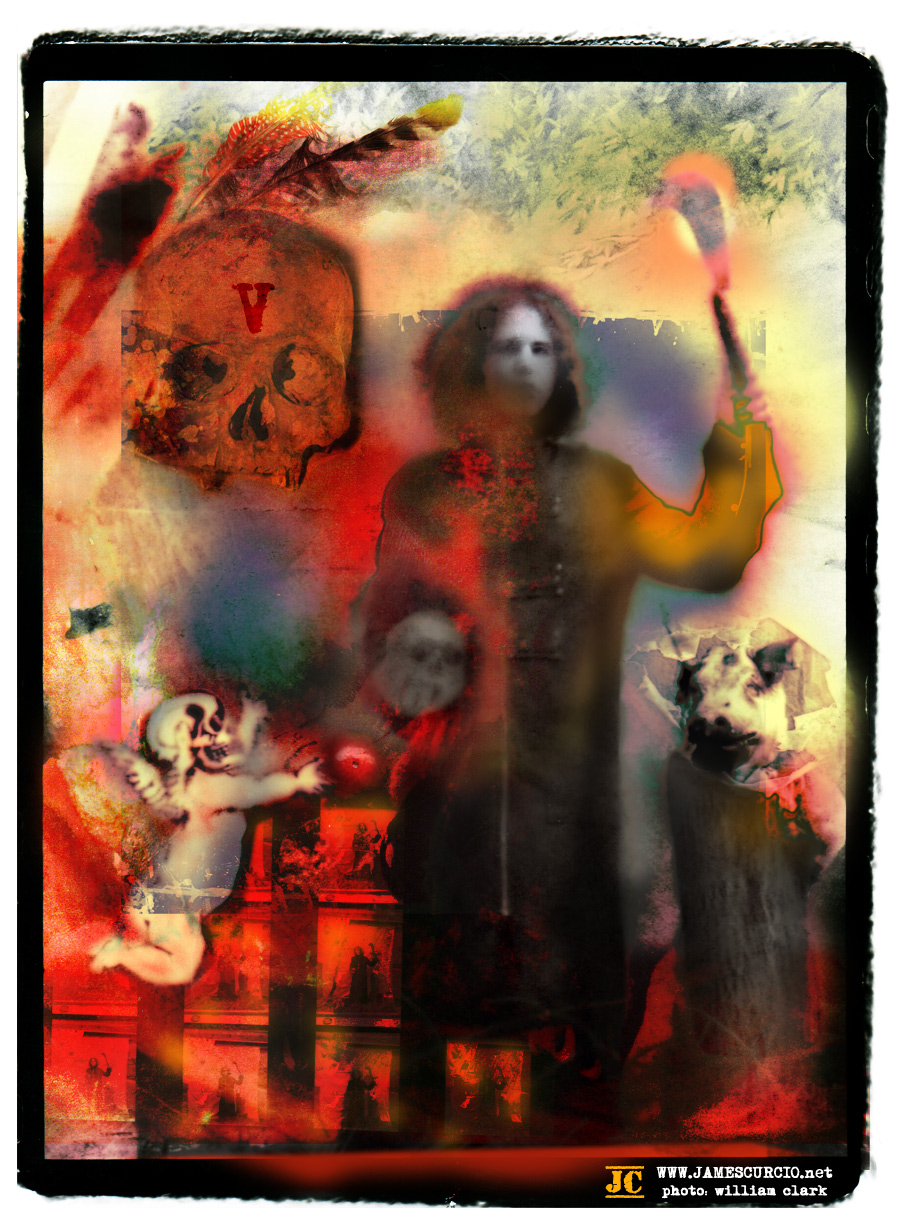
Just a peek under the hood, like ya do. Photo by William Clark.

V

Monday, September 07, 2009

Interview on Kult ov Kaos issue 1


Here is an interview I did early this year for a little web zine, I enjoyed it and thought we covered some interesting topics once it got going, even though I feel like interviewers have mostly been asking me the same questions the past couple years. (Rather than providing links throughout, you can find many of these projects on my portfolio site.)
------------

Saint Natas: Tell me a little bit about yourself. Where did you come from? Who were your major influences?

James Curcio: I wasn't raised by nymphs in some mountain glen or something... I grew up in and around Philadelphia, spent most of my adolescence in the suburbs. My Mom was a lesbian artist, we moved around a lot.

I really couldn't tell you who my influences were in such a general sense. I spent a lot of time, especially in my early youth, reading books. I got picked on a lot for that at the time - you know, other kids would be chugging Mountain Dew or whatever it was they were doing, and I was mainlining philosophy and Sci-Fi. The caffeine excess - that came a little later. I was always looking for something different, I don't know if it's a symptom of suburbia, but there was always this feeling that there had to be something more out there.

Thankfully, I was right.

SN: I first came across your work as a member of the Babalon band. Can you tell me a
little bit about that project? How did it come together? Who was involved? What was it about? What was the experience like? How did it end?

Babalon Band pic c. 2003.
JC: Babalon's first incarnation was actually a somewhat poorly conceived music project that I put together in my final year of college for the integrated arts department. I say poorly conceived, because we were fusing all of these genres and approaches to music together in a forum that didn't necessarily make sense for it - and though some of us had plenty of past band experience, we were still trying to find our voices - together, and separately. Out of that, an artist and music collective formed. In it's heyday, if you want to call it that, we had two audio visual studios, and quite a band of freaks in the "regulars" that would pop in at all hours of the day and night. As often happens with such things, it started to ramp up and there was either the possibility for it to break forward or fall apart. It fell apart, at least so far as I was concerned. So my wife - at the time - who had been the singer of the previous Babalon incarnation started talking with Scott, the guitarist, who was living in Los Angeles. We started a long - distance music project that became Babalon's Descent. And as we wrapped that project, we decided to move out to Los Angeles to work with him directly, and make the band a full - time thing. It was a pretty big commitment, and quite a leap to make. We dropped everything.

I don't know. The story behind Babalon is really elaborate. I'm not sure how to attack it in this format, though I've been asked these questions in plenty of interviews. I don't mean to dodge out, but the truth is that the experience of putting this together, and its painful dissolution, heavily informed Fallen Nation. That book might not be based on Babalon literally, but the ideas are all there. And so are the experiences. I'd like to think that reading the book would be more interesting than hearing me ramble on about the past.
1/2 of HoodooEngine Chillaxing.

SN: What else have you been up to musically?

JC: I've done a couple of studio albums since Babalon - subQtaneous, which wound up becoming a pretty colossal effort... Subq was a collaborative concept album. I must've brought in over thirty musicians when all was said and done. It's a pretty unique effort, maybe too unique for it to ever really catch on in the US. Like a really funky lambic. I played bass with elektroworx for a while, we opened up for Front242, considered going on tour, and wound up breaking up instead. Laid down some drums for a Veil of Thorns release, and have done a lot of music work for various podcasts_ as you know, the crew I work with have this habit of creating original or semi-original material for the audiobooks and podcasts we do.

Right now, I'm working a bit on a tongue-in-cheek, really heavy project with Marz233
from Elektroworx called Hoodoo Engine. Scott Landes - the guitarist from Babalon -
will likely lay down some stuff too if he can find time from the crazy tour schedule he has going with Collide, Mankind is Obsolete, and the Kidney Thieves. If we can find the right front-man, we're planning on making our first release "Nothing Is Sacred." It's really just a place to put our frustration, honestly. That's very different from what we were doing with Babalon or any of these other projects. Every project needs to be unique, and has to have its own intent, its own life span. I can't tell you which will really get feet, that's as much up to fate as it is up to me.


SN: The next thing I came across, a few years ago, was the book, Join My Cult!, published by New Falcon. Tell me a little bit about the idea behind the book and what you'd like your readers to walk away with after reading it.

Tuesday, June 09, 2009

Join My Cult! ebook introduction

Here is the new introduction to the Join My Cult! ebook presently available on Original Falcon's website.
Rewind the tape to 2000, suburban America. Our progress had reached an apex, and while it would in retrospect be seen clearly as Hubris, at the time, there was no end in sight. At this time, it seemed there was the beginnings of a second (or third?) wave American counterculture that never actually completely coalesced, derailed by the conspiracy theories and atrocities that defined the following near-decade.

1998-2000 is when the core of Join My Cult! was written, despite the publication date. I organized and wrote a great deal of it, but really it owes itself to a group of friends that shared a similar experience moving out of adolescence at that time. The bulk of the conversations in this book are real, derived from online and off-line interactions as we delved headlong into exploration of psychedelics, the occult, and sex.

One criticism often leveled at this text has been that "real people never speak like this." This makes me laugh because, although it is a perfectly valid criticism- sane people certainly don't- in this case, we did. And it is with a tongue-in-cheek mockery of our often overly enthusiastic, nevertheless earnest state that I left this material mostly as is, even though I shudder to think some might take it purely at face value.

It has been interesting, over the past six years or so, to receive letters from readers- most of them telling me, to my surprise, how much the book effected them or even "changed their lives." Of course, amongst these were also plenty of people who felt the need to tell me how truly awful it was, and the notable few who actually went so far as to threaten my life. (I take this as the highest compliment.) When I wrote this book, I was unsure it would ever be published, and certainly many of my friends told me it would be for the better if it wasn't. After it was accepted by New Falcon, I had some hopes of it becoming a break-away cult hit.

In the end, it was neither of these, remaining that odd book you might stumble across one day in the corner of an independent book seller. A puzzling, hilarious, train-wreck of an oddity.

I have come a long way since I wrote Join My Cult!, and (I hope) have grown a great deal as an artist and writer since. But there is an intensity that comes with the blind, youthful enthusiasm of a project like this that I doubt I could replicate. New Falcon never properly edited the first edition, and in retrospect, I'm not sure I can blame them. There are many things in this text that seem like grammatical mistakes, that are intentional (particularly changes between tense and point of view with psychotic frequency), and I can only imagine they gave it a go and threw their hands up at the prospect. I occasionally consider giving it a thorough edit myself, but that thought is quickly washed away when I plunge into the text. This edition does have some minor edits from the original which saw its way into print, and you will find some new additions in the appendix, but there is little I could see changing without possibly disrupting the oddly symmetrical whole of this book, which at first glance looks a lot like total chaos.

So I'm offering it for free now, warts and all, to whomever wants to come along for the ride- and I hope in the process I will introduce some of you to a repository of common experience that might seem strangely familiar.

James Curcio
2009

For more of my work, (writing, music, interviews & more) see http://www.jamescurcio.net This free eBook is released under a Creative Commons License. You can share and print it to your heart's content, though you must get my permission for any other use at jamescurcio at gmail dot com


Read the PDF:


(Link for the image impaired.)

Sign up to the Fallen Nation blog feed (includes the Join My Cult! audiobook, presently in progress.)

Saturday, May 30, 2009

Qabbalah and problems regarding spatial metaphors

The following is something I jotted up to a friend as an explanation about something I said in passing on the phone with him about spatial metaphors and the Kabbalah. I assume it'll expand and work its way into the Immanence of Myth. I also have more to say about the first point, some of which was inspired by an article of Mimi Lobell's that John Lobell sent to me recently. Perhaps some of you will find it useful or interesting, if not this'll serve as a reminder to myself. Any conversations that spin off of it are always welcome- questions and conversations in many ways are helping to direct the expansion of this project.

We constantly make our metaphors spatial, often when we are not actually referring to a spatial relation. This could even be the crux of the metaphor. For instance, we commonly say something like "I'm feeling pretty up" or "I'm feeling pretty down." There's a sense that we immediately understand from these metaphors that bears no relationship with reality. In other words, even though it shouldn't make sense, it makes perfect sense. This is the nature of a metaphor, we don't say "she ran like a deer," we say "she was a deer." There's a sense in which something that is logically untrue is true in another sense; the conjoining of these two or more ideas tells us something about its nature, even though the actual statement is false.

(This is an element of mythological thought that has caused no amount of trouble in religion, clearly, but that's not what I want to get at.)

The Qabbalah is in many ways a spatial as well as numerological metaphor created to deal with metaphysical ideas that could not possibly be dealt with in such subtlety in any other way. So a structure was built that allows us to relate these very abstract ideas with one another in a way that is very concrete and intuitive to us: a spatial "map," the tree of life.

Further, it was well recognized by priests and scholars alike at the point of the birth of Kabbalah (anywhere between the 4th and 12th century), that the divine could not exist separate from anything. That is to say, the divine cannot itself have qualities, for to have a quality is to acknowledge the absence of a quality, (if God is light then does darkness exist without God? How can anything exist outside of the absolute/infinite/etc.) Yet if it is without qualities, then how can it be said to exist at all? They worked around this issue with the tree, by saying that all of these seemingly distinct elements are essentially the result of an element outpouring to the next- they are not only linked but actually inseparable.

This "tree" is broken up into what are essentially layers of reality, called Sephiroth (סְפִירָ×”, "eminations"), from the tangible and material (Malkuth) to the completely meta-physical (Keter). These are connected by paths which correspond to the psychological states apparent in the transition from one of these layers to the next, and as such though there are dense correspondences associated with the Sephiroth, the associations for the paths are more narrative. This is most clearly seen in the association of the Major Arcana cards of the Tarot - or the archetypes they represent - with those paths. (FN The Major Arcana are distinct from the other cards, in that they represent archetypical personas that can also be seen as "journey states," such as the Fool and the Magus. There's a lot in the Book of Thoth on these two, not to mention the Golden Bough, Arthurian legend especially the legend of Parcival, or even Apocalypse Now for that matter.)

The usefulness and meaning of these "associations" is possibly best understood not only psychologically but also anthropologically. This quotation from Claude Levi-Strauss is strangely appropriate: "The customs of a community, taken as a whole,
always have a particular style and are reducible to systems... the number of systems is not unlimited and... in their games, dreams, or wild imaginings... human societies, like individuals, never create absolutely, but merely choose certain combinations from an ideal repetior... By making an inventory of all recorded customs, of all those imagined in myths or suggested in childrens and adult games, or
in the dreams of healthy or sick individuals or in psycho-pathological behavior, one could arrive at a sort of table, like that of the chemical elements, in which all actual or hypothetical customs would be grouped into families, so that one could see at a glance which customs a particular society had in fact adopted."

Though this is not the intention of the 'original' Kabbalah we see in the Sefer Yetzirah or Zohar, it is nevertheless what it evolved into, through the practices of Christian and Jewish mystics alike, taking on its penultimate form - in this regard - in the so-called magical orders of the Victorian age. And although much of the analysis and charts of associations produced by these groups may arguably be flawed or at the least culturally biased themselves, and though they are to some extent subjective in any case, it is nevertheless an analytical as well as creative tool too useful to be simply overlooked. These charts, and an explaination thereof, is best found in works like Israel Regardie's Garden of Pomegranates, Dion Fortune's Mystical Kabbalah, or a great deal of Aleister Crowley's work, most particularly the Book of Thoth, Magick In Theory and Practice, 777, and Book 4. (At the same time, all of these should be approached with some degree of skepticism.)

However, in bifurcating the divine, an inherent heirarchy is created within the tree of life so long as you think of that spatial metaphor as literal, that Keter is "above" Chesed or Netzach, that one "ascends" to "travel" from Malkuth to Yesod, etc. None of these are the case- they are metaphysical and psychological realities which have no spatial reality. They are only said to have that as a way of thinking of them, as otherwise we simply can't wrap our head around it. It's a small lie to avoid a larger one. The only truth to the tree of life is actually Ein Sof, the unmanifest which all of the sephiroth eminate from, and even then, in an oddly Hegellian realization, the rabbis later created the idea of Ein Sof Aur, the boundless possibility to pair against the unmanifest, almost Sunyata like-ness of Ein Sof. Sunyata is the Buddhist void which is also the ground of being, both are essentially the same concept, or in this case, category, since Sunyata and Ein Sof both represent the true
monad which simply cannot be conceived, nor thought of as anything other than a quality-less void containing in potentia all possible qualities. (The idea of Sunyata may be argued to contain both Ein Sof (the negative aspect) and Ein Sof Aur (the positive) within it, but this is irrelevant to the point.)

You can see in the duality of ideas such as Ein Sof and Ein Sof Aur that we are actually incapable of creating a truly monistic concept without at least implying a duality behind it, (and often a trinity behind that). It is difficult to say if this is simply a barrier of our own nervous system or an inherent quality of the universe beyond perception- when thinking of any single thing we must "frame" it within an area that is not that thing. It is an odd pre-requisite of thought. To think of a thing outside of which there exist nothing but that thing is mind-boggling, at best we think of it ever expanding, but what would it have to expand into? This is the ground that Kabbalah and other similar metaphysical systems attempt to strike at, through some of the conceptual tricks already discussed.

Monday, May 18, 2009

Join My Cult! audiobook episode 1


Join My Cult (with teeth)

The psychedelic prologue to Fallen Nation: Babylon Burning, Join My Cult! has been rewiring drug-addled brains for the past five years. Now, here, for the first time (because we never bothered to get around to it before), is an installment of the book in audio form. LISTEN (mp3)
Want to read it instead? :
Join My Cult! eBook (PDF)

Add this to your iTunes or check out all the episodes as they run


Episode 2 is also now live. Check back here soon for more.

Saturday, August 18, 2007

Esozone 2007


First-hand report of the recently completed Esozone 2007 occultural event in Portland, which featured the likes of Paul Laffoley, The Foolish People, Freeman, the Viking Youth, and many others. Includes video and audio from the event.

(Alterati article.)

Monday, June 11, 2007

The Esoteric Hip Hop Knowledge of The Black Dot

"Alterati editor-in-chief James tipped me off to a book he saw in a crazy book store tucked away in an obscure corner of Philadelphia’s Reading Terminal Market. Beside the Aleister Crowley and Eliphas Levi tomes and David Icke DVDs was a book about a magickal approach to hip hop. After some digging The Matrix of Hip Hop website and the Hip Hop Decoded: From its Ancient Origin to its Modern Day Matrix book was unearthed.

The author – Harlem based The Black Dot – outlays a trippy occult Hip Hop cosmology, probably best expressed in the video The Five Bloodlines of Hip Hop, where we learn how our ancestors (well, maybe not mine …) came to earth through five elemental gateways, how the Golden Age was destroyed by parasitic mutants, the transformation of the elemental archetypes of communication (Hieroglyphics, Drummer, Oracle, and Dancer into Graffiti, DJ, Emcee, and B-Boy), the unifying power of the etheric pineal gland, how the ancestral bloodlines were reactivated by hip hop in 1973, how the mutants tried to use gangster rap to thwart the reactivation and the hip hop zero point singularity of 2012 where the planet will vibrate to throbbing higher dimensional beats and rhymes."


Read the full Article on Alterati.

Sunday, February 11, 2007

False is the Phantom Thou Seeketh

The following has puzzled me for a while. The thought re-occured to me, so I felt I'd mention it... though it likely won't make a whole lot of sense to you if you haven't at least briefly tangled with the tar baby known as Western Occultism.

I've seen quite a few would be magickians in the past years who either aspire to or claim to be in the process of 'crossing the Abyss.'

I wonder to myself-- how can someone do that, and still believe in something like magick? The framework, the underlying beliefs, the Path itself-- all illusions like anything else. Illusions which need to be discarded when they hinder more than help you.

A magus doesn't believe in magick any more than he believes in the flying spaghetti monster. Which begs the question. Why talk about magick at all?

Any of us who have been pitched into that paradigm know what it's like when you start. You're like a kid in a candy store. (Except all the candy is covered in liquid acid and filled with razor blades.) It's okay to feel that enthusiasm. But just because the spectre in the shadows talks to you doesn't mean he's real.

This is one of the many reasons I ceased external interest in the subject.

An upshot of that, and this is interesting- take the faith which props the whole belief system up away... and watch all the portents, omens, transcendental dreams, visions quests, and grandiose cosmologies crumble into the dust they have always been. This is equally true with any belief.

The inverse is also true. But sorry Mr. Carroll, you can't fake yourself into truly believing something, except through a process of baby steps.

I think I can genuine say I don't believe in anything outside of specific contexts, anymore.

Friday, June 02, 2006

GENERATION HEX: HIGH ROAD ANAMNESIS 2005


"As the Western world continues to accelerate towards information overload, a sort of crass lust for a non-offensive, non-distinct, all-inclusive "spirituality" has become more and more prevalent. Spirituality as a way to ignore the uglier aspects of life and focus on a highly bankable "eternal moment," a soothing white light to clutch like the Orgasmatron in Woody Allen's Sleeper.

In such a marketplace of belief, in which every world faith has been pureed into a homogenized feel-good power shake, it is often the options with a tad more grit to them that stick out. Voodoo, witchcraft, the abyss-transfixed "magick" of Aleister Crowley and Austin Osman Spare and, in the case of this recording, the solipsistic sorceries of a generation raised on late postmodernism, a fragmented mediasphere and the self-conscious posturing of "chaos magic."

While it is the most fevered belief of the "New Age seeker" that all paths lead to the same destination (and that, of course, it is never the destination that counts), one wonders if these strange children of the new millennium may well have eaten so much microwaved food that even such watered-down generalities as the "path" or the "destination" remain valid concepts to them. How does one teach patience, humility, quietude or mindfulness to a generation accustomed to terrorizing its elders with the unsettling speed of its "channel-surfing?"

The book release for Generation Hex, at Alex Grey's Chapel of Sacred Mirrors, was certainly a troubling sign that our children are willing to believe anything as long as it speaks in their "jive-talk." A throng of two hundred arrived to pay tribute to these "anarchs of the new paradigm"—James Curcio, the novelist and musician; Angelina Fabbro, the scientist; Micki Pellerano, the filmmaker; Atman, the academic; Rachel Haywire, the warrior; Shaun Frenté, the diva; and Jason Louv, the editor and circus ringleader, luring the children in. Jupiter, Mercury, Luna, Saturn, Mars, Venus, Sol. Seven seals.

And though the speakers did their best to calm the crowd from their murmurs of end-times, there was something undeniably Apocalyptic to the proceedings. Could God not only be dead, but have been so picked over by the banal "spiritual" masses that only the spears of Reason, Doubt and Humanism which killed him in the first place remain to prop up a new faith with?

The occult teachers of the past carefully coded and obfuscated their teachings. I hazard a guess that it was so that neophytes such as these couldn’t get their pudgy, pink fingers on them. Yet they have indeed, and their peers are, chillingly, taking them seriously. When Ezra Pound spoke in fear of the "sturdy, unkillable infants of the very poor," he might well have been speaking of this spiritually bankrupt "magickal" generation, raised by equally spiritually bankrupt, "permissive" and liberal parents.

If this is truly the grubby face of the "end of linear history" that de Chardin and McKenna predicted, then I can not so much give a positive review to this release as I can a negative review to the last several thousand years of linear history for having let it come to this."

-- Dr. Marvin K. Moloch, Associate Professor of Religious Studies, University of California at Bohemian Grove

----------
On October 27, 2005, these infamous "children of the new millenium," authors of the hit Disinformation anthology Generation Hex descended on Alex Grey’s Chapel of Sacred Mirrors in New York City. Speaking to a full house, the group's discussion and debate as to the nature of magick and its place in youth culture at the beginning of the Twenty-First Century is contained herein. If you couldn't be there in the flesh, this 74 minute recording of the proceedings is the next best thing.

LinkWithin

Related Posts Plugin for WordPress, Blogger...