Showing posts with label philosophy. Show all posts

Wednesday, November 18, 2015

WESTERN CULTURE, 2000 AD

by Guido Mina di Sospiro 

Prophets are the incarnation of a dilemma. Their message is quintessentially esoteric, yet they are driven to make it exoteric. As all dilemmas, this cannot be solved, and the usual outcome is the immolation or downfall of the prophet, unless exceptional circumstances temporarily suspend this predicament. Moreover, that there should be the initiate (the prophet) and the uninitiate (the disciples), has become a rather indigestible concept.

Indeed, traditional values such as the teacher-disciple relationship, training, patience, methodicalness, and constancy, have been lost in the sacred and profane spheres alike. For example, in the figurative arts, think for a moment of Jackson Pollock, who based his life’s work on trying to reproduce in paint the patterns made by his long-lost father urinating on stone. Such paintings, to which I used to refer, perhaps flatteringly, as “unappetising spaghetti”, are on display in many major museums the world over. Clearly, this is not the environment for Cimabue to say to his pupil Giotto, “You have surpassed your teacher.”

And yet, a “prophetic” forum such as this, one that rethinks one’s basic assumptions, feels the duty to promote and divulge esoteric ideas into the public domain. But, what is the state of  popular western culture in the year 2000?


Thursday, October 29, 2015

Why Can't People Disagree Without Taking Things So Personally?


I think a not-so-obvious reason is the relativism of modern moral discourse, best expressed in the theory known as “emotivism.”
In After Virtue, Alasdair MacIntyre wrote that “emotivism has become embodied in our culture.
He defined it as “… the doctrine that all evaluative judgments and more specifically all moral judgments are nothing but expressions of preference, expressions of attitude or feeling.” In other words, emotivism holds that there can be no way of rationally justifying one’s claims about those controversial issues mentioned above. (Intellectual Tackeout).
The basis of our actions aren't rational. Rationalizing is mostly the process whereby we narrativize what we've already done or were going to do anyway. So the issue isn't just about emotional relativism -- it's deeper than that.

It's that we literally don't know why we do what we do, but we have involved stories about why we do what we do, which we call "my beliefs" or even, "me." Might some be rational and some not?  I'm still somewhat unsure about this, based on the various interpretations I've read of post hoc consciousness etc. Maybe research has pointed in directions I haven't caught yet but it seems equally possible that our more cogent rationalization is still a blind, it just might also lead to more valued or preferred results. So we call this "truth" -- and yes I know this is a very William James kind of thing to say.

All It Takes Is The Right Story. Mythos Media

Tuesday, October 20, 2015

Questions Toward The Impact Of Human Nature

I've been doing a great deal of research and thought toward The Glorious Revolutions series we've been running over on Rebel News. Much of this kind of work occurs behind the screen. For instance, the rough document for the first two essays was over 20,000 words long, while the essays themselves wound up being about 1,500 words a piece. Similarly, each required the reading of 5 to 10 books. (In addition to whatever was ready at hand from past reading, with a little Internet refreshing.)

So... it's a process. But the next one I have planned has had me held up for a while. I've had a few conversations that have helped me spell out where I'm stuck, which have been both illustrative and interesting, so I wanted to share one here, while I continue to mull it over...

Wednesday, October 14, 2015

Glorious Revolutions Series

READ: The Whole Series To Present In Its "Glory" (reverse order)


All free on Rebel News, consider joining our Patreon so we can continue to produce independent news, editorials, and activist reporting.


I still remember when the Wall fell. November 9, 1989. If you were alive, you remember.
A newscaster on the television, his image warped and tattered by static around the edges, was talking about the end of nuclear threat. It was a revolution of culture, some said. Then President Reagan appeared, and took credit for the fall of Communism.
Revolutions leave an indelible stamp on those lived through them. But how did a falling wall end the Cold War, let alone stanch the tide of violent revolution? This is the kind of rhetoric we are fed. We’re given the pieces to this puzzle, but never told what image they’re supposed to make.
If it wasn’t already painfully obvious in 1986, it certainly is now. No one should have thought that violent uprising was a thing of the past. The legacy of globalization has generally been more revolutions, not fewer. It’s as if, with every generation, we forget the lessons learned by those that came before. This “nightmare of history,” to refer to Joyce’s famous quote, calls to mind several essential questions. Are revolutionaries incapable of hearing the ghosts of the past? Is this forgetting itself the nature of revolutions? Finally, how can we keep others from using our own hopes and ideas against us? These questions are hard to answer, and any analysis is likely to sound irrelevant to those that have lived through the mute horror of violent conflict.
Still, we must wrestle with this legacy if we are to have any hope of freeing ourselves from it. The cycle of loss and vengeance itself is a crucible for revolutionary ideology.

Read The Series

Friday, October 09, 2015

Cultural Cartography

From Rebel News: 

We’re suckers for simplistic, captivating pictures, mostly because we don’t even realize that we’re being sold a “frame”; we think we’re just seeing “the way things are,” when, in fact, we are buying into a paradigm. That’s why, all too often, while trying to talk our way out of a problem we only dig deeper holes.
... Now imagine the picture holding us captive is a conceptual map that carves up the boundaries of ideas and disciplines, charting the course of intellectual history. A faulty map is the kind of captivating picture that is bound to mislead us. In that case what we’d need is a therapeutic cartography.
— "A Therapeutic Cartography," James K. A. Smith.


AUTHENTIC SUPERFICIALITY

In the previous essay in this series, we looked at how we interact in a marketplace where surface identities drive our purchase choices. We have a very peculiar relationship with the things that we buy — both through and with our iPhones and cars, and soon enough, our sex robots.

More broadly, we identify ourselves and each other through the consumer choices we make, or even the ones we don't make. This is often called signaling, and it's an important part of nonverbal and implicit social communication. That's what the lifestyle brand is all about — integrating consumer choice with our lives, becoming grinning robots in some Orwellian hellscape ourselves, and so forth.

Thankfully that's not entirely how it plays out. Theories about the pervasiveness of brands and media brainwashing fall short of reality. Nothing is quite so simple as the behaviorist “image in, behavior out.” We may signal our queerness or our religion through what we wear and buy, but that isn't all we are. We still have inner lives, and an experience that can't enter into this marketplace, and our identities and beliefs are shifting landscapes more than fixed, binary wastelands.

The idea of Qualia refers to the irreducibility of this inner life. The world of surfaces may be superficial, but there is something lurking somehow beneath all of that, that’s somehow authentic. Erwin Schrödinger, creator of the famous living/dead cat thought experiment, said the following in What is life?: The Physical Aspects Of The Living Cell,
The sensation of color cannot be accounted for by the physicist's objective picture of light-waves. Could the physiologist account for it, if he had fuller knowledge than he has of the processes in the retina and the nervous processes set up by them in the optical nerve bundles and in the brain? I do not think so.
But this way also points toward reductive either-ors. If we're going to distinguish between the commodifiable “dead shells” referred to in the previous article and some kind of deep seated, internal identity, what is that identity? How do we know it's authentic? We are wandering dangerously close to a schema of the false and replaceable versus the fixed and true, and that is not a frame that I’d like to imply. This has become a common sense distinction for most of us: surface and interior. Fake hipsters, and real trendsetters. But the distinction itself is superficial.

Another way of contrasting the idea of real and false self, the figurative and literal, is through mimesis. Here we must challenge the “tyranny of the literal”,
In ‘Realism,’ the opening chapter of J.M. Coetzee’s most recent novel Elizabeth Costello, the eponymous heroine, a successful Australian novelist, gives a speech in which she ironically likens herself to a talking ape from a short story by Franz Kafka. The story’s ambiguities lead her to reflect on this historical loss of certainty, the way it seems to have undone the very possibility of direct communication and unproblematic representation. 
There was, she argues, ‘a time when we knew’: We used to believe that when the text said, ‘On the table stood a glass of water,’ there was indeed a table, and a glass of water on it, and we had only to look in the word-mirror of the text to see them. But all that has ended. The word-mirror is broken irreparably, it seems. ... There used to be a time, we believe, when we could say who we were. Now we are just performers speaking our parts. The bottom has dropped out. 
Her speech is not well received. Elizabeth Costello spends most of Coetzee’s novel acting the role of a celebrity writer. She travels the world making appearances, delivering lectures, fielding questions about the meanings and motivations behind her writing. It is not something she enjoys. Often her appearances do not run smoothly; her ideas tend to provoke dissent and dissatisfaction. ... The audience wants literal confession; but Costello’s aim is to keep ‘her true self safe.’ Or so her son John believes; for Costello the issue cuts deeper than this. She has come to doubt the very existence of such a thing as a ‘true self.’ The word-mirror is irreparably broken, yet she is compelled to appear before an audience. Inevitably, what she presents them is ‘an image, false, like all images.’
So, we are drawn to question the authenticity of both surfaces and interiors. The mirror itself becomes the closest that we have to any kind of certainty — as the image and its reflection can both be called into question.

A MAP OF OURSELVES

We have to contend with this tension between surface and interior, and amongst all the principalities thereof. That's true, even in the face of such uncertainties. Many of us struggle against these seemingly geological forces, without even knowing what we're struggling against.

The self and society as landscape is a frame suggested by Structuralism, and later by Post-structuralism when written in relief. Both position history as structure composed of geological flow rather than events; this was done, in terms of the latter, because the very structures imposed by theory could reify imperialist “grand narratives.” For example,
The history of events, Braudel was to scathingly write, were merely the history of “surface disturbances, crests of foam that the tides of history carry on their strong backs” (Braudel, 1980: 10). The outcome of the struggle for supremacy in the Mediterranean, then, was viewed by Braudel as the outcome of longer term structures (political, social, economic and geographic) and not at all the result events or the actions of individuals. —Extending the Longue Dureé: Manuel De Landa and a Thousand Years of Nonlinear History.
The tension of surface appearance against deeper identity, and the constant anxiety that there is such a thing as a central or deep identity, drives the tectonic forces between what I'll be referring to later as cultural borderlands and centers. We needn’t know which is authentic, but merely recognize the tensions between these principalities. This might still seem a baroque metaphor, even if it’s far from unprecedented in the social sciences, but it's nevertheless apt. Dynamism in the self or the state arises from difference, conflict from too sudden changes; often arising where one identity abuts another, and all are also ever changing.

This is borrowing from the frequent use of geological and even cartographic metaphor in such works. These metaphors are essentially impersonal, even when they refer to parts of personal psychology. For this reason, they have been vastly preferred within post/structural analysis, over the earlier mythopoeia of Freud or Jung, for instance, which paints all inner experience as personal, in reaction to a mythologized external world.

Manuel Delanda’s odd but brilliant 1000 Years of Nonlinear History is possibly the penultimate example of this sort of device. In fact, the entire book is constructed as a series of geological, biological, physical-psychological-historical metaphors (even if he is insistent that it is not a metaphor but rather an “engineering diagram”),
We live in a world populated by structures — a complex mixture of geological, biological, social, and linguistic constructions that are nothing but accumulations of materials shaped and hardened by history. Immersed as we are in this mixture, we cannot help but interact in a variety of ways with the other historical constructions that surround us, and in these interactions we generate novel combinations, some of which possess emergent properties. In turn, these synergistic combinations, whether of human origin or not, become the raw material for further mixtures. This is how the population of structures inhabiting our planet has acquired its rich variety, as the entry of novel materials into the mix triggers wild proliferations of new forms. ...
And so on. It's important to recognize that all the structures on these these maps ebb and flow, empires rise and fall more less the same as colonies of coral might. More prosaically, just as one might stand on the Pacific rim and hundreds of millions of years later, they might spy a new continent on the horizon, a 19th century American Republican might find more in common with many of today's Democrats. Our labels are not what ultimately defines us. After all, nothing is fixed. And what of the center of the world? As Umberto Eco observed, you can hang Foucault's Pendulum anywhere.

Thus, all domains are conceptual maps, even including the inscrutable, uncertain, and ultimately implicit world of qualia. A map does not provide a certificate of authenticity, of course — as so many counterculturists are bound to point out, “the map is not the territory.” But without it, we can’t begin to track our way out of the shifting hinterlands. We cannot properly understand society, or ourselves, until we've charted the surfaces of this never-ending symbolic fault line. But we mustn't find ourselves limited by the names, labels, and borders that happen to be written in this fleeting moment.

So let's look at an example framework...

Wednesday, September 30, 2015

Symbols and Signs

Via. Rebel News


How can we decrease the commodification of these empty signifiers? We can continue to build spaces, both virtual and material, that can be utilized by people who share common goals. We can continue to evolve as people and avoid over-identification with easy to replicate symbols of identity. Our interests and digital footprint aren’t who we are. We mustn’t let the map of our identities — personal or social — become the territory. But the border skirmishes on that map are never ending.


This is far from easy. Products themselves have become secondary, as symbols have overtaken the things they symbolized. Fight Club parodied this tendency as the “Ikea nesting impulse.” This is a challenge of modern life, but it’s hardly a singular observation. Guy Debord’sSociety of The Spectacle, now a standard text amongst neo-Marxists and counterculturists alike, deals with this matter in nearly aphoristic style,
The first phase of the domination of the economy over social life brought into the definition of all human realization the obvious degradation of being into having. The present phase of total occupation of social life by the accumulated results of the economy leads to a generalized sliding of having into appearing, from which all actual “having” must draw its immediate prestige and its ultimate function. At the same time all individual reality has become social reality directly dependent on social power and shaped by it. It is allowed to appear only to the extent that it is not.
We live in a culture where appearances count for a lot more than reality, and so it is little surprise that we may have a hard time actually making this distinction. We are what we seem. When Ludwig Feuerbach wrote the introduction to the 2nd edition of his The Essence of Christianity, he was speaking to Hegel and Marx’s world, the rapidly industrializing 19th century. But he may as well have been speaking of the present,
But certainly for the present age, which prefers the sign to the thing signified, the copy to the original, fancy to reality, the appearance to the essence … illusion only is sacred, truth profane.
Symbols of success matters more than the things they represent. The symbol becomes the value, rather than the thing signified. The sports car, the expensive watch, the designer suit are all, from a utilitarian perspective, equally or even less valuable than items half their cost. Though luxury items such as these are said to cost more because of increased craftsmanship – which may well be true – the customer is still buying them because they are symbols of wealth and success. To have either of these on their own is not enough; the symbols are of greater value. We are performing wealth at one another. Though this seems harmless enough in itself, a common indulgence of the upper class, it is the same mis-match of value (weighing the symbol over what is represented) that characterizes the ennui of our lives. Nihilist Arby’s quite simply wouldn’t make sense as a joke if we didn’t grasp this on an implicit level.

  Read Full Article for Glorious Revolutions series.  

All It Takes Is The Right Story. Mythos Media

Friday, April 24, 2015

Beyond New Age The Problem Isn't Just Belle Gibson

It's a well known truism that, in life, we tend to find what we're looking for.

I realize this truism is tautological, and it's been rendered down so far that it seems meaningless, yet it is something we repeat to one another in so many forms.

This idea has been central to the 'positive thought movement' for well over 100 years, with many different off-shoots, but all can be considered unified in regard to this particular idea: "our mental states are carried forward into manifestation and become our experience in daily living".

The belief is that Somehow (and this is The Secret), our mental picture effects the world. This produces the "law of attraction," whereby like attracts like, and our thoughts somehow manifest reality. This is the very foundation of what's happened with Belle Gibson, as JR Hennesey explored on the Guardian today:
Gibson needed to fake cancer, because the New Age narrative of transcending physical and spiritual sickness is so ingrained into its marketing. New Age philosophy is the clearest example of a utopian movement utterly absorbed by capitalism, which it once (feebly) opposed.
This is a good article on the subject, and I recommend you read it. However, that's not what I want to focus on here,. Instead, I want to look at a deeper process. When we look out into the world, how surprising is it that we see our presuppositions and even past experiences reflected back at us? Are we actually manifesting our thoughts, or could something else be at work? Finally, can we really consider this a phenomenon that's entirely unique to the New Age movement?

Friday, March 27, 2015

The Society of the Spectacle

It's hard to believe Guy Debord's Society of the Spectacle was first published in the 60s. Consider the world we live in today: a world of social media, where the mediated space is on equal footing with our lived experience. In fact, the virtual seems positioned to entirely replace the material in the course of history, a point at which we can truly say would be the end of history.


Now, these quotations, directly from the text:

In a world that is truly topsy-turvy, the true is a moment of the false.
The spectacle presents itself as something enormously positive, indisputable and inaccessible. It says nothing more than "that which appears is good, that which is good appears."
The present phase of total occupation of social life by the accumulated results of the economy leads to a generalized sliding of having to appearing, from which all actual "having" must draw its immediate prestige and its ultimate function.
The spectacle is the existing order's uninterrupted discourse about itself, its laudatory monologue.
... The fetishistic, purely objective appearance of spectacular relations conceals the fact that they are relations among classes: a second nature...seems to dominate our environment. If the spectacle, taken in the limited sense of "mass media" which are its most glaring superficial manifestation seems to invade society as mere equipment, this equipment is in no way neutral but is the very means suited to its total self movement. If the social needs of the epoch in which such techniques are developed can only be satisfied through their mediation, if the administration of this society and all contact among men can no longer take place except through the intermediary of this power of instantaneous communication, it is because this "communication" is essentially unilateral. 
We need not call to mind the PR debacle of Facebook "emotionally manipulating" its users. This is, after all, nothing but the type of marketing manipulation all companies attempt, with varying degrees of success. No. It is the much more casual way that these technologies integrate with our lives that bears the most consideration. It is the business of these platforms to set themselves up as the intermediary, the go-between when you engage anyone in this "topsy-turvy" world.

More anecdotally, (and prosaically), it has been somewhat disturbing to me of late that the few times I've left my Facebook account, many people have ceased contact. When I returned, caving into what has increasingly felt like a Stockholm Syndrome like situations, the refrain was "I'm happy you're back, now we can talk to you again." The virtual is increasingly the world in which we exist in, socially. What then is the fleshy present? The mechanism of mediation is increasingly the "lived world."
To the extent that necessity is socially dreamed, the dream becomes necessity. The spectacle is the nightmare of imprisoned modern society which ultimately expresses nothing more than its desire to sleep. The spectacle is the guardian of sleep. 
Couched in the sort of "pomo speak" that seems to be less in vogue these days, it's not likely to be a top seller anytime soon. The tone almost strikes one as the bullet points read off through a bullhorn at a rally by a chain-smoking Frenchman with a megaphone. There are countless ways that we can critique, interrogate, and ultimately narrate technology. Whether it is our salvation or damnation is almost a literary conceit. But that makes this particular critique no less lucid, or downright prescient.

Next up I'm going to start looking into how Situationism influenced Debord's work. And dig back at the anarchist primitive movement that was fire-bombed in Philadelphia. I'll report back what thoughts seem worth sharing.

All It Takes Is The Right Story. Mythos Media

Thursday, March 26, 2015

The Backfire Effect

You think your beliefs are informed by facts. Yet, research is demonstrating facts couldn't matter less...
Science and fiction once imagined the future in which you now live. Books and films and graphic novels of yore featured cyberpunks surfing data streams and personal communicators joining a chorus of beeps and tones all around you. Short stories and late-night pocket-protected gabfests portended a time when the combined knowledge and artistic output of your entire species would be instantly available at your command, and billions of human lives would be connected and visible to all who wished to be seen.
So, here you are, in the future surrounded by computers which can deliver to you just about every fact humans know, the instructions for any task, the steps to any skill, the explanation for every single thing your species has figured out so far. This once imaginary place is now your daily life.
So, if the future we were promised is now here, why isn’t it the ultimate triumph of science and reason? Why don’t you live in a social and political technotopia, an empirical nirvana, an Asgard of analytical thought minus the jumpsuits and neon headbands where the truth is known to all?
Among the many biases and delusions in between you and your microprocessor-rich, skinny-jeaned Arcadia is a great big psychological beast called the backfire effect. It’s always been there, meddling with the way you and your ancestors understood the world, but the Internet unchained its potential, elevated its expression, and you’ve been none the wiser for years.
...
The backfire effect is constantly shaping your beliefs and memory, keeping you consistently leaning one way or the other through a process psychologists call biased assimilation. Decades of research into a variety of cognitive biases shows you tend to see the world through thick, horn-rimmed glasses forged of belief and smudged with attitudes and ideologies. When scientists had people watch Bob Dole debate Bill Clinton in 1996, they found supporters before the debate tended to believe their preferred candidate won. In 2000, when psychologists studied Clinton lovers and haters throughout the Lewinsky scandal, they found Clinton lovers tended to see Lewinsky as an untrustworthy homewrecker and found it difficult to believe Clinton lied under oath. The haters, of course, felt quite the opposite. Flash forward to 2011, and you have Fox News and MSNBC battling for cable journalism territory, both promising a viewpoint which will never challenge the beliefs of a certain portion of the audience. Biased assimilation guaranteed.

The Backfire Effect


All It Takes Is The Right Story. Mythos Media

Sunday, March 15, 2015

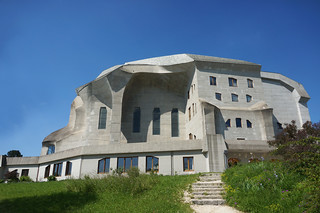
Steiner's Philosophy and an Alternate View of Spiritual Context


https://www.flickr.com/photos/rvoegtli/9059548566
Goetheanum by rosmary
Rudolf Steiner is a largely forgotten thinker in virtually all circles of Western philosophy. Even many in esoteric circles who know the names Crowley or Blavatsky often fail to recognize his name. Despite this, Steiner’s influence is felt today in Waldorf schools, biodynamic farming, social finance, and prisoner outreach, and his school of anthroposophical thought is still debated and taught in Rosicrucian style organizations like the Anthroposophical Society in America. I was first introduced to Steiner through Gary Lachman’s excellent book, Rudolf Steiner: An Introduction to His Life and Work, which detailed the life and work of Steiner in such a way as to be easily approachable. Lachman’s recommendations included Robert McDermott’s The Essential Steiner (later updated as The New Essential Steiner), and there were enough similarities between my own personal philosophy and Steiner’s, that it was an easy purchase to further devour this great thinker’s expansive writing.

Steiner had a great impact on me personally because of his views on geometry and other mathematics are pure, and his insistence that any spiritual belief or experience could be met with the same scrutiny with which the hard sciences were met—essentially, Steiner believed that scientific inquiry could penetrate the spiritual. Steiner’s refusal to tell his readers/listeners to take things on blind faith, and his insistence on additional inquiry, made him different amongst his esoteric peers—less a guru and more an advisor. On a philosophical level, he was well-verse with the great German philosophers, and even upon disagreeing with others, took it upon himself to diligently argue from another’s perspective in order to better understand their point of view. His writings in support of Nietzsche (for Nietzsche’s daughter) are case in point for this. Steiner wasn’t searching for followers. His goal was the pursuit of knowledge; something that can be appreciated, whether you agree with his more esoteric philosophy or think they are just outlandish.

Steiner understood the principles of evolution as they were during his time. The difference was that he applied evolutionary principles to the spiritual as well as the physical—even spiritual entities such angels. Everything evolved. Although scientists don't assume that evolution "ceases" they also don't seem to contemplate whether the consciousness of today is the same as the consciousness of older times, or at the very least, it isn't something that is highly contemplated when examining historical context. So, for example, when we examine the literature of ancient cultures, we take a lot of what those cultures say to mean literally how they said it, but their descriptions have been written within their own consciousness, and their consciousness could have been quite different back then.

Steiner talks about the positioning of the astral body (which also evolves) through the evolution of the human being to show how insight into the spiritual has changed, but he's quick to note that stories and statements made that seem far-fetched for our physical reality are likely to be glimpses of the spiritual world that those individuals could still see, and most importantly, interpret. Many today look upon ancient cultures and think that they believed what they did because they weren't "as smart as us," but we really don't know "what" they truly believed. Steiner also makes the comment that older cultures believed these spiritual things because they weren't that far removed from ancestors that could see directly into the spiritual, and some of their own people still could. He gives them the benefit of the doubt, whereas modern science and history assumes them often ignorant, misled, or not as culturally evolved.

Wednesday, March 11, 2015

The Conspiracy Against The Human Race

The Conspiracy Against the Human RaceThe Conspiracy Against the Human Race by Thomas Ligotti
My rating: 5 of 5 stars

Years of meditating and reading books on philosophy, psychology, years of lucid dreams and night terrors, do not make a person unique. But it is singularly unique to find what feels like your own thoughts reflected back at you when you didn't pen them. As I read The Conspiracy Against the Human Race, I had a strange feeling, as if deja vu and vertigo had somehow been blended together. Had I read this before, if I hadn't written it?

Yet that disturbing familiarity regards an utterly useless process. Reading or writing about philosophy has long had a negative connotation in the United States, thanks to a long anti-intellectual culture in some corners. But here the useless, and indeed the negative, have an absolutely finality that have nothing to do with anti-intellectualism. This is ontological uselessness, the nightmare of being.

Ligotti's core thesis — the self as we know it is a contrivance of evolution, self consciousness an accident. To be deceived into thinking we are a self, that's the situation we find ourselves in, without hope of reprieve or reprisal. Of course, he isn't the first pessimist to set pen to paper, but he is the first to do so starkly, with such uncompromising clarity, without back pedaling or that ultimate cop out, the happy ending, “it was all a dream.”

There is a certain intentional irony here, as indeed our waking lives are a type of dream, and the self we grant some sense of ultimate reality is nothing other than a character in that dream. But to the extent anything is real, that dream character's suffering is legitimate.

Our choice as he sees it is simple — self deception, or insanity. He shows us the basis of horror, rooted not in the supernatural beyond, but much closer to home. It stares back at us in the mirror. The supernatural in a sense gives us a glimpse of our own uncanny ghoulishness, without requiring identification with the absolute truth of the matter. We can close the book, and shake off that chill, for after all, it was just a story.

But this is not merely a thought experiment. It isn't satirical hyperbole, like A Modest Proposal. There is no hope or happy ending to soften the blow. Because the game of life is all fixed anyway, it couldn't matter less if you deceive yourself and write this book off as pessimistic belly aching. Whatever it takes to get you through another day, and prop up the illusion that you are a self in the first place.

Although some may argue about what constitutes “serious philosophy” — as Ligotti himself says, he eschews the circuitous argumentation that generally grants a work that unapproachable aura of seriousness — I would argue that this book belongs within any introductory study of nihilism and even post-modernism. To do so I'd like to demonstrate what I mean. Those purely interested in The Conspiracy Against The Human Race may as well stop here, but I believe this claim demands a little context and backtracking. You'll forgive me if I need to broaden the scope to come back to task.

Sunday, February 22, 2015

The Limits of Physics

A very interesting article over on Aeon:
On the one hand, then, physics is taken to be a march toward an ultimate understanding of reality; on the other, it is seen as no different in status to the understandings handed down to us by myth, religion and, no less, literary studies. Because I spend my time about equally in the realms of the sciences and arts, I encounter a lot of this dualism. Depending on whom I am with, I find myself engaging in two entirely different kinds of conversation. Can we all be talking about the same subject?


All It Takes Is The Right Story. Mythos Media

Tuesday, February 03, 2015

On Fantasy: How Zizek Reads Lacan

The difference Between Lacan and ‘naive realism’ is that for Lacan, the only point at which we approach this hard kernel of the Real is indeed the dream. When we awaken into reality after a dream, we usually say to ourselves ‘it was just a dream’, thereby blinding ourselves to the fact that in our everyday, wakening reality we are nothing but a consciousness of this dream. It was only in the dream that we approached the fantasy-framework which determines our activity, our mode of acting in reality itself.

This is incredibly relevant to the points made previously in our first Critique of Jung.

[Take a Trip with us... Mythos Media.]

Saturday, July 12, 2014

Beyond Narrative: Systems Theory and the Unveiling of History


Eduardo Mata Icaza
The contours of a train of thought has been surfacing lately — it’s the kind of thought that can very easily lead to a book or PhD thesis, if you’re not careful. But at the moment, they are thoughts that have come about researching and writing a graphic novel.

It begins something with systems theory —

My interest in systems theory began with De Landa’s 1000 Years of Nonlinear History, as this turned much of my thinking on pretty much everything on its head,
One of the ideas that I attack in my book is precisely the primacy of “interpretations” and of “conceptual frameworks.” Sure, ideas and beliefs are important, and do play a role in history, but academics of different brands have reduced all material and energetic processes, and all human practices that are not linguistic or interpretative (think of manual skills, of “know-how”) to a “framework.” The twentieth century has been obsessed with positioning everything. Every culture, given that it has its own framework of beliefs, has become its own “world” and relativism (both moral and epistemological) now prevails. But once you break away from this outmoded view, once you accept all the nonlinguistic practices that really make up society (not to mention the nonhuman elements that also shape it, such as viruses, bacteria, weeds, or nonorganic energy and material flows like wind and ocean currents) then language itself becomes just another material that flows through a much expanded picture. Language, in my view, is best thought of as a catalyst, a trigger for energetic processes (think of the words “begin the battle” triggering an enormous and destructive process). (Interview with De Landa.)
…and at the same time pointed a way toward a workable avenue of dealing with a serious problem in how we speak and think about groups of people— we talk of what “Americans” or “the French” or “Women” or “Palestinians” or “gay men” or “Russians” think, so on and so forth, we speak of these things as a given, and as monolithic, or at best we flail at a recognition of the generalization we’re performing as being based on meta-narrative or ideology.
In other words, our basis for such statements, if there is one at all, is merely generalized stories about stories. Or perhaps stories about ideologies. And we speak of these ideologies (Marxists, Christians, Islamic, Neo-liberal, etc) as if they present a material force, as if they themselves are fixed and certain things that are in the world in the same way as a chair or tree, because that’s the only way many of us have learned to think of things. After all, parsing different equally valid ontological categories is time and energy consuming stuff. Consider “Why The World Does Not Exist,”
There aren’t really unicorns on the far side of the moon, are there? Of course not. The very idea is ridiculous. However, in saying that, I am assuming the ontological perspective of science, not the ontological perspective of, say, the fantasy literature aficionado. To take another example, consider witches. They don’t exist in the realm of scientific explanation but they do exist in Goethe’sFaust. Doesn’t this mean that we end up with what Gabriel calls “an unpleasant contradiction”, namely “witches exist and witches do not exist”? He’s sanguine about that affront to logic. “Existence,” he argues, “is always relative to one of more fields of sense.” This sort of suggestion is scandalous not just to scientific orthodoxy but to materialists, who hold that everything in the universe has a material foundation. In Gabriel’s more generous philosophy, everything exists — everything that is, apart from the world.
We think of the as if these classes of ideas have identical ontological ranking. Do all Unicorn feel the same way about Bill Carson? Well, we’d first have to establish that we’re actually talking about things that can compare to one another.
Sometimes we even speak of these totalizing ideas as if they had agency themselves, or as if we are actually saying anything at all, beyond fabricating a myth from whole cloth. This charge can be levied against Christians or Feminists or really any group of people that we cluster based on a single idea, that can’t possibly enclose or even describe or define many of the other traits about them. Like whether they even exist in the same way, or exist at all.
This uncertainty is not meant to imply that concepts can never describe the things they are meant to label. So then we can ask the opposite, what is the sense in which ideologies do present a material force? What are the ways that are some commonalities between one group and another, if we grant all the fallibilities involved in defining a group? This is a fundamental issue the social sciences have wrestled with for hundreds of years, though most of that valuable research and debate never makes it past the walls of one discipline or another. Despite all this work, we might want to take the other approach and come to it as if we’re children: How is it that wholes and large scale groups function, in chaos certainly, but how at all?
Only by looking toward emergent, non-linear, or open systems can we even hope to find a way. Post-modernism has burrowed deeply into the role narrative plays, and it tries to get beyond the limitation of single perspectives through multiplicity — compounding conflicting or divergent narratives, the problematic of narratives that overlap or don’t line up — but this approach too reaches a limit, and beyond that limit it has exhausted itself,
I don’t believe there is such a thing as postmodernism. It’s exhausted. We truly need a complete new thing, and [Deleuze and Guattari’s] A Thousand Plateaus is the direction. Those guys are fifty or sixty years ahead of everyone else. You read it at first and you think you’re reading poetry: “Metals are the consciousness of the planet.” Get out of here, what the fuck is that? Then you read about metallic catalysts, how in a way they are like probing heads that unconsciously accelerate certain reactions and decelerate certain others. They allow the exploration of an abstract chemical space by probing and groping in the dark. And you realize those two are right. (De Landa, Destratified)
What’s even more poignant for me, poignant and troubling both, is how De Landa’s materialism rests somehow within the very idea of immanent mythology we started to unearth in the Immanence of Myth (and I explicitly always considered that work a kind of beginning, groping around it the dark for what hasn’t been and maybe can never be fully grasped), and yet at the same time, that kind of materialism — which removes us as actors, which completely abnegates or disregards or narratives and ideologies — would seem to be completely contrary to immanent myth.
Immanent myth might seem the kind of pinnacle of the post-modern project, standing in opposition to De Landa’s project, (and in another sense Zizek’s as well). But I don’t think that is the case. No. I think this path will show how the absolute mental semiotics or symbolics of myth-theory (such as in Barthes or Levi-Strauss) and the absolute material of De Landa’s “history” are not irreconcilable opposites but two sides of the same.

Eduardo Mata Icaza
We may come at this from many vantage points, and in fact, we absolutely must. One favorite article I seem to continue to return to lately is this one, “Places To Intervene in a System,” which is absolutely worth the read.
12. Constants, parameters, numbers (such as subsidies, taxes, standards).
11. The sizes of buffers and other stabilizing stocks, relative to their flows.
10. The structure of material stocks and flows (such as transport networks, population age structures).
9. The lengths of delays, relative to the rate of system change.
8. The strength of negative feedback loops, relative to the impacts they are trying to correct against.
7. The gain around driving positive feedback loops.
6. The structure of information flows (who does and does not have access to information).
5. The rules of the system (such as incentives, punishments, constraints).
4. The power to add, change, evolve, or self-organize system structure.
3. The goals of the system.
2. The mindset or paradigm out of which the system — its goals, structure, rules, delays, parameters — arises.
1. The power to transcend paradigms.
This is a problem that ultimately reduces to one of scale, and how we can deal with the infinite expansion or contraction of scale (cosmos, culture, individual, cells, atoms — ) without giving primacy to one scale and seeing the others as beholden to that privileged center. Similarly it depends on understanding the structure of our narratives as the chief neurological process through which we come to know both the self and the world; and much as that knowing might seem irrelevant to the macro- scale that emphasizes flows, mesh-works, and all other physical processes that likely span lifetimes as we may take a single breath, even or possibly especially within emergent systems the parts are interwoven with the system, not apart from it, as input or output, but embedded in it. As it. And if we continue to see myth as “collective narrative,” then maybe the first glimmer of this integration of inner and outer, narrative and material, mythos and logos, might occur…
This is the non-fiction or theoretical underpinnings of what I’m looking to do in narrative with the rest of the Fallen Cycle. (So you can see why I’ve before said this single project could easily take a lifetime without ever being satisfactorily concluded. And as each is a stand alone piece, within a larger over-arching mythology, I can only imagine it’ll remain somewhere in the fringe forever. But it’s what I’ve always been drawn to do.)
The problem of the limit of narratives is compounded by how single narratives are used to give us a sense of group narratives (myths.) e.g. Fiction narratives — whether literary or film — tend to over emphasize the role of individuals in the construction of a historic narrative, (nevermind the actual events silently lurking beneath or perhaps tangentially to that narrative.) 

Franz Von Stuck
I’ve been trying to figure out how to tell the story of nations within the personal narrative, and vice versa, e.g. construct a story that deals equally with multiple scales and frames of reference at once. I think within the structure of fiction it remains most engaging to tell the tale of the rise and fall of Peoples as contained within the story of single people, but I’m not blind to how this distorts our perspective of the role that we play in history, when it is quite unlike such a 1:2 ratio. The tale of Cesar as representative of the “rise of Roman power and at once its own hubris,” or even the tale of accidents, such as how a Franz Ferdinand is said to have “caused” the first World War when it’s quite evident that the happenstance of that event is merely how the overall systemic trend happened to unveil itself, in retrospect. (And it’s quite hard to say to what extent our unconscious narrative priorities play not only in what stories we tell, but also, how we tell them, especially in the subtle manner of underlying structure and conflict. This comes up a lot in talks with journalists.)
Yet distorted or not, these tales that make us feel that our actions do matter, and that they do reflect on the whole as well as the other way around, never cease to capture our imagination and attention. That’s what is so engaging about Lord of the Rings, I think, that historic scale wrapped up within very “close” narratives, thanks mostly to the hobbits — despite all its other flaws, and a style that really offends a number of presently in vogue literary conventions.

The recent TV series “Vikings” in a different way struggles with the same issue, looking to paint personal, relate-able narratives atop the hard detritus and great swath of history.

So that’s my challenge. I have been using source material for Tales From When I Had A Face, nearly all of it being Asiatic, particularly from the swath that runs between present Russia and China, nearly from border to border, and even more pointedly, toward the native cultures that seemed to originate in what we now call Siberia. This then covers both the story of the erasure of Native cultures and the rise of American and Russian imperialism, focusing on the Russian side, because it is less well known. And yet, after reading as much history and mythic source as I’ve been able to get through the past two years, when it comes to writing, I’m focusing on pure fiction. You have to let all of that go and focus at once on your creative imagination and on the other with whatever the story demands, and go. I have great misgivings about trying to portray an accurate historic nonfiction tale, and that’s because I frankly don’t believe in such things. Thus, many of my thoughts above. I just don’t think “true history” is any more or less meaningful than invented histories, in terms of their function as art, and I’d rather not make the claim. It feels too much like stamp collecting to me.

All the same, when you want to use a single story about the loss of a single life as it is unveiled, to draw a parallel with the erasure of an entire People and their history, you’ve got to try to take in all you can get.

The first book in the cycle, Party At The World’s End, came out September 2014.


Friday, February 28, 2014

SACRED GEOMETRY AND ALCHEMICAL TRANSFORMATION: THE MYSTERY OF SQUARING THE CIRCLE


Hosted by Scott Olsen and (Modern Mythology contributor) David Metcalfe
5 Sessions, Starts March 5


Explore the geometry of the ancients, and revive integral theories and practices that open you to a wider vision of reality.

The harmony of the universe is demonstrated in the mystery of the squared circle -- which has been a core tenet of sacred geometry throughout the ages. You can find the squared circle encoded in pyramids, temples, tombs, cathedrals, and as Leonardo da Vinci famously demonstrated, in the canons of human proportion. Once you look for it, you’ll see the squared circle everywhere.

  • What ancient mysteries does the squared circle reveal, and how can you apply this knowledge in your daily life? 
  • How can the squared circle help you become more conscious of the natural mathematical order that surrounds us? 
  • How can awareness of the squared circle transform your consciousness?

Join The Course


Thursday, December 05, 2013

A Thousand Years of Nonlinear History

If you haven't read this book already -- read it. It will likely take a while. I had to look up a great number of terms and details... in the process you will learn a lot about systems theory. But it is well worth the effort.

Pick up the book if this format is too hard to read. 

[Take a Trip with us... Mythos Media.]

Wednesday, November 06, 2013

Post Hoc Consciousness

Subjective experience, in the theory, is something like a myth that the brain tells itself. The brain insists that it has subjective experience because, when it accesses its inner data, it finds that information.
Quite so. Read about it here.

[Take a Trip with us... Mythos Media.]

Friday, October 11, 2013

Existential Depression in Gifted Children and Adults

Some food for thought for all those that have felt like "abandoned aliens" most of their lives. (I know I have...)
When people undergo a great trauma or other unsettling event—they have lost a job or a loved one dies, for example—their understanding of themselves or of their place in the world often disintegrates, and they temporarily "fall apart," experiencing a type of depression referred to as existential depression. Their ordeal highlights for them the transient nature of life and the lack of control that we have over so many events, and it raises questions about the meaning of our lives and our behaviors. For other people, the experience of existential depression seemingly arises spontaneously; it stems from their own perception of life, their thoughts about the world and their place in it, as well as the meaning of their life. While not universal, the experience of existential depression can challenge an individual’s very survival and represents both a great challenge and at the same time an opportunity—an opportunity to seize control over one's life and turn the experience into a positive life lesson—an experience leading to personality growth. 
It has been my experience that gifted and talented persons are more likely than those who are less gifted to experience spontaneous existential depression as an outgrowth of their mental and emotional abilities and interactions with others. People who are bright are usually more intense, sensitive, and idealistic, and they can see the inconsistencies and absurdities in the values and behaviors of others (Webb, Gore, Amend, & DeVries, 2007). This kind of sensitive awareness and idealism makes them more likely to ask themselves difficult questions about the nature and purpose of their lives and the lives of those around them. They become keenly aware of their smallness in the larger picture of existence, and they feel helpless to fix the many problems that trouble them. As a result, they become depressed. Full Article.  
Some thoughts:

I think there is definitely something to many of the premises put forward in this essay, although it contains many specific details that seem unhelpful toward establishing that point, such as this reoccurring idea of "higher levels" that individuals may establish through "integration."

Stepping past a great deal of uncertainty in such vague terminology, "higher" or "lower" relative to what? (See also: spatial metaphors.)

It's also neither here nor there, but the example provided of Polonius' speech in Hamlet, "to thine own self be true," completely misses the context and literary intention of that section of the play. But toward the greater point, that's nitpicking.

There are some much larger issues regarding depression, will, and neurology I want to explore here but that is going to take considerable thought, research, and writing. I will run it as soon as it's finished.

So... What do you think?

[Take a Trip with us... Mythos Media.]

Monday, September 30, 2013

Reality (the short and simple version)


However, many other things exist outside it, as well. Unfortunately, we don't know anything about them without the intermediary of our mind.

Thus, we have model-dependent realism as a candidate for understanding 'reality' models, rather than the Idealist-Materialist muddle of the 18th-early 20th centuries. 


[Take a Trip with us... Mythos Media.]

Thursday, August 29, 2013

Epistemological Nihilism: Practical Taoism


The cost of certainty outweighs the cost of uncertainty.

When we are certain, we filter out contrary information, often without being aware of it. This is covered extensively in the study of cognitive and social bias. It is rarely conscious, which makes it all the more dangerous.

When we are aware of our uncertainty, we may become overburdened by cognitive dissonance. This can lead to haphazard decision making, since it doesn't matter anyway.

Of the two, the latter is both the more honest, and also a better representation of the case. However, there is a better option.

This is to begin framing everything in your life not in degrees of certainty, but rather, in degrees of uncertainty. To what extent are you uncertain of a given thing? This may seem like an arbitrary semantic distinction. However, like most reframing tricks, the change of perspective makes all the difference, even though nothing has actually changed.

However, all the people in the world that live their lives in shades of certainty may see you as an Eeyore. They might even call you a nihilist.

That's alright though. This stance of epistemological nihilism is one of the many unspoken undercurrents of Taoism. Various passages of Chuang-Tzu's famous text deal with the subject, but the meaning is easily lost or misconstrued, because the Taoist approach itself recognizes only degrees of uncertainty. Consider the story of the Useless Tree,
Hui Tzu said to Chuang, “I have a big tree, the kind they call a “stinktree.” The trunk is so distorted, so full of knots, no one can get a straight plank out of it. The branches are so crooked you cannot cut them up in any way that makes sense.”
“There it stands beside the road. No carpenter will even look at it. Such is your teaching – big and useless.”
Chuang Tzu replied, “Have you ever watched the wildcat crouching, watching his prey. The prey leaps this way, and that way, high and low, and at last lands in the trap. And have you seen the Yak? Great as a thundercloud, he stands in his might. Big? Sure, but he can’t catch mice!”
“So for your big tree, no use? Then plant it in the wasteland, in emptiness. Walk idly around it, rest under its shadow. No axe or bill prepares its end. No one will ever cut it down.”
“Useless? You should worry!”
This seems to pertain to use rather than certainty, but as with the dialogues of Socrates, it is through the demonstration of what we think we know that the everyday is made absurd. Similarly, the useless is made ideal. 

The following passage is possibly a more 'traditionally Taoist' take on this subject, 
How can Dao be obscured so that there should be a distinction of true and false? How can speech be so obscured that there should be a distinction of right and wrong? Where can you go and find Dao not to exist? Where can you go and find that words cannot be proved? Dao is obscured by our inadequate understanding, and words are obscured by flowery expressions. Hence the affirmations and denials of the Confucian and Motsean [Mohist] schools, each denying what the other affirms and affirming what the other denies. Each denying what the other affirms and affirming what the other denies brings us only into confusion.

There is nothing which is not this; there is nothing which is not that. What cannot be seen by that (the other person) can be known by myself. Hence I say, this emanates from that; that also derives from this. This is the theory of the interdependence of this and that (co-relativity of standards).
Nevertheless, life arises from death, and vice versa. Possibility arises from impossibility, and vice versa. Affirmation is based upon denial, and vice versa. Which being the case, the true sage rejects all distinctions and takes his refuge in . . . [the Dao]. For one may base it on this, yet this is also that and that is also this. This also has its "right" and "wrong", and thatalso has its "right" and "wrong." Does then the distinction between this and that really exist or not? When this (subjective) and that (objective) are both without their correlates, that is the very "Axis of Dao." And when that Axis passes through the center at which all Infinities converge, affirmations and denials alike blend into the infinite One . . . . 

[Take a Trip with us... Mythos Media.]

LinkWithin

Related Posts Plugin for WordPress, Blogger...