Showing posts with label reviews. Show all posts

Sunday, May 31, 2015

Blackbirds and Fox Bones – Notes from an imaginal pilgrimage

By David Metcalfe

We that walk at nights, looking after our sheep, see many strange sights, while other men sleep, (from the 2nd Shepherd’s Play, Wakefield Cycle)

Surprise and excitement accompanied a note I received from Phil Legard mentioning that Hawthonn was ready for release.  As a collection of music that he and his wife Layla recorded in honor of Jhonn Balance, a creative soul who has long been a personal inspiration, I’d been eagerly awaiting the album. As a topic of conversation between my roommate and I just minutes before Legard’s email arrived I was surprised that the first digital release of the collection had come at such a coincidental and timely interval. Yet, so it goes when one walks the borderlands of reality and imagination.

With the song of blackbirds and rattle of fox bones Hawthonn opens an invitation to journey through the imaginal landscape of Jhonn Balance’s post-mortem pilgrimage from Worlebury Hill in Weston-Super-Mare to where his ashes were scattered by his lover beneath a Hawthorn tree which sits on the grounds of St. Bega’s church overlooking an inland lake at Bassenthwaite. Ethereal atmospheres of sound and voice draw the listener to the edge of that summerland beyond the veil, where spirit supplants flesh and all time comes together – a place well walked by Balance long before his transition.
If you kill me, I'd have to live forever,
(Jhonn Balance in response to an audience member at a concert in 2004)
Best known for his experimental sound work with Peter Christopherson under the moniker of Coil, Balance is one of the premier visionary artists of the late 20th century.  As a testament to their vision – Coil’s multiphasic amorphous musical assemblage continues as one of the most challenging, primal, and beautiful examples of contemporary sound experimentation by way of “pop music,” despite the passing of both Balance in 2004, and Christopherson in 2010. Hawthonn’s success as a conceptual album can be seen in its eerie evocation of Coil’s underlying themes – ghostly sketches of possibility emerge from these sonic landscapes, a peculiar and specific spirit hovers over the work. Using what can in some sense be described as musical necromancy the Legards have created a series of sound evocations that allow the listener to embark on a mythopoetic voyage beyond the waking world. Diving deeply into the album’s compositional techniques one begins to understand the delicate process which lead to this effective evocation of Balance’s spirit.
Don't believe AE, see for yourself the summer fields. See for yourself the summer fields, before the tractor comes and wakes you, before the cereal is sown, (Beestings, lyrics by Jhonn Balance)

Tuesday, May 19, 2015

The Lifespan of a Fact

The Lifespan of a FactThe Lifespan of a Fact by John D'Agata
My rating: 4 of 5 stars

The Lifespan of a Fact caught my attention recently, in the course of a number of project-related conversations about truth and journalism. Overall, I would say that it delivers on exactly what it promises: a discussion, sometimes debate, about the nature of literature and fact. The Talmudic formatting is interesting, and allows the conversation to flow around the central text. The only way I think you're liable to be disappointed by this book is if you're looking for any final conclusions. But this is not a subject that can — or should! — have a final conclusion. It is meant to be struggled with.

I think all writers that have worked in "nonfiction" wrestle with this issue — how narratives can't help but manipulate an audience. Literary journalism is kind of inherently manipulative, certainly you can bring out nuances and the complexity of a character, but ultimately you're painting a sympathetic or unsympathetic picture. The closest you can get to the facts would be to read out a list of data points — at this time, according to this source, this thing happened.

The further we stray from that, the more it's didactic. But I think that narrative speaks directly to how we actually engage with the world. We aren't, fundamentally logical creatures, so that "pure fact" approach is actually more alien in some ways than appealing to people through a narrative that you've constructed out of a *particular evaluation* of the facts.

The main issue with full out gonzo journalism is that it was often used to intentionally lie, or use people's ignorance against them. Like when Hunter S. Thompson went after Muskie by making a wild claim about ibogaine, knowing people take the mere suggestion of a possibility, frequently repeated, as fact. We can laugh about that, but I'm not sure there's much difference between that and what Fox News does, except that we might personally agree with Hunter's politics more.

So there's a kind of contradiction here, the understanding that we make sense of our day-to-day world primarily through narrative, that journalism should play to that, and yet on the other hand, recognizing that narratives are inherently misleading, if not outright duplicitous. There are many ways of dealing with this complexity. My inclination is to own a bias, rather than try to cover it up with feints toward "fair and balanced objectivity." But there is no one, or easy solution.

View all my reviews

All It Takes Is The Right Story. Mythos Media

Wednesday, March 11, 2015

The Conspiracy Against The Human Race

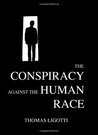
The Conspiracy Against the Human RaceThe Conspiracy Against the Human Race by Thomas Ligotti
My rating: 5 of 5 stars

Years of meditating and reading books on philosophy, psychology, years of lucid dreams and night terrors, do not make a person unique. But it is singularly unique to find what feels like your own thoughts reflected back at you when you didn't pen them. As I read The Conspiracy Against the Human Race, I had a strange feeling, as if deja vu and vertigo had somehow been blended together. Had I read this before, if I hadn't written it?

Yet that disturbing familiarity regards an utterly useless process. Reading or writing about philosophy has long had a negative connotation in the United States, thanks to a long anti-intellectual culture in some corners. But here the useless, and indeed the negative, have an absolutely finality that have nothing to do with anti-intellectualism. This is ontological uselessness, the nightmare of being.

Ligotti's core thesis  the self as we know it is a contrivance of evolution, self consciousness an accident. To be deceived into thinking we are a self, that's the situation we find ourselves in, without hope of reprieve or reprisal. Of course, he isn't the first pessimist to set pen to paper, but he is the first to do so starkly, with such uncompromising clarity, without back pedaling or that ultimate cop out, the happy ending, “it was all a dream.”

There is a certain intentional irony here, as indeed our waking lives are a type of dream, and the self we grant some sense of ultimate reality is nothing other than a character in that dream. But to the extent anything is real, that dream character's suffering is legitimate.

Our choice as he sees it is simple — self deception, or insanity. He shows us the basis of horror, rooted not in the supernatural beyond, but much closer to home. It stares back at us in the mirror. The supernatural in a sense gives us a glimpse of our own uncanny ghoulishness, without requiring identification with the absolute truth of the matter. We can close the book, and shake off that chill, for after all, it was just a story.

But this is not merely a thought experiment. It isn't satirical hyperbole, like A Modest Proposal. There is no hope or happy ending to soften the blow. Because the game of life is all fixed anyway, it couldn't matter less if you deceive yourself and write this book off as pessimistic belly aching. Whatever it takes to get you through another day, and prop up the illusion that you are a self in the first place.

Although some may argue about what constitutes “serious philosophy”  as Ligotti himself says, he eschews the circuitous argumentation that generally grants a work that unapproachable aura of seriousness  I would argue that this book belongs within any introductory study of nihilism and even post-modernism. To do so I'd like to demonstrate what I mean. Those purely interested in The Conspiracy Against The Human Race may as well stop here, but I believe this claim demands a little context and backtracking. You'll forgive me if I need to broaden the scope to come back to task.

Monday, June 09, 2014

Game of Thrones : "Some Weird Ritual of Self Flagellation"

Now that Game of Thrones is officially HBO's most popular show, I think it's fair to look at the show not just in terms of its own narrative, but in terms of the "phenomenon" it may stand to represent. So perhaps we can say a judgement of the show is in fact a judgement of ourselves. To a small extent, that's fair enough.

So, what can we see in that? To start with, I think HBO got "gritty" right with True Detective; it's bleak and realistic in its way but then just when you think it's all darkness you see what the point was all along. Meaning demands some kind of contrast even if the moral center is totally subjective. If there's no light then it all becomes senseless barbarism. That is in fact one of the takeaway points of the final scene of season 1.

Game of Thrones does something else entirely. I went from being fine, even happy with not investing in the stereotypical fantasy meta-narrative, the good guys on a quest or whatever, to just feeling like the entire point of the show is to antagonize the audience and slap your hand whenever you follow such "conventional" thinking as "maybe we can get through tonight's episode without the one character I care about at this point not getting raped?"

I'll still probably watch it at some point because I do like eschewing ideological cliche and seeing how they are playing with that. If only the process didn't feel like some weird cultural ritual of self flagellation. Like is this culture really hung up on punishing any thought of human kindness and genuine contact or what? How many torture scenes can you watch, how many hopes and lives pointless crushed, before you go from "we get it, life sucks and never works out" to admitting you're actually just punishing yourself and using the show as the straight razor.
And if that kind of mirrored social commentary is intentional then it's genius but I'm not sure they don't just want to show titties rake in cash and give the world the middle finger and all the rest is just incidental

[Take a Trip with us... Mythos Media.]

Wednesday, June 04, 2014

Words of Traitors added to Powell's Books "Short List"


"This is a brutal, darkly funny, and, above all, honest collection of short stories crafted especially for lovers of physical books. Illustration styles and even typeface are carefully matched to enrich the unique narrative experience of each tale. Words of Traitors is a work of art unlike anything you've read before."
Recommended by Brian S., Powells.com
Check it out
Note: Words of Traitors is a limited full color short story collection which includes several stories that have been since integrated (along with 404 Documents) into a single edition of Party At The World's End to be released autumn 2014.

[Take a Trip with us... Mythos Media.]

Friday, April 04, 2014

The Hope We Seek (review)


The Hope We SeekThe Hope We Seek by Rich Shapero
My rating: 3 of 5 stars

It was an interesting coincidence that the publisher for "The Hope We Seek" offered an ARC right around the time when my general research was leading me back to the history and myth of the American West. This book fits very soundly within the current, as it is essentially an exploration of those symbols--mining, in some sense, for an American myth, rather than gold.

The prose is at its best when it describes the land itself as an outpouring of the human spirit; at times the craft actually reaches the sublime that the author is clearly reaching for throughout. However, the flip side of this is that at times it feels as though we aren't so much coming along on the journey as watching someone else's religious experience from afar. That goes a way toward saying that my experience of the book is that it isn't nearly as gripping or even interesting as it is good -- and this raises a big question for me of what "good" even means, in this context.

But that question will have to wait for another day. I applaud the effort invested in plumbing the shared psychological history of hope and loss which represents not only the best and worst of the West, but also all of our own personal journeys. That it doesn't seem to speak to the heart as much as it seeks, however earnest the effort seems, is the only flaw in what might otherwise be a five star effort.

View all my reviews

[Take a Trip with us... Mythos Media.]

Saturday, September 07, 2013

Blood Oaths of the New Blues

Awhile back I interviewed James Jackson Toth from Wooden Wand, some 3 years now I suppose, when the Death Seat album came out. I was in a sort of journalistic Swans cycle, having talked with James Blackshaw regarding his album All is Falling, it may or may not have been before or after I spoke with Michael Gira regarding the release of My Father Will Guide Me Up a Rope to the Sky. Point being Gira as producer was a key in all the interviews, and further point being I was so turned around at the time that I couldn’t tell you where my notes are from the conversations or if I took any in the first place.

From what I remember of the conversation with Toth, and from what I know from his music, it really doesn’t matter where the notes are, or really what we talked about. I didn’t get a chance to publish the review or interview, and either one wouldn't really suit what he’s doing anyway. We get so used to consuming commercial crap, and as journalists, or whatever writing is these days, we get so used to following set formulas for presenting it, that the real meaning and humanity is thrown into the gutter.  Just take a look at this snarky bit of back-handed complimentary garbage that Pitchfork thinks is a fitting response to someone's creativity, the reviewer, Grayson Currin, even busts out the tired old "shaman" shtick: Bullshit Pitchfork Review.

This man is a musician in the classic sense, as Gira puts it, “you should be grateful. His songs are beautiful, indisputably, both musically and lyrically, and they’ll give you joy if you listen to them. In my view, he’s a great American songwriter in full bloom.”  With the way things are these days, you might have forgotten that America could make those anymore they’re so rare.

Great songwriters provide you with places to go, and color where you’re at. I remember a strange night in the hotel bar of the Millennium across the street from the Rhine Research Center. I’d been sitting with John Kruth, Director of the Rhine, and Russell Targ, the father of Remote Viewing, talking about politics and cats. When they headed out to dinner, I was left alone, realizing that the wonderful world of psychical research that I’d been swimming in for a few days was not as glossy now that I was sitting there alone with a drink in my hand.

As I looked around at all the strangers, I realized I was a weird, hack writer who could at best turn the experience into an anecdote, and at worst, and more honestly, was quite desperately alone in the crowd.  It was then that James Toth sang to me:
“A hotel bar in the sky, where even your honesties are full of white lies...side by side with strangers who barely blink, they reek of loneliness and umbrella drinks…” 
I wasn’t sure if I was next to strangers, or was that stranger, but in either case at that moment, as a raucous wedding party ran rampant in the upstairs ballroom, I deeply connected with “...a soul without friendship may as well die.” 

That bar has seen me sit with a few psychic spies, and every time that song plays out perfectly no matter what the occasion.  The ability to capture the strangeness of that sort of all American situation in an unrelated song is, in my opinion, the mark of a damn good songwriter.

With an outward ease, Toth's music sneaks in subtleties that reveal his mastery goes freak deep into an intentionally hypnotic atmosphere that seems so natural you might pass it over without a second thought. His voice lulls you with the same deceptive simplicity, but he's got a command of tone that puts him right in the room with you, where he could probably take your watch and wallet without much trouble.

The promo copy that Young God sent me has been burnt out, so I bought a new copy of Death Seat in order to burn it out again. His latest release, Blood Oaths of the New Blues, is no less resonant. He’s got a song on here that may be one of the most beautiful, subtle odes to that blackened English angel Jhonn Balance that anyone could possibly write. I do admit to shedding a tear when Balance passed away, and a coil on my stove exploded when Peter Christopherson left on his journey, some strange cthonic connections there, so anyone who can send those much missed lights a bit of love is alright with me.  I’ve had that song on repeat as I write this to remind me I’m writing about a real person who gives a shit about other real people.

To be honest, since I just bought the new album tonight, I can’t really comment on its lasting effect on my life. In my short time listening, however, it’s already soothing me back into reality after a very odd week, which included a meditative stint sleeping on a floor frequented by scorpions in the North Georgia woods, and meeting Elberton, Georgia's Chief of Police after locking my keys in the car during a visit to the Georgia Guidestones, where I also met two vacationing psychic mediums from Indianapolis who told me I had misused my power in a past life and had father issues that I needed to work on.  Again, if a songwriter can speak to that in some way, they’re damn good.

-

David Metcalfe is an independent researcher, writer and multimedia artist focusing on the interstices of art, culture, and consciousness. He is a contributing editor for Reality Sandwich, The Revealer, the online journal of NYU’s Center for Religion and Media, and The Daily Grail. He writes regularly for Evolutionary Landscapes, Alarm Magazine, Modern Mythology, Disinfo.com, The Teeming Brain and his own blog The Eyeless Owl. His writing has been featured in The Immanence of Myth (Weaponized 2011), Chromatic: The Crossroads of Color & Music (Alarm Press, 2011) and Exploring the Edge Realms of Consciousness (North Atlantic/Evolver Editions 2012). Metcalfe is an Associate with Phoenix Rising Digital Academy, and is currently co-hosting The Art of Transformations study group with support from the International Alchemy Guild.


[Take a Trip with us... Mythos Media.]

Monday, August 12, 2013

Murakami's The Elephant Vanishes

The Elephant VanishesThe Elephant Vanishes by Haruki Murakami
My rating: 5 of 5 stars

Murakami manages to keep the mind riveted in ways that I don't even fully understand. If most of these stories were pitched to me as an editor, I'd think they were somewhere between banal and stupidly fanciful in the way of a story that a seven year-old might tell. But in his hands, they're transfixing. They'd be transfiguring as well, except that sometimes he leaves you with so little to hold on to at the end of a piece that you're left just with a feeling like "what just happened?"

But then you come back to it a month or ten later and realize that it was transfiguring, and that oftentimes we are the last to know, when it comes to our own change. It is just more subtle than, say, an acid trip, which might grab your head and force you to look at what you'd rather not.

As a writer, I had long thought that the central method of the short story was the revealing, twist ending. "Everything was not as it seemed, but here's the big reveal." I'm happy I've had that illusion dispelled. In fact, with most of these stories, it's quite the opposite. Everything is not as you think it is, but you're left not with a revelation but rather a haunting feeling that won't go away. The depth of our uncertainty is itself unfathomable.

That is, maybe, one of the central themes in much of my own work, but it was only made clear when I had a mirror that let me "see around corners," in Jung's terms. That may seem like a leap for some, but you'll find that a Jungian reading of symbols is relevant for much of Murakami's surrealist ("magical") realism, as is discussed somewhat directly in his book Kafka On The Shore.

The bottom line is that if you are looking for a fascinating, troubling,
deep look at banal reality, this is a great opportunity for it.

View all my reviews

Read a translation online of one of my favorite short stories from this collection, Sleep.

[Take a Trip with us... Mythos Media.]

Friday, May 24, 2013

Wittgenstein's Vienna


Wittgenstein's ViennaWittgenstein's Vienna by Allan Janik
My rating: 5 of 5 stars

It is somewhat of a surprise to me, but this may be one of my favorite works of philosophy. The reason why is simple: Wittgenstein's Vienna studies the thought of a particular individual not just on its apparent ground, but also, and possibly more fundamentally, within the context of the culture and history in which it arose. This is something that should be done with many of the thinkers and artists of days past, but Wittgenstein in particular almost demands this treatment.

The proof of this is given in how much he has been misunderstood.

Let me give an example:

"A whole generation of disciples was able to take Wittgenstein as a positivist, because he has something of enormous importance in common with the positivists: he draws the line between what we can speak about and what we must remain silent about just as they do. The difference is only that they have nothing to be silent about. Positivism holds--and this is the essence--that what we can speak about is all that matters in life. Wittgenstein passionately believes that all that really matters in human life is precisely what, in his view, we must remain silent about!" - Paul Engelmann.

I think it has more to do with my stance than some great intellect or anything that my initial reading of the Tractatus -- which in detail I barely understood upon first reading -- is in fact what Wittgenstein had intended, and precisely what many smarter and more famous individuals than myself had completely misunderstood. The last section of the book, which people like Russell though was a sort of throwaway addendum, is in fact the very heart of the matter. And W's later work (touched on in the posthumous Discourses) is not so much a departure from his earlier thought as a clarification about language, which does throw a serious curve ball in regard to the demarcation between that-which-can-be-spoken and that-which-must-be-passed-over-in-silence.

The Tractutus, in other words, is essentially not a work on logic and language, but rather a work on ethics/value/meaning. This thesis is presented very well in Janik and Toulmin's book, and their methodology is such that it wound up being one of the central books in our first investigation of myth, "The Immanence of Myth." (Weaponized.)

View all my reviews


[Where is the fucking counterculture? Mythos Media.]

Saturday, April 27, 2013

Our Kind (Book Review)


Our Kind: Who We Are, Where We Came From, Where We Are GoingOur Kind: Who We Are, Where We Came From, Where We Are Going by Marvin Harris
My rating: 4 of 5 stars

Marvin Harris argues with such an even-toned sense of consideration that he could probably make the outlandish seem plausible. However, that sort of radical sophistry doesn't seem his aim in this work. Rather, he lays out the varied topics of cultural anthropology along with his thoughts on those matters in a casual way that eschews even the radical framing of his Cannibals and Kings. I found all of his points both worth making and quite possible, even if there is always plenty of room to be incorrect in such matters, no matter how sensible you may sound. (Nor how correct your argument may be -- nature observes no particular need to heed all elegant arguments.)

Regardless of the relative "age" of this book, it is still in my opinion a must-read in any introductory course (academic or otherwise) dealing with the issues of the overlap of culture, biology, evolution, and environment.

View all my reviews

[Where is the fucking counterculture? Mythos Media.]

Friday, March 01, 2013

Tideland (Movie Review)

by James Curcio
(First run on Alterati.)


It can be easy for us to forget just how surreal and terrifying childhood really is.

Like in adult life, the fantasies that we invent allow us to interact with a chaotic world that is beyond our control, and often beyond our understanding. They can protect us from trauma, and serve as an intermediary between our inner world, of dreams and emotions, and an outer world.

This kind of ‘magical thinking,’ roleplaying, and fantasy is considered healthy for children. Without it, we would have a difficult time forming opinions, or indeed, cogent selves.

However, with adults, these fantasies are often considered delusions. They aren’t real, we say. But who is to say that what we experience is not real, or that something isn’t real simply because it isn’t what it appears to be? And is the line between childhood and adulthood, as it is commonly considered, the transition from fantasy to reality? Where does one begin and the other end, and what do we lose when we cross that foggy bridge?

In his movie adaptation of Tideland, Terry Gilliam brings us gracefully into the world of Jeliza-Rose, where we are forced to confront many of these difficult questions.

Wednesday, January 23, 2013

Review of "At the Crossroads; An Astrologer Looks at these Turbulent Times"

By Brian George

“The first man must have seen auguries everywhere, he must have trembled at each step that he took.”—Giorgio de Chirico, 1913
__

I was a great admirer of Jessica Murray’s book “Soul-Sick Nation; An Astrologer Looks at America,” which I regard as one of the most incisive, intuitive, and provocative analyses of the escalating crises faced by the US in the first decade of the 21st Century. I eagerly awaited her next book, “At the Crossroads; An Astrologer Looks at these Turbulent Times,” which was published in June of 2012. In the months that I have been savoring this work, again and again I have found myself—quietly—exclaiming, “Of course, of course, that’s it!” When an author is able to enter into the secret chambers of the Zeitgeist, it is as though she is also reading your own deepest fears and dreams and thoughts.

Murray refers to herself as an “archetypal astrologer”: Astrological transits are analyzed less in terms of their purely personal and predictive aspects and more in terms of the alchemical challenges that they pose. She writes, for example, ““As the transit of Neptune (spiritual yearning) to the US Moon suggests, beneath America’s panic about the economy is a malaise that has nothing to do with the material world. Clients who visit an astrologer these days and insist that all they want to talk about are ‘practical’ issues like their 401Ks are missing the point. As distressing as the financial facts are, the deeper issue is of psycho-spiritual health.” Astrology is predictive, yes, but this has to do with the arrangement and rearrangement of archetypal scenery on the stage. Every stage-set is provisional, and we act within a tiny cone of light, beyond which we must learn to see.

At each moment, a particular thing is waiting to occur—like a half-formed sentence in the unconscious of a writer—yet it is we who must translate impulse into action, and, by pulling a focused image from the Rorschach blot of forces, determine what this moment means. “Astrological archetypes work as an interpretive schema because ‘real life,’ just like dream life, is a flow of symbols. An angry dog barking at you on the day of a Mars transit is a symbol. So are big collective happenings like political movements, oil spills, and tsunamis.” As in a dream, each image has both an inner life and a certain open-endedness: The dream comes fully into existence only as we tell the story of it, which we are simultaneously in the process of enacting in our lives. I would refer to this as the primordial mode of vision: No event is so trivial that it cannot be seen within the context of an archetype. Conversely, no archetype is so great that it has ceased to have a moment by moment involvement—and even, perhaps, interest—in our actions.

Tuesday, July 03, 2012

The Forbidden Book - A Review

"...the magician of (Giordano Bruno’s) De vinculis is the prototype of the impersonal systems of mass media, indirect censorship, global manipulation, and the brain trusts that exercise their occult control over the Western masses."
- Ioan Couliano, Eros & Magic in the Renaissance

For those uninitiated into the magical roots of heroism, Disinfo Books (now a division of Red Wheel/Weiser/Conari) recent publication of The Forbidden Book provides an interesting thought experiment dealing with the political and psycho-social intricacies of the heroic ideal and traditional philosophy of magic. Originally published in a Spanish language edition by Roca Editorial in 2007 as El Libro Prohibido, Guido Mina di Sospiro and Joscelyn Godwin’s novel is an important meditation on the potential political implications of esoteric practice.

In The Forbidden Book we are introduced to the Riviera della Motta family, an aristocratic family whose line has dwindled to three heirs, an uncle, Baron Emanuele Riviera della Motta, and his two nieces, Orsina Riviera della Motta and Angela Riviera della Motta. They are the last vestiges, in the imaginal world of the novel, of a lineage of Hermetic alchemists begun by Cesare Della Riviera, whose work entitled "Il Mondo magico de gli heroi" (The Magical World of the Heroes), was popularized, in our reality, by the 20th century Italian Magus Julius Evola.

Thursday, July 22, 2010

Cannibals and Kings


Cannibals and Kings provides a great deal of compelling anthropological thought; it focuses on a systemic view of the ebbs and flows of culture, and has been quite a mind-fuck for me, as I've been reading it in stops and starts alongside Manuel De Landa's A Thousand Years of Nonlinear History. Harris' style is dry but concise, and considering that dryness it is surprising what a quick read this is proving to be. (1000 Years of Nonlinear History, on the other hand, may take me about 1000 years to finish.)

I won't reiterate the central thesis of the book, as it is easy to find on the net. I will say this: a central conceit of this book, and many other works of (theoretical) anthropology that I've encountered, is the premise that there is some intention lying behind the large-scale endeavors of man. Though many of the ebbs and flows discussed in this book-- as one method of production and consumption is outmoded by population increases and so on-- can be understood to operate almost like a thermostat, lying underneath his arguments is the idea that there is something intelligible, something orderly, something sensible in macro- scale human behavior. I'm not saying I agree with this premise, or disagree. I don't honestly see a way that we can know one way or the other. But it's the invisible hook you have to swallow to follow him where he wants to take us. (I was going to say "implicit hook" but I really don't know how a hook can be implicit.)

Purchase book.


Monday, December 15, 2008

This Is Your Brain On Anime (Paprika review for TLAblog)


There is a story of the Chinese sage Zhuangzi that goes:
"Once Zhuangzi dreamt he was a butterfly, a butterfly flitting and fluttering around, happy with himself and doing as he pleased. He didn't know he was Zhuangzi. Suddenly he woke up and there he was, solid and unmistakable Zhuangzi. But he didn't know if he was Zhuangzi who had dreamt he was a butterfly, or a butterfly dreaming he was Zhuangzi. Between Zhuangzi and a butterfly there must be some distinction! This is called the Transformation of Things."


Though on its face this may seem an almost childish idea to most, if you have ever experienced a lucid dream, or if you really pay any attention at all to your inner life, you may come to realize that there is truth to it. What is more, there is a real terror that can accompany realizing that the ground we stand on, at least figuratively speaking, is not solid. All experience is simply experience, whether it involves balancing your checkbook or talking to the monk levitating above a colossal, marching procession of cymbal-crashing frog men.

Many movies have dealt with this idea. (The Science of Sleep and Vanilla Sky are the first two that come to mind that do it any justice, but there are many more.) However, few have done it with such a brilliant flare for the surreal as Satoshi Kon's Paprika. Like his previous film, Perfect Blue (review here), the animation is top notch, and the script solid, though even the best animes tend to be a little stilted in translation. He also utilizes many of the same techniques in both movies, including breaking that fourth wall nearly every scene. In the case of Paprika, these techniques are being applied for a different purpose, and I would say they are done somewhat more gracefully.

(Read full article on TLA Attacks The Movies.)

Friday, October 10, 2008

Recent review of Fallen Nation: Babylon Burning

Modern Collective Unconscious by Amos Lassen

"Fallen Nation" is a trip like none you have ever taken. Paranoia is common, dreams haunt, and ends mean beginnings. The book explores modern culture and pays attention to hidden effects such as complacency, popular cynicism, and lack of diversity, escapism, and irony. The characters search for a better and more humane way of living. Several try to reform the obscure nature of what reality is and while doing so, they are forced to look at their own selves and the way they think and function.
It seems to me that the book is about becoming more individual and losing the belief that we all want to be like everyone else. Curcio shows what will happen if the infrastructure of our world crumbles. He gives no answers because there are none. This is a novel about warfare between and within cultures and knowing which battles are to be waged and which not.
Curcio's writing is unique and special and really fun to read. He is not always easy to understand but, once read, he brings us great rewards."

Order
Fallen Nation: Babylon Burning on Amazon.com

Wednesday, October 01, 2008

Too Clever By Half


"I'd like to share a film with you that I think is, on the whole, highly underrated. "Too clever by half," as a friend of mine put it. That film is Kiss Kiss, Bang Bang.

But before I discuss the movie directly, let me unpack the idiom. Many people seem to feel that if something is "too" clever, "too" smart, it's an affront to their common sense, an assault upon their salt-of-the-earth dignity. I don't know if this belief carries across cultural boundaries, but it seems endemic enough in the states that it even determines the results of elections. The Republican party has made this issue a corner-stone of their assault upon the "liberal elite," a fact well recognized and explored by Sorkin's own "too clever by half" drama, The West Wing.

I'm not entirely sure when being witty became a negative, frankly I don't care. Maybe this just makes me another member of the "liberal elite." But if you're not offended by self-aware satire and snarkiness, you'll likely find Kiss Kiss, Bang Bang one of the most entertaining, funny movies you've seen."

(Read review on TLAblog)

Tuesday, September 02, 2008

SmallPress review of Fallen Nation

"Fallen Nation: Babylon Burning (Mythos Media 2007) is the type of revolutionary fiction that may inspire you to take a visionary road-trip across the South-West searching for the America you’ve only heard about in rock ‘n roll songs or saw while under the hallucinatory influence of some illicit substance and/or the works of Philip K. Dick, Thomas Pynchon, Hunter S. Thompson, and comics instigator Grant Morrison. An impressive hybrid of words, illustrations, photography, pseudo-interviews, and one well-drawn comic strip, Fallen Nation: Babylon Burning’s storytelling both entertains and educates. The latter may immediately turn off the “I’ll learn when I’m in school, thank you very much” crowd, but author James Curcio is by no means preachy when he shares with you his knowledge of philosophical concepts. The author, after all, who holds a B.A. in Philosophy from Bard College, is creatively applying his education to his fiction. Not to digress, but it is not very often that we see a writer effectively reap the fruits of a liberal arts education through the lens of prose as Curcio successfully has done with a confident understanding that intelligent ideas, both classical and contemporary, still have a voice and meaning applicable to perhaps the last undiluted and uncensored of print mediums – the novel."

Read the full review.

Sunday, April 06, 2008

Fallen Nation review on Spiral Nature


I just saw that they did a review on Spiral Nature of Fallen Nation: Babylon Burning, after all. I would nit-pick some of the details (such as classifying it as "occult fiction," I took many pains to make this particular book work just fine for people with little or only passing knowledge of the occult; the autobiographical elements in this book are painted with such a broad brush in this one that it is very nearly entirely fiction, and so on), but it is nice to see someone actually summarize the plot fairly succinctly.

I've never lied about this: I'm god awful at plot synopsis. So far as I'm concerned, plot is something that happens as a result of the characters thinking, wanting, fearing, desiring, and then the ways that those things play out in the world around them and come in conflict with one another. Plot is incidental, and being told the plot of a movie or book tells me so little about whether I'll actually get something out of it or not that I usually don't much care. But I acknowledge that there are few who see eye-to-eye with me on that one, it has most certainly been a thorn in my side with publishers and promotion alike, so- if you're looking for a very basic synopsis of the plot, thank God, here you go:


------------------------------------------------------------------

Fallen Nation James Curcio’s second book, takes up where Join My Cult! left off. Agent 139 and Jesus are in a maximum security mental institution held as suspected terrorists after a restaurant was blown up in the previous novel. Agent 139 wryly comments:

“Bottom line: ideas don’t count for a whole lot in this world, but on their own, they’re mostly benign. Ideals on the other hand can get you a special jacket with one sleeve. Ideals can get you shot.”

Agent 506 breaks them out via mysterious means, and, after a brief visit with Agent 140 fits them with a van tailored with all the tricks and tools they’ll need, the three of them set off on their way to new adventures. They soon pick up a hitchhiking guitarist and decide to form a band, Babalon. The van serves as a tour bus as they pick up groupies and collect followers, making waves wherever they go.

“I like the sentiment of anarchy, but you’re idealizing it. In a world of so many conflicting cultural signals, each person’s idea of what social responsibility is, and how it should be enacted differs. When there is differing opinion, there is conflict. When there is no difference of opinion, there is absolute fascism. Take your pick. The freedom of this ideal turns quickly into the lowest common denominator, the law of the jungle, as people’s priorities and ideals clash with one another. This is exactly how the world is right now, and how it has always been – the war of all against all…You want anarchy? You already have it. In disguise. Anarchy’s always been, and always will be.”

A government agent is charged with the task of eliminating Babalon, perceived as a threat to the status quo by Those In Charge. Cultural warfare becomes more than abstract theorizing when things escalate in a desert battle pitting agent against agent.

(Full review.)

LinkWithin

Related Posts Plugin for WordPress, Blogger...