I've been doing a great deal of research and thought toward The Glorious Revolutions series we've been running over on Rebel News. Much of this kind of work occurs behind the screen. For instance, the rough document for the first two essays was over 20,000 words long, while the essays themselves wound up being about 1,500 words a piece. Similarly, each required the reading of 5 to 10 books. (In addition to whatever was ready at hand from past reading, with a little Internet refreshing.)
So... it's a process. But the next one I have planned has had me held up for a while. I've had a few conversations that have helped me spell out where I'm stuck, which have been both illustrative and interesting, so I wanted to share one here, while I continue to mull it over...
Showing posts with label politics. Show all posts
Tuesday, October 20, 2015
Monday, April 27, 2015
Debord on Riots
Posted by
Unknown
From Situationist International:
AUGUST 13 - 16, 1965, the blacks of Los Angeles revolted. An incident between traffic police and pedestrians developed into two days of spontaneous riots. Despite increasing reinforcements, the forces of order were unable to regain control of the streets. By the third day the blacks had armed themselves by looting accessible gun stores, enabling them to fire even on police helicopters. It took thousands of police and soldiers, including an entire infantry division supported by tanks, to confine the riot to the Watts area, and several more days of street fighting to finally bring it under control. Stores were massively plundered and many were burned. Official sources listed 32 dead (including 27 blacks), more than 800 wounded and 3000 arrests.
Reactions from all sides were most revealing: a revolutionary event, by bringing existing problems into the open, provokes its opponents into an unhabitual lucidity. Police Chief William Parker, for example, rejected all the major black organizations’ offers of mediation, correctly asserting: “These rioters don’t have any leaders.”
Since the blacks no longer had any leaders, it was the moment of truth for both sides. What did one of those unemployed leaders, NAACP general secretary Roy Wilkins, have to say? He declared that the riot “should be put down with all necessary force.” And Los Angeles Cardinal McIntyre, who protested loudly, did not protest against the violence of the repression, which one might have supposed the most tactful policy at a time when the Roman Church is modernizing its image; he denounced “this premeditated revolt against the rights of one’s neighbor and against respect for law and order,” calling on Catholics to oppose the looting and “this violence without any apparent justification.”
And all those who went so far as to recognize the “apparent justifications” of the rage of the Los Angeles blacks (but never their real ones), all the ideologists and “spokesmen” of the vacuous international Left, deplored the irresponsibility, the disorder, the looting (especially the fact that arms and alcohol were the first targets) and the 2000 fires with which the blacks lit up their battle and their ball.
But who has defended the Los Angeles rioters in the terms they deserve? We will. Let the economists fret over the $27 million lost, and the city planners sigh over one of their most beautiful supermarkets gone up in smoke, and McIntyre blubber over his slain deputy sheriff. Let the sociologists bemoan the absurdity and intoxication of this rebellion. The role of a revolutionary publication is not only to justify the Los Angeles insurgents, but to help elucidate their perspectives, to explain theoretically the truth for which such practical action expresses the search.
...
Through theft and gift they rediscover a use that immediately refutes the oppressive rationality of the commodity, revealing its relations and even its production to be arbitrary and unnecessary. The looting of the Watts district was the most direct realization of the distorted principle: “To each according to their false needs” — needs determined and produced by the economic system which the very act of looting rejects. But once the vaunted abundance is taken at face value and directly seized, instead of being eternally pursued in the rat-race of alienated labor and increasing unmet social needs, real desires begin to be expressed in festive celebration, in playful self-assertion, in the potlatch of destruction. People who destroy commodities show their human superiority over commodities. They stop submitting to the arbitrary forms that distortedly reflect their real needs. The flames of Watts consummated the system of consumption. The theft of large refrigerators by people with no electricity, or with their electricity cut off, is the best image of the lie of affluence transformed into a truth in play. Once it is no longer bought, the commodity lies open to criticism and alteration, whatever particular form it may take. Only when it is paid for with money is it respected as an admirable fetish, as a symbol of status within the world of survival.
All It Takes Is The Right Story. Mythos Media
Monday, April 23, 2012
No sympathy for the creative class
Posted by
Unknown
I don't usually post article stubs on Modern Mythology - normally this site features originally written content, which is why posts tend to come in flurries and then dry up for a while - but this article is really worth reading. I have little to add other than my agreement, as an independent artist living and working (sometimes with any pay) in the US.
It is worth reading, in its entirety.
[Check out some of the books, albums, and soon movies produced by Mythos Media and our various media partners.]
It is worth reading, in its entirety.
Of course, those who continue to work in the creative class are the lucky ones. Employment numbers from the Bureau of Labor Statistics show just how badly the press and media have missed the story. For some fields, the damage tracks, in an extreme way, along with the Great Recession. Jobs in graphic design, photographic services, architectural services – the bureau’s phrasing indicates that it is looking at all of the jobs within a field, including the people who, say, answer the phone at a design studio – all peaked before the market crash and and fell, 19.8 percent over four years for graphic design, 25.6 percent over seven years for photography and a brutal 29.8 percent, for architecture, over just three years. “Theater, dance and other performing arts companies” – this includes everything from Celine Dion’s Vegas shows to groups that put on Pinter plays – down 21.9 percent over five years.
Other fields show how the recession aggravated existing trends, but reveal that an implosion arrived before the market crash and has continued through our supposed recovery. “Musical groups and artists” plummeted by 45.3 percent between August 2002 and August of 2011. “Newspaper, book and directory publishers” are down 35.9 percent between January 2002 and a decade later; jobs among “periodical publishers” fell by 31.6 percent during the same period.
So why aren’t we talking about it?
Creative types, we suspect, are supposed to struggle. Artists themselves often romanticize their fraught early years: Patti Smith’smemoir “Just Kids” and the various versions of the busker’s tale “Once” show how powerful this can be. But these stories often stop before the reality that follows artistic inspiration begins: Smith was ultimately able to commit her life to music because of a network of clubs, music labels and publishers. And however romantic life on the edge seems when viewed from a distance, “Once’s” Guy can’t keep busking forever.
Yes, the Internet makes it possible to connect artists directly to fans and patrons. There are stories of fans funding the next album by a favorite musician — but those musicians, as well, acquired that audience in part through the now-melted creative-class infrastructure that boosted Smith. And yes, there have been success stories on Kickstarter, as well — but even Kickstarter accepts just 60 percent of all proposals, and only about 43 percent of those end up being crowd-funded.
Our image of the creative class comes from a strange mix of sources, among them faux-populist politics, changing values, technological rewiring, and the media’s relationship to culture – as well as good old-fashioned American anti-intellectualism.
[Check out some of the books, albums, and soon movies produced by Mythos Media and our various media partners.]
Tuesday, October 11, 2011
Contesting "Human Nature": The Psychology of Power
Posted by
Unknown
By James Curcio art by Eugenio Rucuenco.
The Occupy Wall Street movement has taken aim at “the 1%,” but so far there has not been a great deal of consideration given to the culture or psychology of power.
Countering the charged, idealistic cry of the protesters comes the more cynical stance that “there will always be a 1%.” That, perhaps, it is human nature to claw our way to the "top of the pile," to slay the sitting King and take the throne. Certainly, that is a model we see mirrored in the heroic myths of antiquity.
As a result of our nature, are we forever cursed to live out a narrative of master / slave, of fascist dictator, of oppressor and oppressed? Should we resign ourselves to the "grim meathook future" that seems the inevitable outcome of the myth of the Leviathan, supposing no agents of chaos destabilize the true obsession of fascism? Not control as an end in itself, but rather control as the means to order and homogenization. This is the true face of the New American Century: one of peace secured through violence, possibly tooled atop a myth of racial purity.
The Occupy Wall Street movement has taken aim at “the 1%,” but so far there has not been a great deal of consideration given to the culture or psychology of power.
Countering the charged, idealistic cry of the protesters comes the more cynical stance that “there will always be a 1%.” That, perhaps, it is human nature to claw our way to the "top of the pile," to slay the sitting King and take the throne. Certainly, that is a model we see mirrored in the heroic myths of antiquity.
As a result of our nature, are we forever cursed to live out a narrative of master / slave, of fascist dictator, of oppressor and oppressed? Should we resign ourselves to the "grim meathook future" that seems the inevitable outcome of the myth of the Leviathan, supposing no agents of chaos destabilize the true obsession of fascism? Not control as an end in itself, but rather control as the means to order and homogenization. This is the true face of the New American Century: one of peace secured through violence, possibly tooled atop a myth of racial purity.
Tuesday, September 20, 2011
Occupy Wall Street: Civil War or Smokescreen?
Posted by
Unknown
By James Curcio
As many of you know by now, #occupywallstreet is going strong. Or, at least, a couple hundred more people are living on the NYC streets for the time being.
An Ampedstatus headline reports, "Full-Blown Civil War Erupts On Wall Street: As Reality Finally Hits The Financial Elite, They Start Turning On Each Other",
Rather than seeing one event, we are seeing our own wishes and fears projected on top of whatever this event may be. This, of course, is the frame of reference regarding the ubiquity of our narrative which is our bread and butter here on Modern Mythology. So let me propose the idea that our reaction to the 'non'-event of the Wall Street protest is a function of ourselves, a mirror. It is ideology itself that seems to drive the almost performance-art aspect of protests. Here's a clip from earlier today, showing a throng of cops and protesters, and the actions leading up to an arrest-
![]() |
| Wishful thinking |
An Ampedstatus headline reports, "Full-Blown Civil War Erupts On Wall Street: As Reality Finally Hits The Financial Elite, They Start Turning On Each Other",
"Finally, after trillions in fraudulent activity, trillions in bailouts, trillions in printed money, billions in political bribing and billions in bonuses, the criminal cartel members on Wall Street are beginning to get what they deserve. As the Eurozone is coming apart at the seams and as the US economy grinds to a halt, the financial elite are starting to turn on each other. The lawsuits are piling up fast. Here’s an extensive roundup:
As I reported last week:"Goliath On The Ropes, Big Banks Getting Hit Hard, It’s A “Bloodbath” As Wall Street’s Crimes Blow Up In Their Face"
Time to put your Big Bank shorts on! Get ready for a run… The chickens are coming home to roost… The Global Banking Cartel’s crimes are being exposed left & right… Prepare for Shock & Awe…"Full blown civil war? Really. How about full blown posturing? Some of the content in that post is interesting, but aside from the link-baiting in the title, little of it seems to have to do with the protests themselves, let alone any sort of civil war, between the banks or anyone else. That is not a phrase to use lightly. Let's take a look at a reasonable opinion from the other side of the revolutionary think-tank...
Anarchists and radical organizers have a bit of collective amnesia with regards to the “Battle of Seattle.” The kids in black bandanas were only a very small part of the coalition that shut down the city in October, 1999. Their acts of childish violence against a Starbucks may have become the lasting public image of the event, but they were hardly representative. The bulk of that anti-globalization protest was composed of labor unions, environmentalists, and other organized progressives. All of those groups have deep traditions based in the community organizing traditions of Saul Alinsky and Cesar Chavez. The real work of organizing bears little resemblance to the attention-grabbing “culture jammers.” The real work involves “talking to one person, then talking to another person, then talking to another.” Organizing is slow, difficult, often thankless, but deeply meaningful work. There are “rules,” you see, even for radicals.
Some of these points should be well taken, both by the enthusiastic, fresh-faced youth and by the older jaded activists that lived through the high-water mark of the 60s that Hunter S Thompson refers to in Fear and Loathing:
Rather than seeing one event, we are seeing our own wishes and fears projected on top of whatever this event may be. This, of course, is the frame of reference regarding the ubiquity of our narrative which is our bread and butter here on Modern Mythology. So let me propose the idea that our reaction to the 'non'-event of the Wall Street protest is a function of ourselves, a mirror. It is ideology itself that seems to drive the almost performance-art aspect of protests. Here's a clip from earlier today, showing a throng of cops and protesters, and the actions leading up to an arrest-
Monday, September 05, 2011
Debunking the New World Order Mythology
Posted by
Rusty Shackleford
"When you define the power elite as somebody else, I regard that as a loser's script. I define the power elite as myself and my friends. " -Robert Anton Wilson
By Rusty
I am fully aware of how unpopular writing this will make me. So be it. And let's not pretend I really have very much popularity in "real life" anyway, when most people just seem to look at me with a puzzled or quizzical expression or blank stare and ask me "So, what is it you REALLY do for a living?"
Nor do I have many real friends in "make believe internet land", where most people tend to think I am either some weird kind of legend, an honest-to-god alter ego cultivated by a completely insane person, or worse. So it goes. Please continue to keep an open mind as you read this, and remember to not believe anything just because I say it. It is entirely possible my agenda is diametrically opposed to yours and I am feeding you a line of bullshit. You MAY want to operate under the assumption that this is true of everyone, all of the time, unless this notion causes you to feel powerless and to slip further into self-sabotaging paranoia. As you will.
Lately, the hive mind has been crackling with transmissions via blogs and social networking regarding fascism and corporate police states, abuses of power, and notions, some of which are realistic and some of which clearly aren't, as to who is responsible. Listen: What I am about to tell you may sting, but there is no "New World Order" other than you. You, yourself. You are the New World Order, you are the conspiracy, for better or for worse. Allow me to explain.
The Hopi Indians predicted that there would be a fifth age. This new age they termed the age of "spirit" or of "ether". According to their timeline, and also the timeline of the Mayans and the timeline of the Hindu peoples, December 21, 2012 is roughly the spot in which the current age we are inhabiting transitions into something radically different.
The Hindu people termed the age in which we currently live to be the Kali Yuga. Traditionally, this is viewed by many people to be negative but in the grand scheme of things it is a stepping stone or transitional period to a new age. The Kali Yuga itself refers to a period in which humanity is preoccupied with greed, spiritual ignorance, superstition, bigotry and emotional poverty. Conquering seems to be the overall goal, and multiplying and replicating without any real motive other than to grow and to consume (much like a cancer) seems to be the overriding value of human conduct.
Enter 2012. Many are already aware of the Mayan prophecies concerning a new era, but some may be unaware of the correlation between this and what the Vedic scriptures considered to be the dawn of a new "Golden Age" for humanity. This new age was predicted to be the end of the Kali Yuga or the age of iron and the beginning of the new Golden Dawn of enlightenment for humanity.
Alternately, we see the Hopi Indians predicting much of the same, although there is an admonition and a warning: We collectively as a species can choose to make this "new age" one of enlightenment, one of freedom and beauty, or we can choose to further descend into bickering, extremely polarized left or right wing political ideology, petty in-fighting and bigotry (religious or otherwise.)
Tuesday, July 19, 2011
Ex nihilo nihil fit: Heidegger's Vacuuity and False Vacuum Decay
Posted by
Prof. Rowan

By Prof Rowan
There's no denying that Heidegger was a member of the National Socialist party. The controversy over Heidegger's association with the Nazis is now well-known and all too often used as an excuse, a shortcut, to dismiss his philosophy out of hand with the phrase “well, you know, he was a Nazi!” A recently published book (Heidegger: The Introduction of Nazism into Philosophy (2005), by Emmanuel Faye) has even made the utterly moronic argument that his philosophical work is so thoroughly contaminated by party ideology that his books ought not to be taught as philosophies but rather as “hate speech.” Look, I loathe Heidegger even more than I do Sartre, and I reject his philosophy as emphatically as anyone, but for various reasons and according to arguments more valid than merely calling him a Nazi. [1] The very existence of Godwin's law testifies to the fact that to do so amounts to little more than ad hominem and one that is widely taken to indicate the absence of a better argument, and in the case of Heidegger's “philosophy” there is no shortage of them.
The final section of the newly published English translation of Hans Blumenberg's Care Crosses The River (1987, English Translation 2010), “Dasein's Care,” contains several suggestive and compelling criticisms, including the following:
Perhaps no one has ever shuddered, as if before a yawning abyss, on being asked or asking themselves whether the world in which we live, experience, and gain knowledge really exists... In opposition to many opinions that want to view this question as the core of modern philosophy, it must be insisted that none of the imaginable answers had any consequences. In each case, everything remained the same. Indifference in the face of what looks to be such a hard problematic already sees that nothing will come of it, because nothing can come of it. (Blumenberg 141-2) [2]
![]() |
| Hans Blumenberg is Awesome |
Wednesday, June 15, 2011
Revolution and Notes From The Underground
Posted by
Unknown
By James Curcio
I've written some about how Euripides' The Bacchae was an early inspiration in the writing of Fallen Nation. However, there are many more, some of which have only become more clear to me at the end of the writing process. I'm not sure exactly how that works, but I've found time and again that I stumble upon something that seemed to inform a project I was working on, which I was in the past only loosely aware of... and now I've finished the thing and suddenly these cultural pointers are there, tangible to me as my hand.
So this leads me to ask if any of you know about the Weather Underground? Named after that line from a Dylan tune, ("You don't need a weatherman to know which way the wind blows") the WUO were a "radical left" organization that seemed to use white guilt to crystallize the need for revolution. Not so much on the methodology, but culturally, the forces that created the WUO couldn't have been far from our minds when dreaming up the fictional side to the Mother Hive Brain.
Here is a rather good documentary on the Weather Men which is available free online. Watch the whole documentary on YouTube, it's also available on Netflix On-Demand.
Skilluminati Research has an excellent write up on a figure that had connection with this organization, using more methods sanctioned by the need to counter fascist order with blind chaos, Ronald Stark :
I've written some about how Euripides' The Bacchae was an early inspiration in the writing of Fallen Nation. However, there are many more, some of which have only become more clear to me at the end of the writing process. I'm not sure exactly how that works, but I've found time and again that I stumble upon something that seemed to inform a project I was working on, which I was in the past only loosely aware of... and now I've finished the thing and suddenly these cultural pointers are there, tangible to me as my hand.
So this leads me to ask if any of you know about the Weather Underground? Named after that line from a Dylan tune, ("You don't need a weatherman to know which way the wind blows") the WUO were a "radical left" organization that seemed to use white guilt to crystallize the need for revolution. Not so much on the methodology, but culturally, the forces that created the WUO couldn't have been far from our minds when dreaming up the fictional side to the Mother Hive Brain.
Here is a rather good documentary on the Weather Men which is available free online. Watch the whole documentary on YouTube, it's also available on Netflix On-Demand.
Skilluminati Research has an excellent write up on a figure that had connection with this organization, using more methods sanctioned by the need to counter fascist order with blind chaos, Ronald Stark :
"He had a mission, he explained, to use LSD in order to facilitate the overthrow of the political systems of both the capitalist West and communist East by inducing altered states of consciousness in millions of people. Stark did not hide the fact that he was well connected in the world of covert politics." ("article.)Perhaps this Batman-esque weaponized hallucinogen campaign tickles our wicked imagination, however, when a rebellion is fought as a reaction to violence, violence seems a paradoxical choice. My stance on this issue is not a straightforward one. It's doubtless that not only is there a "time and a place" for revolution, but more importantly, there are times where to do anything but revolt is a crime against one's own humanity. That said, most of the options available to the average citizen amount to petty crime, and are unlikely to result in positive change. As toothless as pacifist rebellion can be, violent rebellion will always spiral out of control or burn itself out, leaving rubble in its wake. We say missiles and bombs can't bring freedom to Iraqis - they can't bring it to Americans, either.
Sunday, May 08, 2011
Against Nostalgia: A Call to Action
Posted by
Prof. Rowan
There is no returning to the past, rather only an overturning. The value of the present cannot be denied or denigrated in the name of a mythic prelapsarian past, no matter how hollow modernity may ring.
There never was a fall.
-Eden?
Try primordial filth.
Was "man" better, morally speaking, from the dawn of time up to the birth of modernity and the machine?
-No. Most emphatically no.
The noble savage is a lie.
Decline, decadence, downfall?
These discredited themes hark back to Oswald Spengler's thesis of a "Faustian Civilization" in The Decline of the West. Long since reputed, this myth has had a long and continuing afterlife in both revolutionary and reactionary forms. There is little difference between the disaffection and pessimism of the left/libertarian strain and the diagnoses of decline and decadence of the right/reactionary type. Both see the present and future as hopelessly degraded and get off on nostalgia for a past that's never been.
"The pathos of this work: that there are no periods of decline," declared Walter Benjamin in The Arcades Project, a statement that applies to all of my work.
While I have no faith in "progress" and even less esteem, nay contempt, for the greater part of contemporary culture. I'm too - "honest" I suppose - to romanticize the past or fantasize and construct impossible, truly U-topian, ideals.
All we have is the here and now. We exist in and as part of the world - and thus our every action, even the slightest, must therefore change the world.
Don't like the world as it is?
What are you doing to change it?
Pre-order a copy of The Immanence of Myth, published by Weaponized in July 2011. (Or sign up to be notified of its release on Amazon.com)
There never was a fall.
-Eden?
Try primordial filth.
Was "man" better, morally speaking, from the dawn of time up to the birth of modernity and the machine?
-No. Most emphatically no.
The noble savage is a lie.
Decline, decadence, downfall?
These discredited themes hark back to Oswald Spengler's thesis of a "Faustian Civilization" in The Decline of the West. Long since reputed, this myth has had a long and continuing afterlife in both revolutionary and reactionary forms. There is little difference between the disaffection and pessimism of the left/libertarian strain and the diagnoses of decline and decadence of the right/reactionary type. Both see the present and future as hopelessly degraded and get off on nostalgia for a past that's never been.
"The pathos of this work: that there are no periods of decline," declared Walter Benjamin in The Arcades Project, a statement that applies to all of my work.
While I have no faith in "progress" and even less esteem, nay contempt, for the greater part of contemporary culture. I'm too - "honest" I suppose - to romanticize the past or fantasize and construct impossible, truly U-topian, ideals.
All we have is the here and now. We exist in and as part of the world - and thus our every action, even the slightest, must therefore change the world.
Don't like the world as it is?
What are you doing to change it?
Pre-order a copy of The Immanence of Myth, published by Weaponized in July 2011. (Or sign up to be notified of its release on Amazon.com)
Monday, April 11, 2011
A Rupture in the Continuum of Time: To Transcend Without Transcendence (kairos)
Posted by
Prof. Rowan
The essay entitled “In the Time of Fascist Desire,” written during my first semester of graduate study, was not only significant as the first time the problematic of kairos took center stage in my work. Rather, the task of “the constructing a secular concept of kairos” answered to the exigency of proposing an answer to the following question posed by Deleuze & Guattari in A Thousand Plateaus:
What makes fascism dangerous is its molecular or micropolitical power…only microfascism provides an answer to the global question: Why does desire desire its own repression, how can it desire its own repression? ...It’s too easy to be antifascist on the molar level, and not even see the fascist inside you, the fascist you yourself sustain and nourish and cherish with molecules both personal and collective.[1]Thus, from the outset, kairos had to be thought in connection to desire – eros – a conceptual linkage for which there is much support – for the answer was to claim that the experience of time toward which all desire tends is the interruption of indifferent, chronological time, by a qualitatively distinct moment, kairos. Furthermore, in Eric Michaud's “Nazi Architecture as an Acceleration of Time” (1993) and The Cult of Art in Nazi Germany (published in French as: Un Art de l'Eternité: L'image et le temps du nationale-socialisme: 1996; English translation: 2004), and in Klaus Theweileit's Male Fantasies (Volume 1: 1977; English translation 1987), there was much to be found that suggested a linkage to the domain of aesthetics – art, architecture, photography and film appeared to be instrumental in evoking such an experience of time and in providing some amount of satisfaction to desire. According to the logic of kairos, first presented in the essay in question, this evocation can only ape kairos, for the architecture of Nazi Germany, for example,“ made the monument as messiah for an impatient community, the heralded new man who came when summoned to liberate the community from time, who came to put an end to its waiting.” [2] If, however, a moment worthy of the name kairos cannot be objectively distinguished from any other time, how then can it be distinguished with certainty from pseudo-kairos? The true from false messiahs? Furthermore, this indicates that kairos is not only emergent but effective in history and in politics, as Paul Tillich writes:
Kairos ...was used not only by the religious socialist movement in obedience to the great kairos... but also by the nationalist movement, which, through the voice of Nazism, attacked the great kairos and everything for which it stands. The latter use was a demonically distorted experience of a kairos [3] and led inescapably to self-destruction. [4]
Saturday, April 09, 2011
Kairos: Complete Podcast Version
Posted by
Prof. Rowan
By Prof Rowan
Hot off the microphone, the entire Kairos series in podcast form. Including a short introduction. Comment, criticize, etc. Please!
Rowan G. Tepper - Introduction to kairos by rowan-g-tepper
Kairos I: Exemplary Acts by rowan-g-tepper
Kairos II: Kairos at the End of Modernity by rowan-g-tepper
Kairos III: La révolution post-historique by rowan-g-tepper
Kairos IV: The Whatever Messiah: We're Who We've Been Waiting For by rowan-g-tepper
Parts I and III have previously been posted. Enjoy! Discuss! Goddamnit! You don't have to read, just listen!
Friday, April 01, 2011
The Puppet Masters: Agency and Paranoia
Posted by
Unknown
By James Curcio
As was reported previously on Disinfo, there has been much recent inquiry into the idea of our sense of consciousness and agency arising through the interaction of things outside our nervous system, such as bacteria in our stomach:
Parasites control ants
Speaking of ants, a study from the science daily on a fungus that can gain control of an ants nervous system to lead them to die in opportune locations:
As was reported previously on Disinfo, there has been much recent inquiry into the idea of our sense of consciousness and agency arising through the interaction of things outside our nervous system, such as bacteria in our stomach:
"The wave of the future is full of opportunity as we think about how microbiota or bacteria influence the brain and how the bi-directional communication of the body and the brain influence metabolic disorders, such as obesity and diabetes," says Jane Foster, associate professor in the Department of Psychiatry and Behavioural Neurosciences of the Michael G. DeGroote School of Medicine." (Disinfo article.)This, however, is just one example of "control from afar," and we see plenty of Manchurian Candidate material in the natural world through parasites, fungus, and bacteria that can selectively control animals to essentially do their bidding at the time and place of their leisure:
Parasites control ants
Speaking of ants, a study from the science daily on a fungus that can gain control of an ants nervous system to lead them to die in opportune locations:
Wednesday, March 30, 2011
Kairos I: Exemplary Acts of Revolutionary Potentiality
Posted by
Prof. Rowan
Kairoticism: Exemplary Acts, the Whatever-Messiah & Revolutionary Post-History
Part 1. Exemplary Acts
Writing in Paris during his intellectual and political engagement with the tumultuous events of the student revolts of May 1968 – a revolution successful at best in part – Maurice Blanchot, in Comité (a single issue publication) defines the “'exemplary act' [as being] such because it goes beyond itself while coming from very far away, superseding itself and in an instant, with a shattering suddenness, exploding its limits.”[1] Two exemplary acts will serve as our approach to the problematic of the eminently temporal conditions of possibility for revolution, to a concept and experience of time as kairos. First, an event of May '68 itself:
The highest violence was no doubt in an instant of non - violence,when, to reject the ban (the banning of (Daniel) Cohn-Bendit was the pathetic “exemplary act” of the powers that be), thousands of workers and students – revolutionaries in an absolute sense – stamped their feet and chanted: “We are all German Jews.” Never has this been said anywhere, never at any moment: inaugural speech, opening and overthrowing the frontiers, opening and disrupting the future.[2]
There is no revolution without exemplary acts... moments when revolutionary potentiality was not only present but was affirmed in a negation that, while opening a void and stopping time, also pointed toward the future...
- Maurice Blanchot, May 1968
Part 1. Exemplary Acts
Writing in Paris during his intellectual and political engagement with the tumultuous events of the student revolts of May 1968 – a revolution successful at best in part – Maurice Blanchot, in Comité (a single issue publication) defines the “'exemplary act' [as being] such because it goes beyond itself while coming from very far away, superseding itself and in an instant, with a shattering suddenness, exploding its limits.”[1] Two exemplary acts will serve as our approach to the problematic of the eminently temporal conditions of possibility for revolution, to a concept and experience of time as kairos. First, an event of May '68 itself:
![]() |
| Daniel Cohn-Bendit |
Wednesday, February 16, 2011
Apocalypse, Undercover : Living After the End of History (I)
Posted by
Prof. Rowan
By Prof Rowan
- A. Kojève – footnote to the first edition of Introduction to the Reading of Hegel, pp. 158-9.
The zombie apocalypse heralds not just the end, but the annihilation of history. The mutism of the (post) modern zombie signifies the irrevocable loss of language – that fickle mistress that first led human civilization from primordial Chaos to the Cosmos of myth, then from exile to the millinery Kingdom of Judeo-Christian theology, and thence into our times. Of course, the sum total of this inheritance has since passed into and come to give shape to the practices of both history and politics: eschatology – secularized – takes the form of the ideology of progress that has long deluded “the left.” In Germany, during the 1920s and 30s the SPD remained convinced until the bitter end that Hitler and the Nazis represented a temporary aberration and that the country would “come to its senses.” This history continues to repeat: we on the political left in the United States have a long way to go and much work to do so as to reverse the damage done by failing to recognize the stark differences between the Neoconservatives and just about everyone the fuck else. Georges W. Bush and Al Gore were the same so you voted for Nader. Fuck you!
While Neoconservatism has fallen out of favor and is scarcely taken seriously outside of a few remaining enclaves, its theoretical underpinnings and fundamental myths have not. The political philosophy and philosophy of history to which Neoconservative thinkers and politicians have subscribed are in truth a particularly theatrical and shamelessly bare-assed instance of the dark inverse of the ideology of Progress, by means of which many cling to the wreckage of Modernity and the Enlightenment project. While for the progressive, justice, utopia, apocalypse, etc, etc, are thought to be part of an inevitable future End of History – a Last Judgment that will brook no more delays, the Neoconservative, begins with and builds upon the extremely ideosyncratic reading of Hegel's Phenomenology of Spirit developed by Alexandre Kojève in his 1933-39 lecture course at the Sorbonne, later published as “Introduction to the Reading of Hegel,” in 1947, as transmitted through Leo Strauss, Francis Fukuyama, etc, etc. According to this line of reasoning, the vanguard of humanity has, in fact, already reached the end of History, and all that remains to be done as a political task is to bring the rest of the world “up to speed” (c.f. Iraq, Afghanistan, etc, etc. Now that all went according to plan, right?)
The disappearance of Man at the end of History... is not a cosmic catastrophe: the natural World remains what it has been from all Eternity... it is not a biological catastrophe either: Man remains alive as animal in harmony with Nature or given Being......the end of human Time or History – means quite simply the cessation of Action... the disappearance of wars and bloody revolutions. And also the disappearance of Philosophy; for since Man himself no longer changes essentially, there is no longer any reason to change the (true) principles which are the basis of his understanding of the World and of himself. But all the rest will be preserved indefinitely; art, love, play, etc, etc; in short, everything that makes Man happy.
Post-historical humanity would thus be “happy zombies,” as it were. For, with the cessation of Action, the disappearance of Philosophy and the end of Becoming, language would become superfluous, mere glossolalia.
According to a footnote added to the second edition, which happened to appear during that fateful year that saw both Kojève's death and the release of Night of the Living Dead, this apocalypse signifies the post-historical epoch during which the Lion of American Capitalism shall lie down with the Lamb of Soviet Marxism (or vice-versa): One can even say that the United States has already attained the final state of Marxist “communism,” seeing that, practically all the members of a “classless society” can from now on appropriate for themselves everything that seems good to them, without working any more than their heart dictates.
...I was lead to conclude that the “American way of life” was the type of life specific to the post-historical period, the actual presence of the United States in the World prefiguring the “eternal present” future of all of humanity. Thus, Man's return to animality appeared no longer as a possibility that was yet to come, but as a certainty that was already present. (161)
Now, I am absolutely exhausted. My next piece will pick up precisely where I leave off today. For now, I need sleep lest I begin to crave sweet, succulent brains.
Hey, James, old Kojevnikoff says that Philosophy is over. He's wrong, but he makes a damn good case.
“In the idea of classless society, Marx secularized the idea of messianic time.” -Walter Benjamin - “Paralipomena to 'On the Concept of History,” XVIIa, Selected Writings, Vol 4, pg. 401.
Friday, June 25, 2010
BP and Obama: Where’s Our Kairotic Moment?
Posted by
Unknown
"Obama has failed to step up to the plate, this is not because he is dealing with a recalcitrant congress or an obstructive opposition party, but because he has failed to step up to the plate and perform the kairotic act. Here we have an event that is going to have massive economic and ecological impact that will reverberate for years, an event is a direct outcome of deregulation and corporate greed, an event that will, in one way or another effect all Americans, and we have an administration that refuses to quilt this event into a whole series of events that have buffeted both the country and the world. In Difference and Repetition Deleuze speaks of repetition in terms of resonances, echoes, and reflections of the past. In repetition the present actuality somehow is haunted by all sorts of other past events.
...
The oil catastrophe echoes and resonates not only with past oil catastrophes, but with the financial collapse, the West Virginia mining disaster, the exploitation of American tax payer dollars by contractors in Iraq and Afghanistan, the exploitation of American citizens by insurance companies, and on and on. If there were ever a moment to quilt together our economic woes, the impending environmental apocalypse, and rampant corruption among the corporations and government as a result of neoliberal ideology,this is that moment. Obama needs to step up to the plate and take advantage of this moment, performing a Kennedyesque moment not unlike that of persuading the American people to go to the moon."Full article.
Friday, December 12, 2008
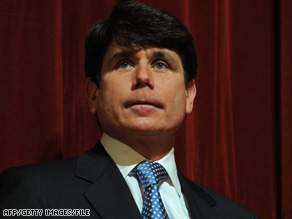
Blagojevich Blog-o-bitch
Posted by
Unknown
Many have commented that Blagojevich's $4500 bail is something of an outrage, amidst so much financial corruption. However, this misses what I think is really going on here. Society pays lip service to certain moral codes, but often rewards something more akin to barbarism. The fact that we need a government at all is ample proof of that- if any of you are familiar with Hobbes' Leviathan, you know where I'm going with that.
The "oversight" provided by government creates an infinite regress when corruption sets in, as it always does. That is, you have people overseeing that something is done properly, but then you need people to oversee them, and people to oversee those people. You have different groups within the same government listening in on each other, and an inordinate amount of money and energy wasted on these different agencies - all rife with varying amounts of corruption - trying to get a leg up on the other.
From time to time, however, a whipping boy is necessary in the name of those morals that we pay lip service to. This is nothing new- in fact many Pagan societies ritualize this "whipping boy" in various literal ways, or translate it directly into the bloody sacrifice. (Though in most of those cases the sacrifice has to be pure / virginal, not an exemplar of the corruption that embodies business-as-usual within the society.) At the moment, it happens to be that guy whose name I find really painful to pronounce, or even type out. Blog-o-whatever. But if, after eight years under Bush, you think the buck stops there.
Think again.
And if you are thinking to yourself, well that's interesting James, but this has little-or-nothing to do with independent media... well, you're right.
Fuck it.
Thursday, November 06, 2008
Obama: much ado about the wrong thing.
Posted by
Unknown
It really doesn't matter- so far as I can tell- that Obama is half black. The fact that it does matter just shows how far we have to go.
What does matter is that he's intelligent, and, despite being a politician (and all that comes along with it), he is also an able statesman. How much that matters is yet to be seen. The work has just started- and I do not envy his job. Talk about first-day-on-the-job pressure, at least in January. The entire world seems to expect a miracle.
That's all I feel like saying about politics right now. The Collide review is on slight delay because though my iPhone claimed to download the mp3s, they're not showing up in my playlist. And I won't be home for 4 days...
Palin: Sigh of relief...
Posted by
Unknown
Palin might have been your vice president, America...
Huffingtonpost article.
Palin was apparently a nightmare for her campaign staff to deal with. She refused preparation help for her interview with Katie Couric and then blamed her staff, specifically Nicole Wallace, when the interview was panned as a disaster. After the Couric interview, Fox News reported, Palin turned nasty with her staff and began to accuse them of mishandling her. Palin would view press clippings of herself in the morning and throw "tantrums" over the negative coverage. There were times when she would be so nasty and angry that her staff was reduced to tears.
Huffingtonpost article.
Subscribe to:
Posts (Atom)