Showing posts with label economics. Show all posts

Saturday, February 23, 2013

World’s 100 richest could end global poverty 4 times over

World’s 100 richest could end global poverty 4 times over
“The richest 1 percent has increased its income by 60 percent in the last 20 years with the financial crisis accelerating rather than slowing the process,” while the income of the top 0.01 percent has seen even greater growth, a new Oxfam report said.
What sense does wealth have in the long run, if we think of ourselves as a species in an enormous cosmos, rather than Americans and Saudi Arabians, or rich and poor? 

Crazy talk, for sure. "Us" and "them." If we don't recognize ourselves as brothers and sisters, we're going to be done for. Nature is far more brutal and unstable on the long run than this little calm blip in history would make us think.

"There are not yet obvious signs of extraterrestrial intelligence, and this makes us wonder whether civilizations like ours rush inevitably into self-destruction. I dream about it . . . and sometimes they are bad dreams."

The words of Carl Sagan in this episode (a stern Kermit the frog) still ring true, despite the fears of that time being slightly different than now. It doesn't matter the nature of the eventual disaster, simply that they are inevitable, and yet we seem to live within a system that is designed to keep us estranged, and to deprive the basic necessities of life to some while others are able to .

The underlying dream of Communism is not a bad one, before it is turned to fascism. Is it human nature that makes such a utopean plans impossible? This requires looking at the myth of human nature and the myth of power. 

[Where is the fucking counterculture? Mythos Media.]

Friday, August 05, 2011

Echo-gnomicks: Financial Meltdown and the Sound of the Underground

By Mr. VI

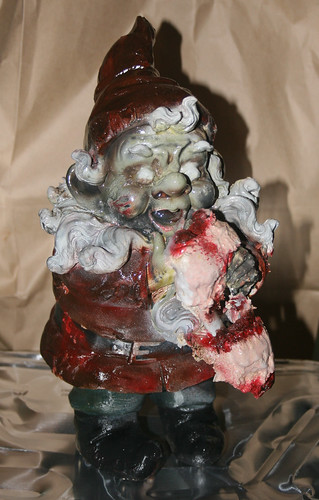
Okay, who did it? Who went and angered the Gnomes of Zurich? Who screwed the dwarves out of their rightful tribute? Who went and annoyed the boys at Gringotts? I know somebody did, because otherwise we wouldn't be in this mess.

No, really we wouldn't. Of course, it always happens this way – humans get greedy for gold and it all goes downhill from there. All you have to do is keep your head down and don't go near them. Instead, like magpies in their black and charcoal plumage, the suits decided to plunder the shiny realm, help themselves to the pots of gold.

Look where that has got us – another financial meltdown. Stocks plummeting, doom upon the horizon. Some part of me wouldn't be surprised if Ragnarok was around the corner, except of course it always is – just at the corner of your eye, but that's another story.

Economics – or as Terry Pratchett puts it 'reflected-sound-of-underground-spirits' a.k.a. Echo-gnome-ics – purports to be the art of dealing with such things. But as anybody who understands the myth of Echo will tell you, there's a bit of a problem.

Echo was doomed to repeat the words of others, her voice taken away by Hera in revenge for consorting with Zeus. Essentially, her communication was reduced to that of a cargo cult – mimicking and repeating sound with little hope of understanding.

Now, notwithstanding the fact that all communication is a bit like this, economics is about appearance. Those bankers and stockbrokers are doing the equivalent of listening to the voices of the gnomes and other chthonic spirits, echoing down mining tunnels and fissures in the Earth. They interpret echoes and make decisions based upon them – an entirely virtual construction based off second or third order perceptions.

It's no wonder really, considering that Paracelsus states that gnomes are capable of passing through solid rock as easily as humans pass through air, so for those of you who enjoy Harry Potter it might help to envisage them as being masters of the Apparate spell.

As apparitions, their substance is by nature more loosely bound than those humans – their outline lest fixed and form more fluid. It makes sense then, that they are masters of the physical, because their ability to modulate matter is a massive engineering boon. This is why in Norse myth, the dwarves are the creatures that create the weapons and tools of the very gods themselves.

This excerpt from Neil Gaiman's award-winning novella The Truth is a Cave in the Black Mountains, which is available in full here, illustrates this really quite well:

Thursday, August 13, 2009

Fragments on the history of Antimarkets / Capitalism

The theme of the past day for me seems to center around the history of capitalism. This has popped up in the several books I am muddling through (I mostly have time to read during my daily trolley/subway commute), and then this morning, while trying to wake me up, I happened upon an interesting article by Douglas Rushkoff that touches on the subject by way of discussing how our interests structure our discoveries and indeed the basis of what we consider real let alone valid. The point Rushkoff makes, and it's well made, is that scientists and mathematicians are biased to support the worldview of our economy as if its a given because thats how they make money- by showing how to game the system. However, that bias makes our economic system seem like universal, natural law. I would like to point out that this is not a bias exclusively unique to economics. Regardless, it creates a feedback loop between the "authorities" that re-enforce the system, and the people managing the system itself. Kind of an echo chamber.

There is some extent to which I let serendipity direct the progress of my research; books that people hand to me, things that I come upon online- all the information that we process is sorted based in part on the information we've already been exposed to, it predisposes us, as does our intentions at that time and a million other variables. There are several ways these tidbits fit into what I'm already working on, but I'll leave that for later.

On to these tidbits-

"Credit represented one more form of autocatalytic or turbulent dynamics that propelled preindustrial European cities ahead of their Eastern rivals, eventually enabling Europe to dominate the rest of the world. Credit (or, more exactly, compound interest) is an example of explosive, self-stimulated growth: money begetting money, a diabolical image that made many civilizations forbid usury. European merchants got around this prohibition through the use of the "bill of exchange," originally a means of long-distance payment (inherited from Islam); as
it circulated from fair to fiar its rate of return accrued usuriously. (This disguised form of usury was tolerated by church hierarchies use to the many risks of the circulation the bills of exchange involved.)


--1000 Years of Nonlinear History.

Then, from the Rushkoff article:


The economy in which we operate is not a natural system, but a set of rules developed in the Late Middle Ages in order to prevent the unchecked rise of a merchant class that was creating and exchanging value with impunity. This was what we might today call a peer-to-peer economy, and did not depend on central employers or even central currency.

People brought grain in from the fields, had it weighed at a grain store, and left with a receipt — usually stamped into a thin piece of foil. The foil could be torn into smaller pieces and used as currency in town. Each piece represented a specific amount of grain. The money was quite literally earned into existence — and the total amount in circulation reflected the abundance of the crop.

Now the interesting thing about this money is that it lost value over time. The grain store had to be paid, some of the grain was lost to rats and spoilage. So each year, the grain store would reissue the money for any grain that hadn't actually been claimed. This meant that the money was biased towards transactions — towards circulation, rather than hording. People wanted to spend it. And the more money circulates (to a point) the better and more bountiful the economy. Preventative maintenance on machinery, research and development on new windmills and water wheels, was at a high.

...

Feudal lords, early kings, and the aristocracy were not participating in this wealth creation. Their families hadn't created value in centuries, and they needed a mechanism through which to maintain their own stature in the face of a rising middle class. The two ideas they came up with are still with us today in essentially the same form, and have become so embedded in commerce that we mistake them for pre-existing laws of economic activity.

The first innovation was to centralize currency. What better way for the already rich to maintain their wealth than to make money scarce? Monarchs forcibly made abundant local currencies illegal, and required people to exchange value through artificially scarce central currencies, instead. Not only was centrally issued money easier to tax, but it gave central banks an easy way to extract value through debasement (removing gold content). The bias of scarce currency, however, was towards hording. Those with access to the treasury could accrue wealth by lending or investing passively in value creation by others. Prosperity on the periphery quickly diminished as value was drawn toward the center. Within a few decades of the establishment of central currency in France came local poverty, an end to subsistence farming, and the plague. (The economy we now celebrate as the happy result of these Renaissance innovations only took effect after Europe had lost half of its population.)

...

The second great innovation was the chartered monopoly, through which kings could grant exclusive control over a sector or region to a favored company in return for an investment in the enterprise. This gave rise to monopoly markets, such as the British East India Trading Company's exclusive right to trade in the American Colonies. Colonists who grew cotton were not permitted to sell it to other people or, worse, fabricate clothes. These activities would have generated value from the bottom up, in a way that could not have been extracted by a central authority. Instead, colonists were required to sell cotton to the Company, at fixed prices, who shipped it back to England where it was fabricated into clothes by another chartered monopoly, and then shipped to back to America for sale to the colonists. It was not more efficient; it was simply more extractive.

The resulting economy encouraged — and often forced — people to accept employment from chartered corporations rather than create value for themselves. When natives of the Indies began making rope to sell to the Dutch East India Trading Company, the Company sought and won laws making rope fabrication in the Indies illegal for anyone except the Company itself. Former rope-makers had to close their workshops, and work instead for lower wages as employees of the company."


I've been thinking about this in the back of my mind most of the day, but I seem to be fighting with a sinus thing yet again so I'm not the most clear-headed at the moment. Conclusion is that you either need to enter the game through having enough money to work with compound interest and investment, accept that you will be someone's indentured servant all your life, or build your own trade network and accept that most likely, if you are ever truly successful, you will be shut down or attacked by the powers-that-be as posing a threat to their way of life simply because you provide an alternative to their credit monopolies. (Certainly, if you gather the means to defend yourself from such incursions- as the founders of this country did- you would be even more likely to be branded as terrorist.)

This final scenario was one of the premises I was playing with in fictional form in Fallen Nation: Babylon Burning.

A shitty game. Anything beats option #2.

Tuesday, October 21, 2008

Economic Tsunami (Clusterfuck nation)


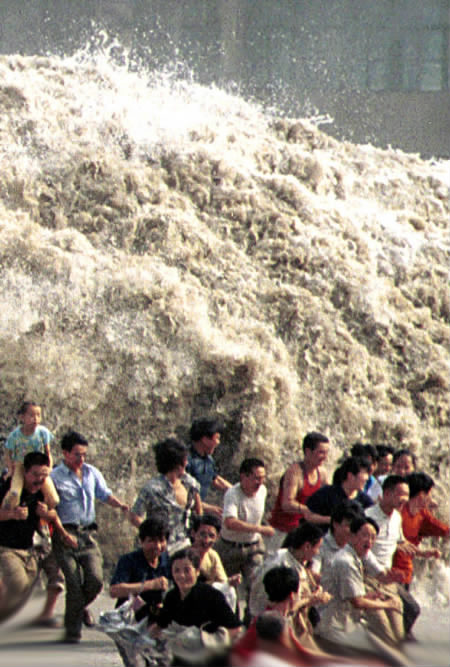
"To switch metaphors, let's say that we are witnessing the two stages of a tsunami. The current disappearance of wealth in the form of debts repudiated, bets welshed on, contracts canceled, and Lehman Brothers-style sob stories played out is like the withdrawal of the sea. The poor curious little monkey-humans stand on the beach transfixed by the strangeness of the event as the water recedes and the sea floor is exposed and all kinds of exotic creatures are seen thrashing in the mud, while the skeletons of historic wrecks are exposed to view, and a great stench of organic decay wafts toward the strand. Then comes the second stage, the tidal wave itself--which in this case will be horrific monetary inflation--roaring back over the mud flats toward the land mass, crashing over the beach, and ripping apart all the hotels and houses and infrastructure there while it drowns the poor curious monkey-humans who were too enthralled by the weird spectacle to make for higher ground. The killer tidal wave washes away all the things they have labored to build for decades, all their poignant little effects and chattels, and the survivors are left keening amidst the wreckage as the sea once again returns to normal in its eternal cradle."

(Read full post on clusterfuck nation.)

LinkWithin

Related Posts Plugin for WordPress, Blogger...