Showing posts with label harry potter. Show all posts

Friday, August 05, 2011

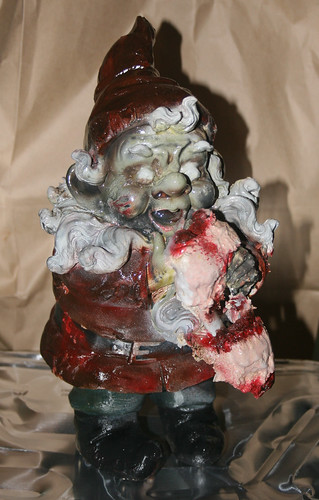
Echo-gnomicks: Financial Meltdown and the Sound of the Underground

By Mr. VI

Okay, who did it? Who went and angered the Gnomes of Zurich? Who screwed the dwarves out of their rightful tribute? Who went and annoyed the boys at Gringotts? I know somebody did, because otherwise we wouldn't be in this mess.

No, really we wouldn't. Of course, it always happens this way – humans get greedy for gold and it all goes downhill from there. All you have to do is keep your head down and don't go near them. Instead, like magpies in their black and charcoal plumage, the suits decided to plunder the shiny realm, help themselves to the pots of gold.

Look where that has got us – another financial meltdown. Stocks plummeting, doom upon the horizon. Some part of me wouldn't be surprised if Ragnarok was around the corner, except of course it always is – just at the corner of your eye, but that's another story.

Economics – or as Terry Pratchett puts it 'reflected-sound-of-underground-spirits' a.k.a. Echo-gnome-ics – purports to be the art of dealing with such things. But as anybody who understands the myth of Echo will tell you, there's a bit of a problem.

Echo was doomed to repeat the words of others, her voice taken away by Hera in revenge for consorting with Zeus. Essentially, her communication was reduced to that of a cargo cult – mimicking and repeating sound with little hope of understanding.

Now, notwithstanding the fact that all communication is a bit like this, economics is about appearance. Those bankers and stockbrokers are doing the equivalent of listening to the voices of the gnomes and other chthonic spirits, echoing down mining tunnels and fissures in the Earth. They interpret echoes and make decisions based upon them – an entirely virtual construction based off second or third order perceptions.

It's no wonder really, considering that Paracelsus states that gnomes are capable of passing through solid rock as easily as humans pass through air, so for those of you who enjoy Harry Potter it might help to envisage them as being masters of the Apparate spell.

As apparitions, their substance is by nature more loosely bound than those humans – their outline lest fixed and form more fluid. It makes sense then, that they are masters of the physical, because their ability to modulate matter is a massive engineering boon. This is why in Norse myth, the dwarves are the creatures that create the weapons and tools of the very gods themselves.

This excerpt from Neil Gaiman's award-winning novella The Truth is a Cave in the Black Mountains, which is available in full here, illustrates this really quite well:

Sunday, February 13, 2011

Vampire Sun, Werewolf Moon (pt. 1)


Two thousand years ago, today would have been the first day of Lupercalia. Now bear with me, I haven't blogged like this in a while, but there is a link between Valentine's Day, the werewolf, Pan, and this post I'll explain in part 2. James' article on True Blood back in August of '09 convinced me to give that series a shot, and it's only fitting that this be the first post I publish to this blog, for reasons that will become clearer in tomorrow's post.

In this post I'll begin to highlight how the vampire manifests as an inversion of the solar hero and werewolf as inversion of the lunar hero's path. If you have seen contemporary texts like Buffy, True Blood, Underworld, Supernatural, or Twilight you're more than empowered to know what I mean when I say vampire and werewolf

While it seems that there are a lot of different ways that people manifest fantasy and fetish in their adult lives, fantasizing about vampires and werewolves is a consistent and resilient trend. More than enough ink has been devoted to why the vampire and the werewolf have continued to evolve alongside culture-and continue to also bring in revenue. With Twilight, vampires and werewolves created a high water mark in terms of pure profit for the publishing industry. Vampires and werewolves are the twin archetypal draws in western commercial pop culture.

The zombie comes in at a strong third, of course, especially when you lump in the promethean Frankenstien's Monster - clearly a manifestation of fear of death combined with fear of eternity and given significant anchoring both in religious references and an entirely predictable fear of the exploited seeking vengeance. There's also the mind-controlled killer, a shadow of the zombified murderer most purely expressed in Fritz Lang's The Cabinet of Dr. Caligari and referenced nowadays as alternatively a 'manchurian'/'monarch mind-control' assassin or as a shambling, brain-eating ghoul. I suspect there are far fewer teens laying awake at night longing to be turned into a mind-controlled killer or shambling, feral ghoul than there are teens hoping to be bitten by a werewolf or a vampire (although, if Poppy Z. Brite had written Twilight, perhaps things would be different.)

This hints at a kind of mythomathematics - there are certain innate qualities that dictate where vampire begins and ends, where werewolf begins and ends, and they both oppose and unite, a constant dance. The vampire is the inversion of the sun, specifically - not of light. The sun cannot see itself in the mirror, because it does nothing but radiate light - the vampire is the sun's shadow, and in it's presence ignites, becomes enflamed, and the vampire's individual self is eradicated.

The moon, however, is a reflective, mutable space - when the werewolf bathes in lunar light it changes, cycles. Why is the vampire destroyed by its symbol while the werewolf is transformed? It speaks to a larger mapping of symbol to myth.


The vampire is not a solar hero, it's an antithesis of that archetype - the solar hero is a conquering and vanquishing hero - so the vampire is changed, often destroyed utterly by the sun, and exists as the shadow of the sun. The werewolf, on the other hand, is lunar - the lunar hero does not conquer, the hero transforms, transcends, and overcomes through metamorphosis. The werewolf, on the other hand, is the inversion of the lunar hero - the werewolf is overcome by transformation when exposed to the full moon, and the transformation eradicates the consciousness, leaving only the Id behind and in charge.

Let me be clear, I do not think that writers sit down with a mythic map scripted, but rather that these mythic entities resonate in ways which lead the writer down culturally indicated paths. Stephanie Meyer distilled the essential duality then played within it as a melodramatic frame for teen angst. It is a formulae that produces catharsis and is obviously well-adapted to the present zeitgeist, much like J. K. Rowling's remarkable placement of Harry Potter into the vacuum left in culture by the evolution of Disney away from being the conduit by which magick and witchcraft could be safely sampled. Neither Meyer or Rowling ar transgressing into the myth space - they are reinforcing it, and in many ways expanding it. Still the dualism of Sun and Moon remains strewn throughout the vampires and the werewolves of Stephanie Meyer, and the elite and the technologically enabled magical children, once almost entirely the dominion of Walt Disney's kingdom, are now flooding into the mindshare of the memeplex geographically materialized in the Wizarding World at Universal Orlando.


The sheer publishing glut of vampire and werewolf narratives ensures that every possible iteration of plot will eventually be explored, something that requires fan texts to enact this transgressive allegorythym. Transgressive Star Trek fan-fiction could assimilate the borg through some klingonicization into a functional part of the Federation - which to a Trekker is as queering of a social space as Harry/Draco fanfic is of a personal space to a young fan of Harry Potter.


Transgressive mythmaking becomes a space that calls to a writer because there a kind of synthesis can be achieved - transgressive art an inroad to synthesis - "Rejection" is a by-product of "acceptance" since it acknowledges existence, and allows the rejected a voice. Once the voice begins utterance, the possibility of a dialogue towards synthesis begins. For a writer, there are a number of ways to play with transgression. Blade, for example, is an outsider, a queer in both vampire and human worlds, able to walk in sunlight. Underworld and its sequels all follow transgressive trends that seek a synthesis - as all thesis and antithesis must synthesize - and also in Underworld the vampire and werewolf trangressively merge into a queer razor-taloned green-skinned mutant who is both lunar and solar - conqueror of transformation.

(more to come)


Pre-order a copy of The Immanence of Myth, published by Weaponized in July 2011.

LinkWithin

Related Posts Plugin for WordPress, Blogger...