Showing posts with label postmodernism. Show all posts

Friday, October 09, 2015

Cultural Cartography

From Rebel News

We’re suckers for simplistic, captivating pictures, mostly because we don’t even realize that we’re being sold a “frame”; we think we’re just seeing “the way things are,” when, in fact, we are buying into a paradigm. That’s why, all too often, while trying to talk our way out of a problem we only dig deeper holes.
... Now imagine the picture holding us captive is a conceptual map that carves up the boundaries of ideas and disciplines, charting the course of intellectual history. A faulty map is the kind of captivating picture that is bound to mislead us. In that case what we’d need is a therapeutic cartography.
— "A Therapeutic Cartography," James K. A. Smith.


AUTHENTIC SUPERFICIALITY

In the previous essay in this series, we looked at how we interact in a marketplace where surface identities drive our purchase choices. We have a very peculiar relationship with the things that we buy — both through and with our iPhones and cars, and soon enough, our sex robots.

More broadly, we identify ourselves and each other through the consumer choices we make, or even the ones we don't make. This is often called signaling, and it's an important part of nonverbal and implicit social communication. That's what the lifestyle brand is all about — integrating consumer choice with our lives, becoming grinning robots in some Orwellian hellscape ourselves, and so forth.

Thankfully that's not entirely how it plays out. Theories about the pervasiveness of brands and media brainwashing fall short of reality. Nothing is quite so simple as the behaviorist “image in, behavior out.” We may signal our queerness or our religion through what we wear and buy, but that isn't all we are. We still have inner lives, and an experience that can't enter into this marketplace, and our identities and beliefs are shifting landscapes more than fixed, binary wastelands.

The idea of Qualia refers to the irreducibility of this inner life. The world of surfaces may be superficial, but there is something lurking somehow beneath all of that, that’s somehow authentic. Erwin Schrödinger, creator of the famous living/dead cat thought experiment, said the following in What is life?: The Physical Aspects Of The Living Cell,
The sensation of color cannot be accounted for by the physicist's objective picture of light-waves. Could the physiologist account for it, if he had fuller knowledge than he has of the processes in the retina and the nervous processes set up by them in the optical nerve bundles and in the brain? I do not think so.
But this way also points toward reductive either-ors. If we're going to distinguish between the commodifiable “dead shells” referred to in the previous article and some kind of deep seated, internal identity, what is that identity? How do we know it's authentic? We are wandering dangerously close to a schema of the false and replaceable versus the fixed and true, and that is not a frame that I’d like to imply. This has become a common sense distinction for most of us: surface and interior. Fake hipsters, and real trendsetters. But the distinction itself is superficial.

Another way of contrasting the idea of real and false self, the figurative and literal, is through mimesis. Here we must challenge the “tyranny of the literal”,
In ‘Realism,’ the opening chapter of J.M. Coetzee’s most recent novel Elizabeth Costello, the eponymous heroine, a successful Australian novelist, gives a speech in which she ironically likens herself to a talking ape from a short story by Franz Kafka. The story’s ambiguities lead her to reflect on this historical loss of certainty, the way it seems to have undone the very possibility of direct communication and unproblematic representation. 
There was, she argues, ‘a time when we knew’: We used to believe that when the text said, ‘On the table stood a glass of water,’ there was indeed a table, and a glass of water on it, and we had only to look in the word-mirror of the text to see them. But all that has ended. The word-mirror is broken irreparably, it seems. ... There used to be a time, we believe, when we could say who we were. Now we are just performers speaking our parts. The bottom has dropped out. 
Her speech is not well received. Elizabeth Costello spends most of Coetzee’s novel acting the role of a celebrity writer. She travels the world making appearances, delivering lectures, fielding questions about the meanings and motivations behind her writing. It is not something she enjoys. Often her appearances do not run smoothly; her ideas tend to provoke dissent and dissatisfaction. ... The audience wants literal confession; but Costello’s aim is to keep ‘her true self safe.’ Or so her son John believes; for Costello the issue cuts deeper than this. She has come to doubt the very existence of such a thing as a ‘true self.’ The word-mirror is irreparably broken, yet she is compelled to appear before an audience. Inevitably, what she presents them is ‘an image, false, like all images.’
So, we are drawn to question the authenticity of both surfaces and interiors. The mirror itself becomes the closest that we have to any kind of certainty — as the image and its reflection can both be called into question.

A MAP OF OURSELVES

We have to contend with this tension between surface and interior, and amongst all the principalities thereof. That's true, even in the face of such uncertainties. Many of us struggle against these seemingly geological forces, without even knowing what we're struggling against.

The self and society as landscape is a frame suggested by Structuralism, and later by Post-structuralism when written in relief. Both position history as structure composed of geological flow rather than events; this was done, in terms of the latter, because the very structures imposed by theory could reify imperialist “grand narratives.” For example,
The history of events, Braudel was to scathingly write, were merely the history of “surface disturbances, crests of foam that the tides of history carry on their strong backs” (Braudel, 1980: 10). The outcome of the struggle for supremacy in the Mediterranean, then, was viewed by Braudel as the outcome of longer term structures (political, social, economic and geographic) and not at all the result events or the actions of individuals. —Extending the Longue Dureé: Manuel De Landa and a Thousand Years of Nonlinear History.
The tension of surface appearance against deeper identity, and the constant anxiety that there is such a thing as a central or deep identity, drives the tectonic forces between what I'll be referring to later as cultural borderlands and centers. We needn’t know which is authentic, but merely recognize the tensions between these principalities. This might still seem a baroque metaphor, even if it’s far from unprecedented in the social sciences, but it's nevertheless apt. Dynamism in the self or the state arises from difference, conflict from too sudden changes; often arising where one identity abuts another, and all are also ever changing.

This is borrowing from the frequent use of geological and even cartographic metaphor in such works. These metaphors are essentially impersonal, even when they refer to parts of personal psychology. For this reason, they have been vastly preferred within post/structural analysis, over the earlier mythopoeia of Freud or Jung, for instance, which paints all inner experience as personal, in reaction to a mythologized external world.

Manuel Delanda’s odd but brilliant 1000 Years of Nonlinear History is possibly the penultimate example of this sort of device. In fact, the entire book is constructed as a series of geological, biological, physical-psychological-historical metaphors (even if he is insistent that it is not a metaphor but rather an “engineering diagram”),
We live in a world populated by structures — a complex mixture of geological, biological, social, and linguistic constructions that are nothing but accumulations of materials shaped and hardened by history. Immersed as we are in this mixture, we cannot help but interact in a variety of ways with the other historical constructions that surround us, and in these interactions we generate novel combinations, some of which possess emergent properties. In turn, these synergistic combinations, whether of human origin or not, become the raw material for further mixtures. This is how the population of structures inhabiting our planet has acquired its rich variety, as the entry of novel materials into the mix triggers wild proliferations of new forms. ...
And so on. It's important to recognize that all the structures on these these maps ebb and flow, empires rise and fall more less the same as colonies of coral might. More prosaically, just as one might stand on the Pacific rim and hundreds of millions of years later, they might spy a new continent on the horizon, a 19th century American Republican might find more in common with many of today's Democrats. Our labels are not what ultimately defines us. After all, nothing is fixed. And what of the center of the world? As Umberto Eco observed, you can hang Foucault's Pendulum anywhere.

Thus, all domains are conceptual maps, even including the inscrutable, uncertain, and ultimately implicit world of qualia. A map does not provide a certificate of authenticity, of course — as so many counterculturists are bound to point out, “the map is not the territory.” But without it, we can’t begin to track our way out of the shifting hinterlands. We cannot properly understand society, or ourselves, until we've charted the surfaces of this never-ending symbolic fault line. But we mustn't find ourselves limited by the names, labels, and borders that happen to be written in this fleeting moment.

So let's look at an example framework...

Thursday, March 19, 2015

The Congress

The real meat of this narrative hangs on an old but incredibly fruitful frame: is an artist's work or their persona ultimately of value? The pop-cult of personality certainly points in the direction of the mask. She is offered the opportunity to sell the mask to Miramount studios, and go on her merry way. Live her life, but never act in anything ever again. They own the mask.

Robin Wright acts in her own narrative gonzomentary,
and does it with the gravitas of a fallen angel.


This film sets up an incredibly tight first act, and then veers in an entirely unexpected, psychedelic direction from there.

As at-times interesting and surreal as the rest of the movie is, it could've been done in a way that was more consistent with where the movie seemed to be going, although that course change isn't so joyfully pointless as Tarantino's Dusk Till Dawn. Vampires and crotch cannons don't suddenly appear in the middle of a crime drama. Rather, you're dropped into the middle of Waking Life, with a bit more Matrix revolutionary zeal and a bit less philosophical speculation.

Might consistency have bit deeper and bled a bit longer? Maybe. That depends on your tastes.

But whatever flavor suits you, this film hearkens to a time, now lost to the haze of distant memory, when movies sought to make us question our culture, and our place in it. (I think it might have been the late 90s.)

Pop-art often employs repetition of the mask or container. (Think Warhol.) The Congress, in its way, can be considered a part of this tradition. In a movie that seeks to analyze an industry that functions only by cannibalizing itself, and doing so often off the flesh of its talent, the only tools available are a pastiche of what has come before. This is a sense in which The Congress is deeply postmodern, in a more than passing sense.

Its inveigh against Hollywood uses self-referential bricolage as a device for their own deconstruction. Tropes from nearly every genre available to Hollywood are used toward that end. Pointillism, bricolage, etc. are only useful devices to the extent that they relate back to a single thread. In this case, that thread is not a single narrative, not plot or resolution, but the theme of alter-ego as product. The alter-ego as icon, as obsession, as the lure painted over the heavens when the Gods of old will no longer do.

How much can you drill down into a single theme, how many fourth walls can you break, before the sublime turns into the redundant?

That line is seriously tested through the final act, but not, I think, ultimately broken.

All It Takes Is The Right Story. Mythos Media

Wednesday, March 11, 2015

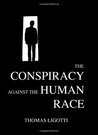
The Conspiracy Against The Human Race

The Conspiracy Against the Human RaceThe Conspiracy Against the Human Race by Thomas Ligotti
My rating: 5 of 5 stars

Years of meditating and reading books on philosophy, psychology, years of lucid dreams and night terrors, do not make a person unique. But it is singularly unique to find what feels like your own thoughts reflected back at you when you didn't pen them. As I read The Conspiracy Against the Human Race, I had a strange feeling, as if deja vu and vertigo had somehow been blended together. Had I read this before, if I hadn't written it?

Yet that disturbing familiarity regards an utterly useless process. Reading or writing about philosophy has long had a negative connotation in the United States, thanks to a long anti-intellectual culture in some corners. But here the useless, and indeed the negative, have an absolutely finality that have nothing to do with anti-intellectualism. This is ontological uselessness, the nightmare of being.

Ligotti's core thesis  the self as we know it is a contrivance of evolution, self consciousness an accident. To be deceived into thinking we are a self, that's the situation we find ourselves in, without hope of reprieve or reprisal. Of course, he isn't the first pessimist to set pen to paper, but he is the first to do so starkly, with such uncompromising clarity, without back pedaling or that ultimate cop out, the happy ending, “it was all a dream.”

There is a certain intentional irony here, as indeed our waking lives are a type of dream, and the self we grant some sense of ultimate reality is nothing other than a character in that dream. But to the extent anything is real, that dream character's suffering is legitimate.

Our choice as he sees it is simple — self deception, or insanity. He shows us the basis of horror, rooted not in the supernatural beyond, but much closer to home. It stares back at us in the mirror. The supernatural in a sense gives us a glimpse of our own uncanny ghoulishness, without requiring identification with the absolute truth of the matter. We can close the book, and shake off that chill, for after all, it was just a story.

But this is not merely a thought experiment. It isn't satirical hyperbole, like A Modest Proposal. There is no hope or happy ending to soften the blow. Because the game of life is all fixed anyway, it couldn't matter less if you deceive yourself and write this book off as pessimistic belly aching. Whatever it takes to get you through another day, and prop up the illusion that you are a self in the first place.

Although some may argue about what constitutes “serious philosophy”  as Ligotti himself says, he eschews the circuitous argumentation that generally grants a work that unapproachable aura of seriousness  I would argue that this book belongs within any introductory study of nihilism and even post-modernism. To do so I'd like to demonstrate what I mean. Those purely interested in The Conspiracy Against The Human Race may as well stop here, but I believe this claim demands a little context and backtracking. You'll forgive me if I need to broaden the scope to come back to task.

Thursday, December 05, 2013

A Thousand Years of Nonlinear History

If you haven't read this book already -- read it. It will likely take a while. I had to look up a great number of terms and details... in the process you will learn a lot about systems theory. But it is well worth the effort.

Pick up the book if this format is too hard to read. 

[Take a Trip with us... Mythos Media.]

Friday, January 20, 2012

Heiner Müller's "Hamlet Machine"

 
I throw open the doors, to let in the wind and the cry of the world. - Ophelia

Ophelia, John Everett Millais
Image by Barnaby Thieme
While not well known to English-speaking audiences, Heiner Müller is considered by many Germans to be a leading dramatist of the twentieth century. Many of his plays rework classical myths or stories in a struggle to make sense of the collision between mythology and ideology in post-war Eastern Europe.

His Hamlet Machine is a postmodern masterpiece and a harrowing portrait of life under totalitarian rule. Much of the complex play consists of dramatic monologs, dense with allusions to Shakespeare's play and other works of European culture.

The Hamlet-actor begins in Brechtian mode, aware of his own role in the ensuing drama, announcing: “I was Hamlet. I stood at the shore and talked with the surf BLAH BLAH, the ruins of Europe in back of me.” (1) These lines echo the Fisher King of T. S. Eliot's "The Waste Land," who “sat upon the shore / Fishing, with the arid plain behind me”. (2)

Like Eliot, Müller also presents “a heap of broken images,” where mythological symbols flail like broken engines, gesturing wildly toward inhuman meanings.

In Shakespeare's play, it will be recalled, the hero's father fell victim to murder at his uncle's hands, abetted by Hamlet's complicit mother. Hamlet Machine describes the funeral thus: “The bells tolled the state-funeral, murderer and widow a couple, the councilors goose-stepping behind the highranking carcass' coffin, bawling with badly paid grief”. (3)

Müller's inspiration for Hamlet's father was Traitscho Kostoff, a Bulgarian communist who was executed in a Stalinist purge. (4) Contemporary audiences may sooner think of the bizarre state funeral of Kim Jong-Il, but the subject of the allusion does not matter. Different actors play the parts, arriving on cue for their prescribed roles, but the historical drama does not change. Hamlet reflects:

The set is a monument. It presents a man who made history, enlarged a hundred times. The petrification of a hope. The name is interchangeable, the hope has not been fulfilled. The monument is toppled into dust. (5)


History is fixed by a small number of possibilities, pre-determined by unpersuasive narratives that bind action to violence and oppression. Even the utopian visions they nominally serve have lost their power to persuade or animate. One thinks of the technocrats of Müller's East Germany, tunelessly singing Marxist-Leninist hymns.

As the play proceeds, the Hamlet-actor tries to reject the role to which he has been consigned, refusing to go along with this murder-drama. The dramatic action breaks down, and a political demonstration explodes onto the stage, suggesting the 1967-8 student protests in Berlin.

The Hamlet-actor is swept up in the angry mob and pushed to the police lines, where, in an arresting image, he confronts his own reflection in bullet-proof glass, and sees himself facing himself from the opposite side of the line.
Heiner Müller

I look through the double doors of bullet-proof glass at the crowd pressing forward and smell the sweat of my fear. Choking with nausea, I shake my fist at myself who stands behind the bullet-proof glass. Shaking with fear and contempt, I see myself in the crowd pressing forward, foaming at the mouth, shaking my fist at myself. (6)

He responds with rage to his own complicity in totalitarianism, then goes home to watch television, “at one / with my undivided self.” (7) In Shakespeare's Hamlet, inaction is a fatal flaw, but when all courses lead to murder, inaction and action both mean self-betrayal, and purity is found only in death, or, in its political equivalent, television.

***

I am Ophelia. The one the river didn't keep.”

Ophelia chooses suicide instead of murder. Like Nietzsche's ascetic, her violence turns inward, sublimating her will to power. Her character represents a type for Müller, a woman whose inflexible moral code renders her capable of anything.

She is the “woman dangling from a rope,” suggesting the far-left RAF terrorist Ulrike Meinhof, whose strident critique of hegemonic capitalism ignited a series of bank robberies and murders. (8) Eventually she was captured, and hung herself in her cell.

Müller's Ophelia would also choose death as a way of dismembering the mechanisms of oppression:

I smash the tools of my captivity, the chair the table the bed. I destroy the battlefield that was my home. I fling open the doors so the wind gets in and the screams of the world. I smash the window. With my bleeding hands I tear the photos of the men I loved and who used me on the bed on the table on the chair on the ground. I set fire to my prison. (9)

In his autobiography, Müller comments “Lenin always said revolution comes from the provinces, and women are the provinces of men.” (10)

***

Born in Eppendorf in 1929, Müller spent his childhood under the shadow of the Nazi regime. In "The Father," an early autobiographical prose-poem, he describes being woken from sleep when he was three years old:

In 1933, January 31 at 4 a. m., my father, a functionary of the Social Democratic Party of Germany, was arrested from his bed. I woke up, the sky outside the window black, noise of voices and footsteps. In the next room, books were thrown to the floor. I heard my father's voice, higher than the other voices. I climbed out of bed and went to the door. Through a crack I saw how a man was hitting my father in the face. (11)

Two officers of the Nazi SA, the predecessor to the notorious SS, took his father to a concentration camp, where he was held for over a year for his socialist activities. Müller was shunned as the son of a criminal, and other boys in his village were not allowed to play with him.

After he visited the camp with his mother, he was haunted by the image of his father diminished behind the wire mesh fence, and later, by memories of walking for hours in bitter cold to meet his father upon his release.
 
Flandern (detail), Franz Radziwill
Image by Barnaby Thieme
I wish my father were a shark
Who tore to pieces forty whalers
(And in their blood I had learned to swim)....
(12)

In these early memories, we find the germ of his later political views. Müller would remain a socialist for the rest of his life, though he appears to have been deeply demoralized by Stalin's tyrannical abuses. He was tolerated as a high-profile artist of the GDR, but was also a fierce critic of his country. Hamlet Machine was banned in East Germany until its final days. (13)

Perhaps in these early memories, we also find the seeds of his feverish, fragmentary style. Hamlet Machine resembles the disjointed impressions of a child-dreamer, woken from sleep by disturbing events for which he has no context or compass.

Perhaps Müller seeks to bring his audience to that moment of his childhood, to share with them his epiphany of chaos. It may be the only truth of which he was certain.

***

“One can make many things of Hamlet Machine,” Müller said. “First of all, its unperformability certainly stands for stagnation.” (14) And the play is indeed notoriously difficult to stage. The playwright Tony Kushner notes:

Certainly the most immediately striking fact of Müller's dramaturgy, of all of his dramatic texts, is that they were written intentionally to resist production, to make of their production an act of appropriation. When one first encounters Müller's plays one worries how they 'should' be done, one searches in vain for the key to their staging, assuming that the author has hidden such a key in the text or that it may be uncovered through some sort of anthropological investigation. Research, and learning, is required; but ultimately, familiarity with the plays' referents and antecedents will not reveal how they are to be staged. Eventually any theater artists intent on doing Müller's works will find themselves faced with a heady and alarming freedom, for the key to the staging must, to a far greater degree with Müller's plays than with any other major body of dramatic work, be invented upon the occasion – by the historically informed, politically engaged imaginations of those doing the staging. (15)

This may gives a clue to the title of Müller's play. It is sometimes taken to refer to the author himself, i.e., Hamletmaschine (HM) = Heiner Müller (HM). The author himself “carefully disseminated this interpretation.” (16) But I prefer to think of the play itself as a meaning-making machine, powered by its interpreters, directors, actors, readers, and audience. All are free to move among its fragments, and to create something for themselves.


Heiner Müller's play Hamlet Machine is available here (English, PDF), und hier (auf Deutsch).

Mesocosm is a writer and researcher in intellectual history and mythology. His blog is http://mesocosm.org.


References
1) Müller H. ed. Carl Weber. Hamletmachine and other texts for stage. Performing Arts Journal Publications. 1984. p. 53
2) Eliot T. S. "The Waste Land," lines 423-5, from The Complete Poems and Plays; 1909-1950. Harcourt, Brace, & World. 1971. p. 50.
3) Müller, 1984. p. 53
4) Müller H. Krieg Ohne Schlacht; Leben in zwei Diktaturen. Kiepenheuer & Witsch. 1994. p. 292
5) Müller, 1984. p. 56
6) Müller, 1984. p. 56
7) Müller, 1984. p. 56
8) Müller, 1994. p. 294
9) Müller, 1984. p. 54-5
10) Müller, 1994. p. 295
11) Müller H. A Heiner Müller Reader. The Johns Hopkins University Press. 2001. p. 14
12) Müller, 2001. p. 15
13) Müller, 1994. p. 296
14) Müller, 1994. p. 295
15) Kushner, T. "Foreward," from Müller, 2001. p. xvi
16) Müller, 1984. p. 51

LinkWithin

Related Posts Plugin for WordPress, Blogger...