
 |
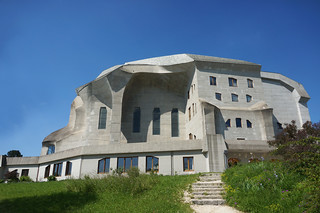
| Goetheanum by rosmary |
Rudolf Steiner is a largely forgotten thinker in virtually all circles of Western philosophy. Even many in esoteric circles who know the names Crowley or Blavatsky often fail to recognize his name. Despite this, Steiner’s influence is felt today in Waldorf schools, biodynamic farming, social finance, and prisoner outreach, and his school of anthroposophical thought is still debated and taught in Rosicrucian style organizations like the Anthroposophical Society in America. I was first introduced to Steiner through Gary Lachman’s excellent book, Rudolf Steiner: An Introduction to His Life and Work, which detailed the life and work of Steiner in such a way as to be easily approachable. Lachman’s recommendations included Robert McDermott’s The Essential Steiner (later updated as The New Essential Steiner), and there were enough similarities between my own personal philosophy and Steiner’s, that it was an easy purchase to further devour this great thinker’s expansive writing.
Steiner had a great impact on me personally because of his views on geometry and other mathematics are pure, and his insistence that any spiritual belief or experience could be met with the same scrutiny with which the hard sciences were met—essentially, Steiner believed that scientific inquiry could penetrate the spiritual. Steiner’s refusal to tell his readers/listeners to take things on blind faith, and his insistence on additional inquiry, made him different amongst his esoteric peers—less a guru and more an advisor. On a philosophical level, he was well-verse with the great German philosophers, and even upon disagreeing with others, took it upon himself to diligently argue from another’s perspective in order to better understand their point of view. His writings in support of Nietzsche (for Nietzsche’s daughter) are case in point for this. Steiner wasn’t searching for followers. His goal was the pursuit of knowledge; something that can be appreciated, whether you agree with his more esoteric philosophy or think they are just outlandish.
Steiner understood the principles of evolution as they were during his time. The difference was that he applied evolutionary principles to the spiritual as well as the physical—even spiritual entities such angels. Everything evolved. Although scientists don't assume that evolution "ceases" they also don't seem to contemplate whether the consciousness of today is the same as the consciousness of older times, or at the very least, it isn't something that is highly contemplated when examining historical context. So, for example, when we examine the literature of ancient cultures, we take a lot of what those cultures say to mean literally how they said it, but their descriptions have been written within their own consciousness, and their consciousness could have been quite different back then.
Steiner talks about the positioning of the astral body (which also evolves) through the evolution of the human being to show how insight into the spiritual has changed, but he's quick to note that stories and statements made that seem far-fetched for our physical reality are likely to be glimpses of the spiritual world that those individuals could still see, and most importantly, interpret. Many today look upon ancient cultures and think that they believed what they did because they weren't "as smart as us," but we really don't know "what" they truly believed. Steiner also makes the comment that older cultures believed these spiritual things because they weren't that far removed from ancestors that could see directly into the spiritual, and some of their own people still could. He gives them the benefit of the doubt, whereas modern science and history assumes them often ignorant, misled, or not as culturally evolved.


