Thursday, April 15, 2010

Personal Mythology: Dionysus, A Night Of Drumming (cont)

(For the other posts in the personal myth series, click.)


I was at a festival in the middle-of-nowhere, which we generally refer to as Pennsyltucky. It was a festival held on grounds tended by a Pagan commune, and we were several days into it. As is often the case at events like this, there was a fire circle, surrounded by sand, and an area where drummers often congregate. This particular night was young. There was a slight chill in the air for summer, but faint. Also the kind of pregnancy you can feel before an enormous storm hits. The leaves were turning up. The fire was low, there were a few people huddled about the fire in conversation, and one or two people idly tapping on their drums. I sat down behind an assortment of goat skin drums, lashed together by ropes. I began playing with mallets, hesitantly at first.
    Now, I don't want to cut the flow of the narrative, but I feel the need to interject that I don't feel that anything that happened after this was the result of some incredible talent on my part - rhythm comes pretty naturally to me, and I've played bass for over a decade, but I'm no exceptional drummer by any stretch of the imagination.
    Things started to coalesce every so slightly. More people joined the circle. Those who had been sitting stood up and began swaying around the fire. There was the distant rumbling of thunder, echoing off the hills that surrounded us.

Immanence of Myth anthology: Update April 15 2010

I have finally reached a point where I can say that, although much tweaking and perhaps some re-tooling is left to be done, the first drafts of all of my Immanence of Myth essays are complete. A quick look at word counts has my material at about 1/3 - 1/4 the length of the total book. Since this was originally going to be a solo work, I don't think that is too surprising. The other 1/3 or so is contributed pieces, and the rest are in the form of interviews / conversations. 

With the exception of a couple submissions that I am still expecting, all the submissions are in. A few interviews are still in progress, or about to begin. But for the most part, the whole of the project is beginning to come into some kind of fuzzy focus. To my thinking, this is not only on track. This is ahead of schedule. My internal plan has been to have the project at such a point that I felt confident putting it on the shelf for a couple months by May. As I've said, if you have anything else to get to me by then, please do so. (I'll except... or accept... something very rare and wonderful after that point, but otherwise the doors will be closed, at least on this edition.) 

Over the coming months I am going to be turning my attention increasingly towards some creative - myth and music making - projects that will demand most if not all of my attention. This project will, I hope, gain something for sitting in the cask for a little while. At the least, I'll gain some perspective, and will return when the smoke clears on those projects, to enter the next phase of the project. 

It looks like my partner, Jazmin, will be assisting me with the proofreading and copyediting process. I am incredibly happy about this, by that point she will have her MLS, and she has a very meticulous approach to such things. I am a big picture thinker. Details drive me crazy. So if this thing is going to avoid being rife with typos, it's a good thing to have someone like her onboard.

I will not be setting a release date until the project is actually in layout, which I do not expect until late 2010. At that point, we should also be able to set a tentative release schedule. And I hope that all of you who have come along for the ride so far will not only pick up a copy -- but that you will continue to spread word about this project with those that may find some benefit from it. 

Right now this is the tentative lineup: (!There are some not included in this list because the final materials are not in yet. So if you don't see your name and you have a piece in progress, don't freak! Titles are also tentative.)

I. THE IMMANENCE OF MYTH
  • Editor's Intro - James Curcio
  • An Untrue But Regularly Held Belief - Stephan Griswold 
  • Is Myth Dead? - James Curcio
  • Can Your Elbow Play Beethoven's 5th Symphony In The Key Of Purple? - James Curcio
  • Dissecting A Living Thing - James Curcio
  • Immanence and Butchery - (pt 1 Mr. VI & James Curcio)
  • Immanence and Butchery - (pt 2 & 3 Mr. VI.) 
  • The 101st Monkey Is A Conspiracy Theorist - James Curcio
  • A History of Ideas - James Curcio
  • Myth Is A Mirror - James Curcio
  • Breathing Myth - Damien Williams
  • Beyond Representation - James Curcio
II. PERSPECTIVES 1 - MYTH & MODERNITY
  • Pretty Little Suicide Machine - James Curcio
  • The Myth of a Counter-Culture - James Curcio
  • The Tragic Art of Abstraction - Yakov Rabinovich 
  • The Shining World - Yakov Rabinovich 
  • After God - The Temporal Absolute - Rowan Tepper
  • Kairopolitics of Revolution - Rowan Tepper
  • Guising Along The Web - (updated CC from Alterati.com) - Brian Corra
  • Initiation: The Masks of Identity (pt 1 & 2) - James Curcio
III. PERSPECTIVES 2 - PERSONAL MYTHOLOGY
  • A View Of The Gods - Michael Anthony Ricciardi
  • A Trail of Breadcrumbs - James Curcio
  • Mythic Narratives - Aeolus Kephas
  • Paper Tiger - Jason Horsley
  • I Am Ecstacy - Mica Gries
  • Medea Companion - Tons May
  • Artist's Statement - Brian George
IV. PERSPECTIVE ON MYTHS 3 - CREATIVE CONVERSATIONS
  • Interview - David Mack (Updated & expanded version of Alterati.com interview.)
  • Interview - William Clark
  • Interview - Foolish People
  • Interview - Laurie Lipton
  • Interview - Amanda Palmer (CC from Alterati.com interview.)
  • Interview - Jared Louche (Tentative.) 
  • Interview - Rudy Rauben (CC from Alterati.com interview.) + The Well comic
  • Interview - Sean Jenx
  • Interview - Brooke Burgess 
  • Interview - David Aronson (CC from Alterati.com interview) + Shadows In Heaven selections
As always, feel free to contact me with any questions, concerns, ideas... 


Wednesday, April 14, 2010

Personal Mythology: Dionysus, Maenads, continued

Here are some more thoughts I jotted down about Dionysus today, which concludes the first drafts of my personal myth series.


 The common association with Dionysus is with wine. This is usually what most people think when you say "Dionysus" to them. "Ah, the God of wine," they often say, as if this explains anything at all. There is some validity to this association; certainly a state of "divine intoxication" that exists outside of all social boundaries is the entrance-point to his realm. However, though wine was his sacrament in some Grecian traditions, this association is hammered home more firmly in the form of the Roman Bacchus. Dionysus, especially the "proto-Dionysus" forms of Zagreuss, Bromeus, and many other similar outsider divinities originating in the Mediterranean and Asia Minor, all shared sacramental drinks of fermented honey and other grains. This may seem incidental but it isn't. The individual symbols that make up a complex, a God, a Symbol, are all multifaceted, and they are all entrance points into the entire network. Let's look at just a few before making some generalizations about the symbol itself, and turning to personal experience.
    Honey comes up in several places in reference to Dionysus. The pine-cone tipped wands that the bacchante (women of Dionysus) carry drip honey. It can be fermented into a drink, and it is also a curiously effective emulsion for making elixirs with hallucinogenic properties. (There is much argument about to what extent hallucinogens factored into the various historic examples of generally Dionysian rituals.) Honey itself was often considered to originate from a form of fermentation out of death,
"According to Virgil, Aristaois sacrificed four bulls and four cows. He let their bodies lie for nine days; then bees swarmed from their entrails which had become liquid. Here the number four certainly has cosmic significance. It corresponds to the four cardinal points. ... The animal is transformed into a sack containing its own liquids. After four weeks and ten days- roughly forty days, as in the traditional brewing of mead- grapelike clusters of bees fill the hut. ... The natural phenomenon ushering in the great festival for the early rising of Sirius ... an awakening of bees from a dead animal." (Kerenyi, Pg. 41, Dionysus: Archetypal Image of Indestructible Life.) 
    Mythologically, honey is the sweetness of life, a nourishing source, which is derived as a result of death and rebirth. It may be facile to point out that alcoholic libations are also called "spirits," especially without an analysis of the etymology of the term, but on its surface it nevertheless seems appropriate. (That it is essentially regurgitated nectar, bee vomit, is also somewhat amusing but seems less mythologically significant. Just like the fact that much can be said about the mythological significance of the moon,but the moon is essentially a large, cold hunk of rock. These two things may or may not have bearing on each other, depending on whether the physical reality has an immediate bearing on the psychological reality of a thing.)
    I also developed a mythological fascination with bees; those familiar with my works will recognize this readily. When I was working on the first draft of Join My Cult!, I randomly happened upon Wax: Or How I Learned Television From The Bees. This is a very bizarre pseudo-documentary that mythologizes bees and beekeeping through a rather schizophrenic lens. I had already been taken in by the image of the hive, many agents acting independently yet, secretly, operating in tandem, but this movie only further pushed me into the realms of absurd lunacy as I continued through that literary experiment. The hive, the honey, and the directional sense of these curious creatures all seemed magical to me, and like the other disparate symbols of Dionysus, have appeared and re-appeared throughout my lives as what seem like separate metaphors until I realize, again and again, that they are all tied together through this central or mono-mythical figure, Dionysus.  

Monday, April 12, 2010

Pretty Suicide Machine: Fragment on sacredness


I spent most of today dealing with some errands - amazed at how physically exhausted I became moving a small fraction of what I have to move this month (I have gotten so out of shape!) - talking on the phone with a wonderful muse and friend, loving my bunny, and generally trying to take a break to let some more gestation occur. That has been the way with The Immanence of Myth, which is why I refuse to set solid deadlines for this one, as I so often do with other projects. There must be thousands of stops and starts, periods of reflection, of expulsion, of feverish writing, and gestation in between. I am writing this out of a deep desire to contribute something that will - I pray - help inspire many others to realize just how much change the can create with their words, music, films, etc etc.

Anyhow...

Here is a little fragment from today when I had an idea that felt too important to let sit: 
It is easy to draw a distinction between myths that participate more in what we might consider the sacred, and those that do not. This is a crisis that I hinted at in Is Myth Dead? Although I avoided confronting it directly for a reason. We cannot so easily separate myths from the sacred, nor can we extricate either of them from the biases of a specific culture, least of all the ones we are immersed in. Artistic movements such as the Surrealists did move in this direction; there was a general desire to rediscover, reconnect with some primal, sacred source. Consider this quote from Bataille's essay The Surrealist Religion, "Everything Breton has put forward - whether it concerns the quest for the sacred, the concern with myths, or rediscovering rituals similar to those of primitives - represents the exploration of the possibility we again discover, possibility in another sense; this time it is simply a question of exploring all that can be explored by man, it is a question of reconsituting all that was fundamental to man before human nature had been enslaved by the necessity for technical work." (pg. 75 The Absence of Myth.) It is easy to make this distinction, and feel a need to somehow return to a state of sacredness, real or imagined, which seems to have been stripped from or lives, from our very psychological beings, by the realities of global industrialization. Let's resist the urge to see it as such a clear dialectic, and instead move forward under the supposition that we are exploring an ideological history through the unfolding of a select few of the legion of mythic ideas that differentiate the world now from the world four thousand years ago. A multiplicity of myths, not clear, opposed opposites. If new myths are born, re-tethered to something sacred, they must be new, brutal, possessing unavoidable gravity, poignant, fragile, they must be anything but contrived, planned, and developed with the intention of bringing us the sacred. She does not come to us on a platter. More likely, the platter will have your beating heart on it. 

Sunday, April 11, 2010

Statistics, Damn Lies and Statistics

There are many issues that I've slammed my head against for years about verification, fact, and truth. I have already put a lot of time and effort into trying to synthesize the elements of this relevant to myth in some of the early sections of the Immanence of Myth. (For the final form of that, you'll have to wait until publication.)

I will use the work I've been doing there as an entrance point into just how difficult these things can become. Whenever I pen a single line, it is clear to me that there are tens if not hundreds or thousands of silent assumptions lurking behind that line, which support it, bring me to say it, and which, submerged under the surface, contain the actual inter-mixture of truth and fallacy which our statements generally contain. There is no means of gaining a statistical analysis of most of the sweeping generalizations that are required to perform any kind of philosophical investigation of myth, culture, or psychology. Even when there is, the results are dubious.

For example, how does one really remove the cultural bias from a study on social cognition done in the United States? Pushing this one question and refusing to back down is the reason why I began college a psych major and finished in another department. You cannot! And the fact that you cannot is not something that should be pushed under the carpet. This would sidetrack my main point here but there was a recent article in the NY Times that made the case I've been making for years:
...This unnerving possibility springs from recent research by a loose group of anthropologists and cross-cultural psychiatrists. Swimming against the biomedical currents of the time, they have argued that mental illnesses are not discrete entities like the polio virus with their own natural histories. These researchers have amassed an impressive body of evidence suggesting that mental illnesses have never been the same the world over (either in prevalence or in form) but are inevitably sparked and shaped by the ethos of particular times and places. (Article here.)
The fact that this surprises anyone, or that it is something that has just dawned on professionals in this field, is both hilarious and terrifying. However, I'm not here to poke fun at the massive and curiously lucrative blind-spots of psychiatry, (although I could do that all day), but rather to point out my own. I am aware that most of the work I'm doing falls down to anecdotal and personal experience, "written large" as a means of exploring myth. There is no time nor means to statistically verify the statements I am making. This is the formula of artistic and creative work: one must dive inwards, be honest to that, and hope that the experiences that spring from within will resonate with the inner lives of others. The idea of a creative process born and verified on statistical analysis is both curious and nauseating. (I'm looking at you, Hollywood.)

But we are still left in the cloud of unknowing. Non-fiction, analytical writing has the aura of science to it. We are taught to support our arguments, to verify, verify, verify. But what this actually means is we are taught to lie, lie, lie: as no true verification is possible. All that we can do is "philosophical due diligence."
And here is the rub: the culturally shaped analytic/individualistic mind-sets may partly explain why Western researchers have so dramatically failed to take into account the interplay between culture and cognition. In the end, the goal of boiling down human psychology to hardwiring is not surprising given the type of mind that has been designing the studies. Taking an object (in this case the human mind) out of its context is, after all, what distinguishes the analytic reasoning style prevalent in the West. Similarly, we may have underestimated the impact of culture because the very ideas of being subject to the will of larger historical currents and of unconsciously mimicking the cognition of those around us challenges our Western conception of the self as independent and self-determined. The historical missteps of Western researchers, in other words, have been the predictable consequences of the WEIRD mind doing the thinking. (Article here.) 
James Lincke
My solution for this book thusfar has been to do that due diligence, and to front-load the introduction with a sort of gauntlet that includes many (though not all!) of the presuppositions that must be made when trying to responsibly explore the psychological and cultural territory.

Let me be clear at the extent of this: I'm not even convinced that there is such a thing as "culture." A footnote from my introduction on this,
A note about characterization, and the usage of terms such as "capitalist society." It should be obvious that, within the contexts we are beginning to explore, "capitalist society," "existential philosophy," "corporate culture," and so on are all myth-structures that we're essentially presupposing. Like any other myth they may or may not relate to a series of facts, but more important the effects of the characterization is real. In other words, there are sufficient people that believe in such a thing as "capitalist society" as to make it worth talking about, even if, speaking very strictly, there may be no such thing. Even "culture" can be considered a myth in this sense, as Manuel De Landa explains in 1000 Years of Nonlinear History. This applies equally to phrases like "world-view," a term which has become fairly commonly even outside anthropological writing. Terms like this sometimes create more questions than they answer. What exactly does it mean? Is it a passive or active process? Can it be willfully changed, or is it provided fully-formed? We will attempt to engage with as many of these terms as possible, but there must be a level of approximation in using such terms, or else we would be footnoting every couple words, and the book in front of you would be thousands of pages long. Let us say that it could be either of these things, in different contexts, and move forward. (Immanence of Myth)
"Culture" is... a useful fiction. But you can't observe it like a table, and it operates on a scale such that the trends we observe that we think of as proof that there "is" culture could be any number of other things.

Like most of what I'm working on in this project, this is not "merely academic." I don't struggle with these things just because it's a fun game. (Sometimes it isn't fun at all, and sometimes it is.) These are things I find myself smacking up against on a daily, if not moment-to-moment, basis. In my life, this comes out more frequently than I'd like. How often am I in the dark, working to gather some facts to help inform a decision- only to find that the information that I gathered was appropriate more to a different context, that they changed, that I changed, or that I had some false assumption lying under the very question? That's rhetorical. The answer is: "really fucking often."

The extent to which we're stumbling around in the dark amazes me, mostly due to the fact that so many seem to have this deluded sense of certainty. It is not some philosophically rhetorical reduction to say: I know that I don't know. I depend increasingly on intuition for this very reason: because it seems to draw a holistic image which, though also fallible, is often a great deal more informed than the conscious processes I might otherwise attempt. The challenge there lies more in unifying the intuition which might say "YOU MUST GET ACROSS THAT RIVER," and the actual process of somehow doing it. Intuition does not provide that, it only provides the direction. The mechanics are up to us. Should I build a raft? Should I try to swim? Should I see if I can circumvent it by foot? How strong is the current, and how deep does it get? Intuition doesn't help us with any of those things. It just screams in your ear, with no explanation, GET ACROSS THAT RIVER. And you'd best pray that the intuition is right, that it isn't a desire posing as your intuition, and that halfway across, another impulse will suddenly scream into your ear WHAT ARE YOU DOING IN THIS RIVER, YOU FOOL? CLIMB THAT MOUNTAIN OVER THERE!

Faith for the faithless is a tricky proposition. But else do we have?

I'm going to start working on that raft...

Thursday, April 08, 2010

David Mack: Drawing Outside The Lines, Updated


By James Curcio

This interview expands an interview David and I conducted in 2007 for Alterati.com. It will be run in the Immanence of Myth anthology along with many other interviews with creators working in the realms of modern myth. (Edit: now available!) 

I still remember the first time I encountered Kabuki. I was just browsing around a Barnes & Noble, buzzing on caffeine, and this beautifully illustrated hardcover book found its way into my hands.
It’s not hard to be taken in by the art, really, it is both graceful and bold- but I actually laughed out loud when I started reading it- there was a section where the characters were talking to one another, and then moving through a building. Now most sequential artists would draw panel after panel of them walking and talking, West Wing style, maybe breaking it up with different angles and whatnot so it’s not just a bunch of talking heads. But you just give us a top down view of the building, and little talk bubbles as they wind their way around the maze. I just thought that was completely brilliant…
I never would have thought of that, but then looking at it, it’s just like “of course!” This is something I’ve seen continuing through these books, that you are really good at finding the straightest line, the best means of telling the story rather than just adhering to whatever storytelling conventions people might be used to.

David Mack: I like how you described that. I think you described it very astutely. That is how I approach the art. As a tool of the writing. I try to consider what pace, or rhythm, or medium or visual personality of style of art will best and most effectively communicate that particular story or scene of the story.

Do you refer back to previous myths and stories when you write? Are there any that you find yourself returning to frequently?

Tuesday, April 06, 2010

Looking at the impact of symbols: Contact With the Subconscious

(This is the most recent post in a personal myth series.) 


    The story does not end here, however. (It never ends, not really.) Our subconscious can never be truly boxed away; and the ability to deal with the experienced that are shored up from that "world" conferred by psychedelics or even a practice like yoga can never fully prepare us for the strength of a confrontation with its full strength, though they certainly can help. You can spend years on solid ground and then, as I recently experienced, you can take a single small step and fall back into the water. Luckily, swimming is a skill one doesn't need to entirely relearn, even if it's been a long time.
    To conclude this section I'd like to give an example of this. Nothing theoretical or conjectural, but rather an experience taken directly from my life, not more than a day or two ago.

(Click on post title for more.) 

Thursday, April 01, 2010

Magical thinking: mythologizing our daily lives


(This is a follow up to my post on Magical Thinking.) 


The meaning-attribution process is primarily automatic or subconscious, but also not entirely outside our influence. Meaning isn't attributed consciously. Yet, at some point, on some level, we have to choose what the pieces of our personal history mean. There are many ways that this plays into our lives. In cases of clinical depression, for instance, there is some evidence that the thought processes that produce depression are habitual. It is likely, if not absolutely certain, that at some point the "pathways" were conscious, or at least they lay closer to the surface, like young roots that have yet to fully embed themselves in anything other than topsoil.

Saturday, March 27, 2010

The Mystery of Motivation

I'm not sure if this is worthy of a blog post here, but I did want to just say something briefly-- though not so briefly that it would fit on my twitter feed, and it is relevant to this blog, so, why not...

The past few days have been challenging for me. I'm not going to go through details but to say that it's mostly neurochemical, and it has rendered even the things that normally drive me out of bed in the morning totally empty. Most of my other creative projects haven't held much interest for me the past couple days; I've shut off my phone, considered deleting all my social media accounts (I'm still considering that, but for other reasons), even pointlessly contemplated dropping everything and wandering off into some mysterious wilderness never to be seen again, and so on.

Yet, every single day, I get up, and the first thing I'm thinking about is the Immanence of Myth project. Aside from the very few closest to me that keep me tethered enough that I never would actually just disappear off the face of the planet without a word (for now, anyway), this is it. Every day, I have a book out, I'm going through looking for references, I'm writing. Even when it's hard to care about much of anything else. I honestly don't know why I care about this project so much at this point, and I certainly don't know if anyone else is going to give a damn when it is finally published. Despite all the hard work that has already gone into it by myself and all the other contributors and artists I've interviewed for it, it could just languish in print-on-demand purgatory. (Only with sufficient commercial demand will it make it to a full - in-store distributed print run.) But, unlike almost all the other projects I've worked on, there's a big part of me that simply doesn't care.

I do hope, of course, that it will be useful to other artists, writers, thinkers, for many years to come. On some level of course I care if it is read and discussed. But that's not what I'm doing this one. Not this one. I'll leave my delusions of fame and fortune for other projects. Right now, this is the one thing I seem to care about even when I don't care about anything else that I'm supposed to be doing. So who knows, maybe I'm onto something. Maybe I've finally gone round the bend. It does seem odd to me that it should be a book mostly composed of essays that would get its hooks into me like this. But who am I to say? Sometimes we're strangers most of all to ourselves, and I feel like I'm retracing my own footsteps when I work on this project in particular.

Well. That's all I have to say about that for now. If you don't mind, I have some research to get back to...

Initiation and Tuning Hammers

As I work more on my piece on Initiation for Immanence of Myth, there was something of an obscure comment I made, where I said "It is my present opinion that sometimes what cannot be accomplished with a sledgehammer may be arrived at with a tuning hammer. But time will tell." I got around to explaining that in a footnote, or at least beginning to. So this is my show and tell for the day:
FN This is rather obscure, however: Frederich Nietzsche regularly referred to "hammers" in his work, "How to philosophize with a hammer," the subtitle to Twilight Of The Idols, which he suggested be instead entitled "Hammer of the Idols" rather than "Twilight of the Idols," as his vitriol against Wagner at that point was supposedly already spent (ref fn. 3 pg .xiv Twilight of the Idols, Duncan Large translation) and the reference was taken to be meant as a parody of Wagner's "Twilight of the Gods." However, and this is the point here, within Twilight of the Idols the hammer is not one used for bashing but rather one used to "sound out" the true quality of idols, as one rings a bell. (ref. xvi, also the introduction. Duncan Large.) Not that it's important, but a tuning hammer isn't even "banged" with at all. Either way the metaphor is acoustic, it's about careful listening and resonant frequency, rather than the application of brute force. In regard to what I meant with this somewhat cryptic statement, the "resonant frequencies" that myths attempt to bring out in an audience must already exist within the audience, the way a certain pitch makes a glass or bell vibrate, or even shatter. One does not simply pound harder, or imply more shocking techniques in the hopes of drumming over the din of the polite and dispassionate speech of an audience as it strolls through the gallery. That glass has a specific frequency that derives that result from it. If the frequency is off, no result. The same may be true in regard to the task of the mythic artist, and so the challenging task for us, is to find the frequencies that will move the audience in such a way that it moves them beyond the detached mental state of mere entertainment, without falling into the opposite defensive posture of intellectual contemplation that much performance art does, where one goes "ah, that is interesting," and then tries to snaffle more wine and cheese before it runs out. This is of course, supposing that the intention of the mythic artist is an initiatory one, which it often is but certainly needn't be.

Thursday, March 25, 2010

The Gspot: Lady Gaga Hijacked


This is the true and faithful record of what happened when we tried to record a interview with Lady Gaga. We used to scoff at the allegations of her involvement with powers both  shadowy and nefarious. I have to tell you the truth now! It's all true! Don't be fooled. Hear this voice crying out in the wilderness! I must go now before they come back! Go to citizen-y.com NOW while you STILL CAN!

HALPME!!!!!!!!

Wednesday, March 24, 2010

THIS R SRS BIZNESS: with co-writer Jason Stackhouse

In which we discuss some of the finer points of literary theory. (Or maybe I'm just posting this to piss off you True Blood fans that are presently googling in hopes of finding some tid-bit of info on the forthcoming season. Spoiler alert: Bill was kidnapped by Raelians.)

And yes, his name really is Jason Stackhouse, get over it. And we really are working on a screenplay together, this isn't how we spend all our collaboration time. Just you know, most of it. 

Don't worry, I'll return you to actual content soon. Probably when the double-shot wears off.
(CLICK post title to read conversation)

Pretty Suicide Machine: Hints of a Solution

Some more thoughts I'm working on for Pretty Suicide Machine. (Everything you see up here is always in progress. If you want the final results, please pick up a copy of the book when it is released!)


...
We cannot say we have really looked at the ideological forces at play without also considering our cultural experience of time. While this may seem perplexing to some, it is indeed our experience of time that is colored by our cultural upbringings, not merely our ideas about time. Granted, there is an element to the passage of time that occurs the same regardless of culture, or so we must generally assume; but the way that we process our experience, in relationship to time, is a very cultural manner. Speaking generally, we may live with an emphasis on the past, the present, or the future. Many so-called primitive cultures are past-oriented; the focus of their cosmogeny, their festivals and rites and so on all relate towards connecting with the time "before," when the world was hewn, when man was taught to work with fire or tools, or so on. Examples of this exist throughout Eliade's Sacred & The Profane, as well as Alan Dundes' essay Thinking Ahead, which we will be turning to in a moment. There are also examples of present oriented cultures, as has been observed in several Australian Aborigine tribes (ref). We, however - and for this moment by "we" I am referring most specifically to Americans and those closely tied to American culture - live in the future. Dundes spells this out very thoroughly in Thinking Ahead, but a few examples may help clarify the point:
It is not only the past that is sacrificed for the future; it is also the past. Sometimes it is an unpleasant present which is denied in favor of a reference to a brighter future. "Better luck next time" and "Tomorrow's another day" are examples. In addition, there is the proverbial cry of baseball fans backing a loser: "Wait till next year." ... But it is not just the unpleasant present which is denied. Americans are so future-oriented they are discontent even with pleasant presents. For the present reality, no matter how good it is, can never be as good as the future might be. ... With Americans and their belief in efficiency, evolution, perfectability, etc., "The best is yet to come." Whatever one has, one hears, "You ain't seen nothin' yet." The same kind of sentiment is expressed in the American military slogan: "We have not yet begun to fight." Nevertheless, in American culture, one never does catch up with the carrot on a stick in front of the donkey; one never does reach the "pot of gold at the end of the rainbow." (Now there is a compact folkoristic expression of the American worldview!) (Dundes, pg. 76) 
    Now consider this observation in light of what we have been discussing. Is it any wonder that blind progress has yielded the results that it has? One cannot help but be reminded of the word of the "hungry ghosts" in the Tibetan Book of the Dead. For those unfamiliar with this image, Chogyam Trungpa provides a concise summary, "In the hungry ghost realm, there is a tremendous feeling of richness, of gathering a lot of possessions; whatever you want you do not have to look for." We only need to turn on the television to see that element of our psychology being worked upon; after all the Bardo refers not to just the state after death, but psychological realms we must contend with at all stages of existence. He continues, "...this makes us more hungry, more deprived, because we get satisfaction not from possessing alone but from searching. ... This is symbolized by the image of a person with a gigantic belly and extremely thin neck and tiny mouth. ... The joy of possessing does not bring us pleasure any more once we already possess something, and we are constantly trying to look for more possessions." (pg. 7 Fremantle and Trungpa). The economic system that we have developed, in accord with our cultural experience of time, in accord with our ideology of progress, and so on, not only promote the psychological state being described here: they depend on it. The American economy depends on consumption. And though it may prove nothing definitively, it is both interesting and horrifying to consider the growing obesity problem in this country, as we think of the image provided of the "hungry ghosts," eating food that provides no real sustenance; always hungry, never satisfied. Always yearning for a future that is yet to come.
    None of this is to say that the society we live in is the direct result of conscious planning on the part of a government, or some secret Illuminati or Masonic order. Though there are surely sociopaths at the helm of many major corporations, this "suicide machine" does not require any conscious malice to run its course. Even the best intentions, when rendered within the framework of this system, will yield the same results so long as you follow its definition of success and progress. Everything that we have discussed has been set in place and kept in motion by mass psychological factors. The machine is simply the result of unchecked ideological forces.
    There are other dimensions of this mythic complex to explore, but I'd like to sew a seed in the back of your mind to consider not only through the rest of this book, but hopefully far after you've put it down. At this point, you may be feeling a certain amount of despair at our predicament. In all honesty, it is something I've had to wrestle with many days of my life. We have thousands of years of history crushing down on our heads; and, if you'll pardon the mixed metaphor, it should be quite evident that any single attempt to change the course of this history will gain little more result than a pebble tossed into a river with the intent of diverting its flow. However, there is one thing that we might take solace in, and which may provide some hint at a future solution: all of this has been the result of accumulated myth, and the behavior that has followed from those myths. This, above all else, is why I think modern myths are so absolutely essential- not any one myth, unless it sets fire to the imaginations of a generation, but rather the collective force of all of our myths, if directed towards a goal. If any goal is worthy of such an effort, it would be to provide new perspectives, and new methods of being in the world, which result is something far better than our eventual, mutual annihilation.

Monday, March 22, 2010

A Long Road Out of Hell: Jacob's Ladder & The Book of the Dead

This is an update of a piece I wrote on Alterati in 2007, and follows up on my previous post about the initiatory crisis. I hope you enjoy it-- and watch Jacob's Ladder!
---

Like most kids in America, I grew up on the programming that is made available through the mass media. We take it in as a given. The innocence of childhood is not so much innocence as a simple willingness to take in everything as face value. Whether or not it represents a lack of critical thinking, I don't know, but it is a kind of wonder that is incredibly easy to manipulate. How advertisers must wish we could remain so unjaded?

I grew up before the internet boom, even before the real boom of cable television, so I remained relatively inexperienced about what was out there, and what the possibilities of cinema really are. I watched PBS like it was crack, which I guess is somewhat unusual; the rest of my subconscious was populated by the likes of Transformers, or a sneaked peek at Friday the 13th. (Which, if I remember correctly, frightened me much less than it frustrated me at the relative brevity of all the sex scenes.) Movies were entertainment: nothing less, nothing more. I thought the only way to tell a story was from the beginning, to the end. This is precisely the view of movies and television that most people hold throughout their adulthood, from what I can tell.

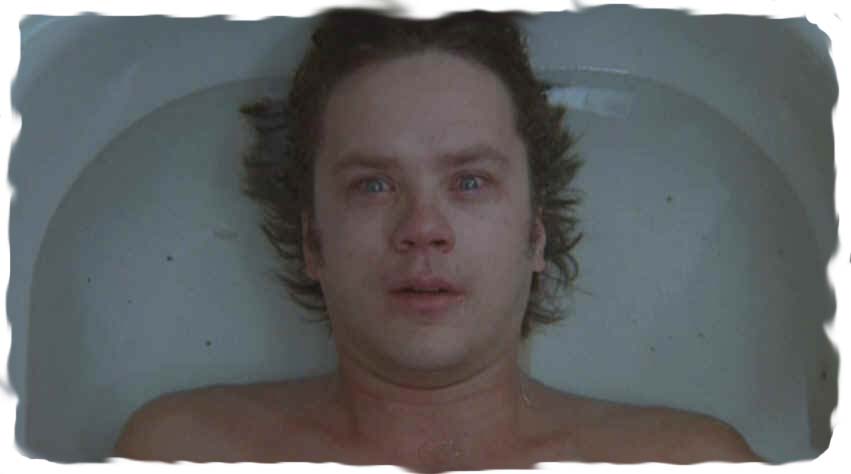
Then, still relatively young, I saw Jacob's Ladder. I can't remember how. Maybe it was on late night. It doesn't really matter. The main thing I remember is a first inling of a sensation I had never before experienced: gnawing, existential terror. Despite its somewhat lurid imagery, Jacob's Ladder is not horrifying because of what it shows, like Hellraiser, not even because of what it doesn't show, as with Hitchcock's Psycho. It is horrifying because you really don't know how solid the ground beneath you is. If you let you take it in, if you begin to apply it to your perspective of your own life, you might begin to wonder: am I dead already, living in the feverish flash-forward of the impending end? Is my entire life a moment like this, a white-hot moment lived and relived from different angles, a moment simultaneously already finished and not-yet-begun?


This, before I'd ever encountered hallucinogens, before I explored the occult or read James Joyce; this was my first contact with that kind of uncertainty.

At the time, I didn't know why it made me feel so uneasy. Not really. At the time, it seemed like a weird movie about a troubled Vietnam vet who was uncovering some kind of government conspiracy. I wasn't at first aware of the fact that this "story" was just the feverish delusions in a dying man's mind. But I couldn't get the movie out of my mind, I found myself playing it over and again in my mind, piecing it together in different configurations, and then it dawned on me.

Later, I came to understand and to love the idea of a tale that contains many stories or layers within it; a story which changes, like a hologram, depending on where you are standing or what you bring to it. (A non-linear meta-narrative, if you will.) Jacob's Ladder isn't the only instance of this approach, I later found it in Grant Morrison's Invisibles, in Alan Moore's Promethea, a technique changed and rendered differently in the hands of hundreds of different artists. This is an idea and approach to myth and media making that has inspired my work ever since. I can't say it is the technique I employ in every work I've done, but certainly most, and it is one that I hope to master before my eternal moment is finished -- before it has ever begun.

The odd truth is, by the time I had started writing my first novel in my early college years, I had completely forgotten about Jacob's Ladder. It was only by sheer chance that I recently saw this movie again, and was reminded where many of these seeds were first sewn. Now, almost two decades since I first saw it, I could recognize this piece of storytellig for what it really is, and just how much I was indebted to it, (which is not to say I ever stole from it. This is not how inspiration works.)

So let's get to the movie itself, since I've talked around it so much. If this story isn't really "about" Jacob Singer, a man with post-traumatic stress disorder, forced to re-live his past again and again, then what is it about? It is a modern re-interpretation of many of the ideas of the Christian Mystic Meister Eckhart, and the Bardo Thodol, the Tibetan Book of the Dead. It is about the timeless final passage into the hinterlands which all of us must take - and which, in a manner of speaking, we have already taken. And which we are taking right this very moment. This is the only true hell, which results from clinging to the things of this world as they are stripped away, one at a time. The beings we encounter there, they too will be demons should we resist them.
 Or like Jacob's chiropractor, they can be angels, if we follow the natural order of things and let the bliss shine through. Every character serves as a metaphor for this psychological process: Jezebel, clearly an emissary of the lower realms of lust; Sarah, his wife in an alternate life, Sarah, mythologically, the first wife of Abraham, the princess, and the counterpoint of Jezebel, who could just as well be considered a stand-in for Lilith. There comes a point in film analysis where clearly the analyst is projecting, but there is amble evidence that most of this symbolism is intentional. Even when it isn't, a truly successful work of art succeeds both through intent and as a blank mythic canvas: it is what we say it is.
    In the process of building a modern myth, original sources must be bent and re-worked to fit the new form. Purists will snub their noses at this, but artists should recognize it for what it is: progress and creativity at work. For instance, an original Eckhart passage relevant to the subject of this movie goes:
"They ask, what burns in hell? Authorities [the Fathers] usually reply: “This is what happens to willfulness” [to individual will, self-interest]. But I say it is “Not” [it is the Nothing] that is burned out [that burns] in hell. For example: suppose a burning coal is placed in my hand. If I say the coal burns me I do it a great injustice. To say precisely what does the burning, it is the “Not”. The coal has something in it that my hand does not. Observe! It is just this “Not” that is burning me – for if my hand had in it what the coal has, and can do what the coal can do, it, too, would blaze with fire, in which case all the fire that ever burned might be spilled on this hand and I should not feel hurt." (Speech 5b, DW Ι)
    An interesting point but not exactly riveting material for a screenplay. In the movie, it becomes:
"The only thing that burns in hell is the part of you that won't let go of your life: your memories, your attachments. They burn them all away, but they're not punishing you, they're freeing your soul. If you're frightened of dying and you're holding on, you'll see devils tearing your life away. If you've made your peace, then the devils are really angels freeing you from the earth."
This idea of the dual nature of heaven and hell appears in Buddhism, in Hinduism, and Christian Mysticism. The same can be said for this idea of the duality of angels and devils, after all the root of the words "devil" and "deva" (angel) means "divine." They are the psychological agents of the "inbetween lands," depicted as the River Styx in Greek Mythology. The Bardo is the "inbetween state," the state between here and there. When we reach divinity, or unity, or nothingness, as we choose to call it, there is no room for ego, for separate divinity. All of those things have been burned away. That union is annihilation. As we see in the Jewish tradition, in Greek mythology, and many other places: to look upon the face of God is to be annihilated in fire. Heaven or hell. The end or the beginning. Neither and both. They are right here, if we open our eyes.


The name "Jacob's Ladder" originates from the Book of Genesis, where Jacob sees a ladder ascending into heaven. On the way up, one encounters different "spheres of existence," which were associated by Christian and Jewish mystics alike with the Sephiroth on the Tree of Life. There can be little doubt that all of these inferences were intentional on the par of the script writer and film-makers, they say as much in interviews on the Director's Cut of the DVD.

Psychological facts such as these, which transcend cultural boundaries (even if they wear different garb or go by different names) can truly be called "myths," and so, in the end, Jacob's Ladder is precisely what I mean when I refer to a "modern myth," and say that modern media, and art, can serve as modern myths. They can occur in the public sphere rather than in a pedestal or in some rarified temple in Tibet. They can happen in a place so profane as a movie theater. The producers just need to learn the tricks of the trade to sneak it by the profane gatekeepers that fund such endeavors.

Initiation: the Masks of Identity.

Forgive me if this repeats bits and pieces of some much older posts - it can be hard to keep track - but I believe strongly this is an important topic to discuss, and a key addition to the Immanence of Myth anthology. To that end, if you have personal experiences of initiation that truly changed your life, PLEASE pass that on to me for this anthology. I have a handful already, but this is a topic that I think deserves real attention, because it is a serious issue.
----


There are many works available that systematically explore the vicissitudes of initiation within tribal and so-called primitive or archaic cultures. At the forefront of the works that deal with this subject within archaic culture is Mircea Eliade's Rites and Symbols of Initiation, which covers the various functions which initiation can serve, and provides elaborate examples of all of them, from the shamanic process of rebirth to that of the men's rites whereby a boy becomes a man. Though a sketch of these ideas will serve us in regard to dealing with the main issue of this chapter, I will avoid elaborate restatement for the sake of brevity.
That issue is initiation, its importance, and its relevance to our “modern” lives. Initiation is in fact such a constant in the cultural body that it is evident in one form or another in nearly every human culture that has ever existed before the industrial age, at which point it became notably absent, at least on the surface. This absence has produced a very real psychological crisis, although as we will see in many ways the initiatory impulse has merely transferred itself, oftentimes to behaviors and beliefs which only shallowly fulfill that impulse.

(Click on post title for more.) 

LinkWithin

Related Posts Plugin for WordPress, Blogger...