Showing posts with label cannibals. Show all posts

Tuesday, March 05, 2013

The Underworld of the Periphery: Countercultures of the Future


Those that just don't fit, the underclass or outcast, those of the periphery, the counter-culture -- these are popular topics around here, and for good reason,

"Peripheries are often border zones where peoples or things are thrown into unexpected contact, hybrid spaces yielding new possibilities for social and cultural organization."

Think of the musical genres, poetic innovations, and linguistic creoles of the Caribbean; or think of the social “margins” or the “queer periphery,” where disenfranchisement and stigmatization give rise to relatively free experimentation in social practices and cultural life. Though centers may seem more advanced or more privileged than peripheries, decisive change and innovation often begin at the fringes. Yet the very tendency toward difference and transformation out on the margins often meets with a violent reimposition of norms from the center: Soviet tanks rolling into Prague, or the Janjaweed and Sudanese military sweeping through Darfur, or the police descending on Stonewall.
There must be a place where this power may, to borrow from these spatial metaphors, centralize, without fearing this kind of backlash from those who would be the center, after all it is often the demigod who descends to the underworld that doesn't want the keys to the kingdom. "You can have it!" they cry, but the dispossessed nevertheless seek solace in the company of other lone wolves, were-wolves, or beings of both worlds.

This site is such a place, even this post (or the links in it) doorways to ideas that might germinate, and as always, help you "find the others."

The countercultures of the future are already being born and are parts of the future’s new markets. 

It can therefore be an advantage to know what to expect from them. They stand up against greed and religion, burst the boundaries of biology, and expand the idea of anarconomy still further. We bring a translated excerpt from the new book Modkultur – fra undergrund til bundlinje (Counterculture – from underground to bottom line).
Present-day countercultures differ from those of the past in one important way. In the past, if you were part of a counterculture, you were in all the way, and it was unthinkable that you could also be part of another counterculture. In the England of the 1960s, you could be mod or rocker, but not both. The hippie culture from the late 1960s involved a strong identity – one which didn’t immediately combine well with other countercultures like e.g. the equally colourful gay culture. This is not how it is today. The number of countercultures has grown immensely, but it isn’t unusual to be part of several and to form your identity from an unique blend of the countercultures and subcultures you choose to be part of. Many young people are situals – individuals that like social chameleons change surface identity according to the situation they are in. One and the same person can easily be goth, trekkie and vegan, and still also be part of the live-action role-playing circuit.
Many things suggest that future countercultures will be even more complex in a future where the entire world is connected via a ubiquitous network of wireless internet and virtual worlds. The critical mass of individuals needed to make a counterculture viable and vibrant does not have to be limited to any particular physical location, but can be spread all over the world.

[Where is the fucking counterculture? Mythos Media.]

Saturday, February 19, 2011

Twilight Selves: Cannibalism, Werewolves and Identity Part #3

By Mr. VI


(This is the third and final post in a series. Part 1 and Part 2.)

We've talked about wolfish behaviours in previous articles, and of the apparent admiration they garner from the general populace, despite the supposed moral outrage. Topically, at the time of writing, the Italian premier Silvio Berlusconi is due to be placed on trial in April on charges of having sex with a minor.

As writer and thinker Jasmina Tešanović put it in a post on the widely read Boing Boing blog:

'Silvio Berlusconi will be the first head of a G-7 state to be arraigned in court on charges of paid sex with a minor. '

The G-7 are seven of the largest developed countries whose finance ministers meet once a year to discuss economic and financial policy. In terms of elites and finance, such a group is surely an exemplar. These 'developed' countries are supposedly world-leaders, they literally have provided other nations with something to aspire in terms of wealth and power.

Yet one of their leaders allegedly performed an act which, amongst others, might be seen as a few inches above the ultimate crime in the West – that of paedophilia:

'The Church as well as Catholic believers are divided. It's not about sex, says one of the high ranked church officials: hardly any Italian anymore confesses those misdeeds as sins. It's his way of doing it. Then there's the hardcore of Italian machismo, who aspire to that level of misbehavior themselves, and frankly admire Berlusconi for his orgies.

[...]

So what did Berlusconi do so wrong in his unfortunate dalliance with Ruby, and the numerous other girls that he invited to his home and paid generously? The court in Milan issued 27 pages of evidence. Ruby was a minor when she was partying "bunga bunga" style at his place, and he knew it. Ruby was caught stealing from friends, and he freed her from the police although the cops had her in custody as a minor. Ruby was an illegal immigrant, and he smilingly promised to forge her papers for her.

Finally, he arranged to deceive the Italian police by absurdly claiming that Ruby was the niece of recently deposed president Hosni Mubarak, in order to set her free.'

Yes, that Mubarak. The former de facto dictator of Egypt who was ousted by a popular insurrection after 29 years. Currently, a wave of unrest is sweeping the Middle-East. Tunisia, Egypt, Algeria, Libya and Bahrain – all these places are writhing against the status quo.

All these are protesting against the current power-dynamic in their nations, and they are doing so by banding together, becoming a pack which may very well topple regimes through sheer force of numbers and will.

These are not bloodless revolutions either, and nor should we expect them to be. A vicious response from the power-holding elite is to be expected. Teeth must be shown; the urbane suited figures must shift to strike and strike hard. It is the size and connectivity of the band which is the threat, and thus the bonds must be severed – a reflex which may be seen with the clamp-down on internet access in affected countries.

Terror is therefore the primary weapon deployed by such an elite, that and speed. These things are archetypically wolfish, as mentioned with the Harii and the berserkers in the last post. They are affects, in the Deluezian sense. Communication is also an affect – it's no coincidence that elites often have controlling interests in the media. Berlusconi is the head of a vast media empire after all, and it is standard practice of dictators to control television and newspapers. The transmission of ideas, whether they be open or cryptic, and the way they are received and used by those within the group is also a characteristic of the group itself.

These affects are what shape and maintain the identity. By partaking of the affects they reinforce the identity – by acting wolfishly, they reinforce the perception of themselves as wolf which enhances the potency of the actions taken-as-wolf, creating a feedback loop.

This reinforcement further emphasises the predator/prey dynamic. Mythologically speaking, it is possible to assume wolf-shape by wearing a skin, as mentioned with the ulfheðnar in the previous post, or drinking from a wolf's paw print - to name two examples.

Terror and rapidity of hostility subject the victims to a significant perceived threat which triggers behaviours within the reptile brain in the same way that enforced scarcity may render a 'need' for protection and leadership.

This scarcity plays a large part in many mythological narratives. In the previous post, I touched on Valhalla, and Judeo-Christian and Islamic thought also posits a post-mortem existence where the adherents-as-elect may be freed from scarcity.

Paradise
late 12c., "Garden of Eden," from O.Fr. paradis, from L.L. paradisus, from Gk. paradeisos "park, paradise, Garden of Eden," from an Iranian source, cf. Avestan pairidaeza "enclosure, park" (Mod.Pers. and Arabic firdaus "garden, paradise"), compound of pairi- "around" + diz "to make, form (a wall)." The first element is cognate with Gk. peri- "around, about" (see peri-), the second is from PIE base *dheigh- "to form, build" (see dough). The Gk. word, originally used for an orchard or hunting park in Persia, was used in Septuagint to mean "Garden of Eden," and in New Testament translations of Luke xxiii.43 to mean "heaven" (a sense attested in Eng. from c.1200). Meaning "place like or compared to Paradise" is from c.1300.
Running throughout these religions is the motif of mankind's fall from grace – quite literally a refusal to abide by the conditions wherein the species may remain in pre-scarcity bliss. Moses, Jesus and Mohammed – these individuals purportedly carried the knowledge of the conditions which would once again return humanity to a place where scarcity no longer occurs.

Those who follow these conditions are able to achieve reintegration, and those who do not are doomed to wander outside the ultimate gated community, until the inevitable forces that engender privation and scarcity destroy the world – literally all that is extant – and it is remade as being perfect.

So runs the standard exoteric interpretation, an interpretation which a variety of fundamentalist sects have taken to heart. Regardless of the iteration of the monotheist stream, they have performed an act of spectacular hermeneutics:

The chosen – chosen by virtue of adherence to practices which form an identity – are due to inhabit this walled garden and are thus apart from the general populace. The world-as-is exists solely to bring about the exteriority of this new environment.

God, or Allah is utterly exterior to the human world – for it is the domain of the Devil, imperfect and lacking in the full grace of co-existence with deity. The prophets and/or Christ are agents of that grace – to Christians, the potency of Jesus is that he is the living embodiment of that grace.

To the fundamentalists mentioned, the world is hence something to be ended.

The environment is thus a resource to be consumed, and the unbeliever to be eliminated or converted. The ending and removal of all that does not acknowledge the utter exteriority of the deity actually hastens a return to grace.

Or to put it bluntly; killing or converting the unbeliever gets your name on the Paradisial guest list. It makes opening time come quicker. This is the doctrine espoused at multiple points through the ages, most notably during the Crusades, and finds its most violent expression in the modern-day suicide bombers.

It is at the root of much sectarian religious violence, and the reflex to sacralise – literally 'to set apart' also echoes this exteriority. To many fundamentalists, they are strangers to the world. It is their job to re-order it according to the precepts of their group. There are myriad religious groups who campaign for certain changes to be made – too many and varied to be discussed here.

This same reflex is often what forms pressure groups, and on a larger scale forms the protests we have been seeing. The urge to break down current structures and change their arrangement is what binds them together and gives them an identity. The protests in Egypt were not designed to kill or destroy the nation, rather they were to cannibalize and re-purpose the structures within it.

But, ironically it is an analysis of the suicide bomber/terrorist as the exemplar of modern bogeyman which lead us to an intriguing proposition. The primary weapon is that of fear, something it shares with many existing power-structures. What is unique, is that the suicide bomber operates from a position of inexorable success because they can induce that affect without an army or police force.

Even if they fail to detonate, do damage or kill people, the mere fact that they exist induces terror. They hold the status quo in a double bind. Even the fact that they might exist has an effect.

What's more, like werewolves, they often appear ordinary until a critical point - until they change into the extra-ordinary. This means that anybody has the potential to be one.

As such, the doctrine of total war occurs when an entire population may become 'weaponised' – everyone becomes a weapon in potentia. Far from it being driven merely by radicals, politically Egypt and other movements prove that a population has a potential to detonate – everyone carries the 'virus' of 'lycanthropy.'

This does not limit itself to politics either – one may argue the potential to form packs is inherent to humanity, and the narrative of the werewolf is one that is inherently liminal. One bite, one contact with a sorcerer, one horrific combat experience and it may emerge.

This is in itself amoral – a simple fact. One event may affect a larger group. The werewolf is inherently a myth about bonding and connection, even when viewed as the outsider or Other. It does not have to be elitist, rather it can be read as a figure in constant flux, emblematic of necessity and change.

Rather than being isolationist, it can serve as an acknowledgement of the very concept of identity itself being shared amongst all; if it stands for recognition of difference, as a borderland figure, it provides entrance and exit.

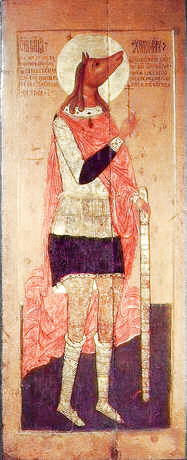
In the Eastern Orthodox Church, St. Christopher, patron saint of ferrymen, travellers and many others, is held to have been dog-headed, while in Egypt the jackal headed god Anubis served as guide to the dead.

Immersion in the archetype provides us with an in-between state of utmost potential, regardless of circumstance. Once again we return to the idea that scarcity need not apply, only this time through utilisation of personal resources applied to whatever environment we encounter.

I've titled this short series Twilight Selves, not because I wished to make references to the novels or films – though it's a useful SEO bonus – but because twilight is the blue hour between day and night.

We all have a mutable identity, a twilight self that adapts to circumstances and environment; as fluid and rich as dreamstuff, able to prosper in harshest of circumstances, and as potent as the Biggest Baddest Wolf There Ever Was.

Be seeing you.
Mark out the points

Build the pyre

Assemble different drummers

Light up the fire

Put on your masks

And animal skins

Illumination, illumination

Listen to the drums

Between each beat, each beat of the drum
- The Death and Resurrection Show


Pre-order a copy of The Immanence of Myth, published by Weaponized in July 2011.

Wednesday, February 16, 2011

Twilight Selves: Cannibalism, Werewolves and Identity Part #2


(This is Part 2 of a series. The first is available here.)

So, have you been thinking on the things you know that others do not? The mysteries of code, the runes of circuit and mechanism, the rituals of spreadsheet and year-end? All these and more are incomprehensible to many.

How do you accept such things as normal, as easy and mundane? There are things in your life which appear arcane to those not living as you. Whether it be a hobby, or occupation, take a moment to examine the things in your life which you perform and may sometimes use as an identifier.

I, for example, write things like this. If you look at my profile, you'll see 'writer' there. Not particularly arcane, you may think. Except I spend a good portion of my time stringing together words in varying combinations in order to affect *you*, the reader. I could no more cease stringing these words together than you could stop your heart beating without risk of damage.

Take away a keyboard, and I'll write with a pen and paper. Take those away and I'll compose pieces in my head, use my tongue and lips to form words and speak them out loud. It's like breathing to me. I cannot cease playing with language.

Thus I identify as a writer. Rhythm, language, communication; I love these things, I really, truly do. To me, there is glory and ecstasy in it; to evoke a response in the audience and lead you in a certain way to show you things - this is what I do.

For others though, the idea of choosing to write words on a page is a chore, a necessary evil rather than an attempt at art. It's not a matter of glory and and wonder, it's simply utilitarian.

And that's fine, because it illustrates the point we're making here; there is a difference between the two groups I have outlined. I could say that writers and thinkers will intuitively understand the compulsion I am speaking of. I might say that non-writers will not understand the brutal horror of the blank page, or conversely, are incapable of experiencing the thrill of possibility that same brutality engenders.

Of course, that would be elitist. A cadre of writers, artists and poets who intuitively understand the world in a unique and important way, vital to the rest of humanity; this would be the narrative I would be situating myself within, rubbing shoulders with all others who've identified as a writer.

But in the last post, I promised you I would show you how mythic analysis can help you to parse the seeming contradiction of the wolf-pack and cannibalism:

On my personal blog, I've discussed the Germanic conception of luck and might and how it ties into the notion of kingships, heroes and power. Such things were held as transferable properties, able to be lost or stolen, and more importantly, won through great deeds.

Whereas most feudal monarchies claimed their authority from the Divine Right of Kings, wherein God ordains the lawful king, pre-Christian Germanic traditions often claimed descent from the gods directly – by blood and affiliation rather than dogmatic assertion.

The Anglo-Saxon Chronicle gives the following genealogy for Penda, a pagan 7th Century King of Mercia, in a time when most rulers had converted to Christianity:

'Penda was Pybba's offspring, Pybba was Cryda's offspring, Cryda Cynewald's offspring, Cynewald Cnebba's offspring, Cnebba Icel's offspring, Icel Eomer's offspring, Eomer Angeltheow's offspring, Angeltheow Offa's offspring, Offa Wermund's offspring, Wermund Wihtlaeg's offspring, Wihtlaeg Woden's offspring.'

Both the Chronicle and the poet Snorri Sturlson mention such divine genealogies within the Angle and Saxon tribes. The latter, although a Christian, is mainly responsible for the preservation and recording of the tales which we know as Norse mythology.

Snorri was a renowned poet, historian and politician. Twice elected to the highest legal office of Iceland, he was influential enough to be a thorn in the side of King of Norway, which indirectly led to his death at the hand of a chief named Gissar.

History records that Snorri received a warning letter informing him of the intent to kill him, but as the runes were ciphered, he could not read it. For all his influence, it was the arcane and specialised form of writing which prevented him taking steps.

Those myths preserved by Snorri present the god Odin as the chief deity of the Norse – pater familias of a pantheon of gods including Thor, Loki and Freya. This arrangement appears to be something of an attempt to model the old gods along Classical lines.

However, regardless of any such attempts, archaeology seems to indicate that the majority of Icelanders honoured Thor in their pagan days, while Odin was reserved for poets and the aristocracy.

Often sinister and nearly always morally ambiguous, Odin shares a root name with his Anglo Saxon and German counterparts – Woden and Wodan respectively. This Proto-Indo-European root is *wodh which is variously glossed as madness, fury, or poetic inspiration. The suffix implies a mastery thereof, and so it is no surprise that Snorri, as a poet, might seek to place the god in his proper place.

Modern depictions of Odin often focus on his aspect as a god of war and slaughter – legions of metal fans know the name from countless songs. Death, sex, battle and darkness – all these thrill, and more importantly, sell records.

It is Odin who hanged himself for nine nights to gain the runes, pierced by his own spear. It is Odin who is said to have brought the gift of poetry, albeit indirectly, to the world of man. As an exemplar of cryptic wisdom, and even the physical image of the wizard – all long grey beard, funny hat and staff – the god stands squarely in archetypical territory.

But what has this to do with the wolf-pack and the cannibal?

Consider the previously stated fact that it was Odin who was honoured by the aristocracy - the kings and powerful folk in Germanic society. Now, imagine why these luminaries would ally themselves with a figure surrounded by wolves and ravens.

Conjure the images in your mind; the fields of corpses, a veritable feast for the black birds with shining eyes and knowing calls. Or perhaps the speed and lethality of the wolves, acting together to bring down their prey, pitiless in pursuit?

In society where most are illiterate, the power wielded by those who knew the runes as alphabet – quite apart from their purported mystic dimensions – is great. Consider also the notion of Valhalla; a post-mortem existence in which scarcity does not occur, where men may fight, fall, and rise again endlessly, until the final doom of all things where they may perish utterly in one last world-shaking battle.

At first glance this mythological reflex might seem similar to the notion of Paradise or Heaven so beloved by the Peoples of the Book, however it may be examined further in relation to the wolf-pack in ways which are useful to us.

(A subsequent post will address the place of the eschatology of Christianity, Judaism and Islam in relation to these issues.)

First of all, one of Odin's by-names is anglicised as Valfather, literally 'Father of the Slain' implying that all those who fall in battle are inextricably connected to that god. Indeed, though first pick of the fallen warriors passes to Freyja, she takes only half, and Odin the other.

These warriors are hence known as the 'Einherjar', or 'lone fighters' in Old Norse. Bold and valorous, they have attracted the god's attention and are brought to Valhalla by the valkyries. Etymologically, both '-herjar' and 'harry' seem somehow connected:

harry
O.E. hergian "make war, lay waste, ravage, plunder," the word used in the "Anglo-Saxon Chronicle" for what the Vikings did to England, from P.Gmc. *kharohan (v.), from *kharjaz "an armed force" (cf. O.E. here, O.N. herr, O.H.G. har, Ger. Heer "host, army"), from PIE root *koro- "war" (cf. Lith. karas "war, quarrel," karias "host, army;" O.C.S. kara "strife;" M.Ir. cuire "troop;" O.Pers. kara "host, people, army;" Gk. koiranos "ruler, leader, commander"). Related: Harried; harrying.

The former of these two has been linked to the Harii tribe by Orchard, Simek and Lindow, of whom Tacitus writes in his Germania c. 1 AD:

'As for the Harii, quite apart from their strength, which exceeds that of the other tribes I have just listed, they pander to their innate savagery by skill and timing: with black shields and painted bodies, they choose dark nights to fight, and by means of terror and shadow of a ghostly army they cause panic, since no enemy can bear a sight so unexpected and hellish; in every battle the eyes are the first to be conquered.'

Consider the bond between warriors in a given band; an elite grouping capable of striking fear into their enemies; they attack at night and use terror tactics to win their battles, combined with natural skill. By coming out of the night, they defy the usual rules of war, and with fear as their ally they become a feared foe, catching the enemy at its weakest and most unprepared; the victory may be achieved more easily than a straight fight, as proponents of guerilla warfare have found, the world over.

Military hazings, gang tests and ritual initiation – these are born of the same reflex. By ensuring all members are bonded by experience and activity, the individuals identify as part of the group. They are an elite, sharing qualities, experiences and knowledge; identity shifts so that the definition of individual self necessitates partaking of the group-self.

Indeed, the former identity may be destroyed, and the newly initiated pack-member may survive; in short they may 'die' and 'rise again'. Combine this with scenarios which subtly alter the position of consciousness - whether by ritual, ordeal, or entheogenic consumption – and we are presented with a journey of the psyche which may mirror those in other so-called shamanistic cultures.

Indeed, as god of magic, a figure such as Odin may be regarded as having strongly shamanistic overtones.

Plus, the runes themselves are held to be Mysteries, containing more than simple shape and sound values, rather like the notion of the Greek stoicheia - elements – or the mystic attributions to Hebrew letters. The sense of such mysticism is one which is grounded in elitism – only the initiated can comprehend the full utility of the symbolism.

Finally, one cannot invoke the idea of Odin without considering the notion of the berserker. The 9th century skaldic poem Haraldskvæði describes the ulfheðnar 'men clad in wolf skins' as follows, emphasis mine:

I'll ask of the berserks, you tasters of blood,
Those intrepid heroes, how are they treated,
Those who wade out into battle?
Wolf-skinned they are called. In battle
They bear bloody shields.
Red with blood are their spears when they come to fight.
They form a closed group.
The prince in his wisdom puts trust in such men
Who hack through enemy shields.

Further, in Ynglinga Saga, Snorri writes:

Odin could make his enemies in battle blind, or deaf, or terror-struck, and
their weapons so blunt that they could no more but than a willow
wand; on the other hand, his men rushed forwards without armour,
were as mad as dogs or wolves, bit their shields, and were strong
as bears or wild bulls, and killed people at a blow, but neither
fire nor iron told upon themselves
These two quotes suggest a significant change in consciousness which alters the berserker at the biophysical level, a frenzy which caused the Norwegian King Harald Finehair to make good use of them in battle during his campaign to unite the kingdoms of that country.

All these considered, these facts imply that there is a link between the extra-ordinary and the idea of power, something which is deepened when one considers that ravens and wolves are often eaters of carrion. This motif is intrinsically linked with cannibalism as an ability and desire to consume that which is thought beyond use through social convention.

Truly, when one opens up to cannibalism and consumption of the dead, more food becomes immediately available, removing one from the privations of scarcity. This allows prosperity when others are short on resources, something which is extremely valuable when enmeshed in dynamics of power.

The pillar of the community maintains their position by the employment of wolfish tactics; the state cuts the most vulnerable of services and repurposes its funding. The werewolf bite is contagious, and soon it becomes the case that the weaker packs are cannibalized, gobbled up.

The tactics which make the aristocracy/plutocracy so successful are hence demonised when they are external to it – wolves which are not part of the power-bloc are hunted down and killed, just as all berserkers were eventually outlawed in medieval Iceland – by the 12th century, berserker bands had all but disappeared.

But the nature of a werewolf is literally a wolf in human shape, and thus it might be said that it is difficult to discover their existence. Guerilla strategy and tactical dissimulation are still options, despite indications to the contrary. In the next post, we'll examine how eschatology and warfare combine to form acts of creative resistance – in short, how to remain in the twilight and prosper under seemingly impossible conditions, by being true to that '[O]ther who hides in me' as Machen puts it.

Until then,

Be seeing you.
Pre-order a copy of The Immanence of Myth, published by Weaponized in July 2011.

Friday, February 11, 2011

Twilight Selves: Cannibalism, Werewolves and Identity. Part #1

By Mr. VI

“We now see ... wolfpack behaviours (on markets), and if we will not stop these packs, even if it is self-inflicted weakness, they will tear the weaker countries apart,” Swedish Finance Minister Anders Borg 9th May 2010

Economics, politics, sociology and philosophy; history and diplomacy. All these involve study of narratives, both the past and the present, in order to predict and if possible control the environment. That which is controlled is in a sense rendered stable and coherent, it is fixated like an insect in amber; integrity is preserved and the body politic is kept intact. The meaning extracted from mythic narratives provides reference, often an origin point – a kind of social genealogy which specifically situates the community at large within time itself.

It is the idea of control and bodily integrity which generates a shadow; an uncontrolled, amorphous idea of insatiable hunger; an enemy which devours all those things which enable the maintenance of the status quo. As can be seen by the quote at the beginning of this piece, the old metaphors still hold evocative power – with the economic upheavals of the early years of the 21st century, the wolves are once again to blame; their greed has supposedly placed the right thinking folk in a great deal of trouble. What is this terror then? This fear of another form of life, of existence, which somehow exists outside the norm, and is unnatural enough to evoke such a violent response? Or to frame it another way, in terms of myth, why is the monster a recurring theme, its unspeakable hunger something that arises again and again, irrespective of time and place?

So runs the introduction to an essay of mine in Immanence of Myth. Like any good editor, James has to impose limits on writers, both for coherency and reasons of space. Understandably, it's difficult to cover a whole line of thought in a few thousand words, and fortunately we have the extra space of this blog to examine things in more detail. Thus, this is the first in a short series of explicitly connected posts by myself (and the other contributors if they feel so moved) on the implications of cannibalism and the wolf-pack in relation to levels of self-hood. We've discussed the cannibal as an exterior entity, as an auslander – the malign stranger; what then of those wolves in the board-room etc, curled at the heart of the status quo itself?

As Welsh horror writer Arthur Machen puts it:

'[W]e lead two lives, and the half of our soul is madness, and half heaven is lit by a black sun. I say I am a man, but who is the other that hides in me?'

And lest we think the discussion of wolves and predators is purely theoretical, this article dated 7th February 2011 from Britain's Daily Mail on a so-called 'super-pack' of four hundred wolves killing horses should put that to rest.

As the article states - emphasis mine:
“Dr Valerius Geist, a wildlife behaviour expert, said the harsh Siberian winter - where temperatures plummet to minus 49C - had killed off the animal's usual prey.

He said: 'It is unusual for wolves to gather in such numbers of hunt large animal like horses.

'However, the population of their usual prey, rabbits, has decreased this year due to lack of food, so wolves have had to change their habits.
'Wolves are very careful to choose the most nutritious food source easiest obtained without danger - which in this case happens to be horses. "They will start tackling dangerous prey when they run out of non-dangerous prey.'”

The whole metaphor of a ravenous, insatiable wolf with great big teeth – all the better to eat you with, my dear – is predicated on the idea that the creatures will kill and eat anything; nothing can stop that hunger. In actuality, they hunt easy prey, and this in itself is the true root of the terror. Easy prey is vulnerable prey, defenceless or otherwise weak.

The sick, the disabled, the old and the very young; these are perfect prey for the wolves, and to devour them is to commit an act which is beyond the pale of society - pale being a pointed stick which serves as marker or boundary, as in impale or fence paling.

This violation of the social order is an act of violence against it by those beyond the boundary.

Where does this idea of violence fit within the status quo? Suppose we posit that in fact, the actuality of the situation is more complex; the function of the metaphor is to provide a descriptor for those whom the rules of a culture of scarcity do not apply.

In my previous post, I suggested that scarcity is essentially what gives rise to the notion of power, and conversely, that of weakness. It is manipulation of scarcity that drives demand, and those that can provide are valued and feted over those who cannot.

All we need to do is view the recent banking crisis to see how quickly the dichotomy is revealed. The individuals who ran the Western world's financial system were once economic giants moving millions and fuelling the globalization machine which has brought us wonders undreamt by our great-grandparents.

Now they are abruptly wolves, preying on the weak and the vulnerable, ruining lives and wiping out life-savings. Supposedly violating the trust of investors, they are said to have committed an act of violence against those who trusted them.

Yet, the ease with which they moved through the world, their wealth and power, is still desirable. If anything, the rage occurs because the act of violence is sublimated as theft. The perceived removal of power breeds anger - the loss of the signifier of power highlights the division between have and have not.

This increases desire - again scarcity tightens the knot. That same desire leads to increased occurrences of 'wolfish' behaviour. In time, scarcity renders us all wolves, but the lone wolf stands little chance against a pack. A pack is able to hunt prey that would be dangerous to a single individual.

In a pack therefore, the danger quotient falls, increasing yield. Thus, the individuals are perceived to be more powerful both in and of themselves as well, as members of the pack. Again, it is desirable to become part of the group.

The larger a pack, the greater the risk of internal conflict - only under extreme conditions can necessity overwhelm dominance, and this is not always enough. Thus often, multiple packs or groups evolve, each with an exclusive set of identifiers and protocols. This creates an inclusive and exclusive division, an inner and an outer within the larger group.

Do those within the in-body view those outside as like themselves, or has the very act of assumption of identifiers induced a sense of difference? As an elite evolves, it separates itself from the larger body, becoming a law unto itself. Could we argue that this sense of difference and identity is a primary root of almost all idealogical conflict?

These levels of identity-within-identity raise interesting questions about the very idea of cannibalism itself. If cannibalism is the consumption of one's own kind, then what of the consumption of those who are not of the same kind?

Since the metaphor of consumption also implies incorporation, it follows that those within the body necessarily utilise those without. The co-option and capture of the external to maintain and enhance the body can easily be seen in the actions of say, large corporations or the enslavement of the enemy and the conquered. On the microcosmic scale, we ingest external entities and re-purpose them for our own bodies.

Mythologically speaking, if one is elevated to the post-scarcity of godhood, what happens to one's humanity? What happens when a group of individuals are able to communicate in their own jargon, their own secret language; sub-prime mortgages, exchange-rates, currency fluctuations, hedge-funds?

All these are occult, beyond the ken of those not inculcated or initiated into the mysteries of finance; the virtual trading of ideas and potentials is as esoteric as the Greek Magical Papyri, and yet these hidden spells influence the lives of billions.
By these secret ways, they render the act of utilization of easily accessible resources into a cryptic thing, only performable by those properly trained and operating within their particular framework.

In the next post in the series, I'll show how analysis of a given mythic construct may yield the keys you need to subvert the apparent duality between the monstrously strange cannibal which inspires such horror, and the pillar of the community who has wealth, power and respect.

But for now, consider this: What secret codes and magic spells do you know, that others don't? What runes and arcane operational knowledge do you possess by which you effect your daily life?

Pre-order a copy of The Immanence of Myth, published by Weaponized in July 2011.

LinkWithin

Related Posts Plugin for WordPress, Blogger...